Ancient Rome: Republic, Empire, and Decline — Topic Guide
Ancient Rome profoundly shaped the history of Europe, the Mediterranean, and the Middle East. Beginning as a small city in Latium, it became a conquering republic and then a vast empire. Its institutions, laws, roads, army, and culture continued to influence Western societies long after the fall of the Western Roman Empire.
From Rome’s Origins to the Republic
According to tradition, Rome was founded in 753 BCE by Romulus. The city was first ruled by kings. In 509 BCE, the Romans expelled their last monarch and established a republic.
Power was divided among several institutions. Two consuls, elected for one year, led the state and commanded the army. The Senate, dominated by wealthy families, exercised strong influence over finances, diplomacy, and public affairs. Assemblies of citizens voted on laws and elected magistrates.
Roman society was initially divided between the patricians, members of the aristocracy, and the plebeians, who made up most of the free population. Over time, the plebeians gained additional rights, especially through the tribunes of the plebs.
The Expansion of the Republic
Rome subdued neighbouring peoples and gradually extended its control over the entire Italian Peninsula. Its disciplined army, network of alliances, and ability to integrate defeated populations contributed to its success.
The Punic Wars then pitted Rome against Carthage for control of the western Mediterranean. Hannibal crossed the Alps and won several victories, but Rome ultimately prevailed. Carthage was destroyed in 146 BCE.
Rome later conquered Greece, part of Asia Minor, North Africa, Gaul, and several territories in the Middle East. These conquests brought wealth, land, and large numbers of enslaved people. They also encouraged the spread of Latin and the Roman way of life.
This expansion, however, increased inequality. Wealthy landowners enlarged their estates, while many small farmers lost their land. Social tensions and rivalries between generals gradually weakened the Republic.
The Crisis of the Republic
Beginning in the second century BCE, political conflicts became increasingly violent. The land reforms proposed by the Gracchi brothers provoked fierce opposition and ended with their assassinations.
Military leaders also became more powerful. Their soldiers were often more loyal to them than to the state, especially when generals promised land and rewards. Marius and Sulla fought one another in civil wars.
In the first century BCE, Julius Caesar, Pompey, and Crassus formed the First Triumvirate. After the death of Crassus, Caesar and Pompey became rivals. Caesar crossed the Rubicon in 49 BCE and triggered another civil war.
After his victory, Caesar accumulated power and was appointed dictator for life. He was assassinated in 44 BCE by senators who feared the permanent end of the Republic.
The Birth of the Empire
Caesar’s death led to further civil wars. Octavian, his adopted son, eventually defeated Mark Antony and Cleopatra at the Battle of Actium in 31 BCE.
In 27 BCE, Octavian received the title Augustus. He preserved some republican appearances but concentrated most political authority in his own hands. He became Rome’s first emperor.
Augustus reorganized the administration, stabilized the frontiers, and reformed the army. His reign began a long period of relative peace known as the Pax Romana. For nearly two centuries, the Empire experienced prosperity and major urban growth.
The Empire at Its Height
During the second century, the Empire stretched from Britain to Egypt and from Spain to Mesopotamia. It brought together dozens of peoples, languages, and religions under a single authority.
Roads facilitated the movement of legions, officials, and merchants. Ports, aqueducts, bridges, and sewer systems supported the growth and functioning of cities.
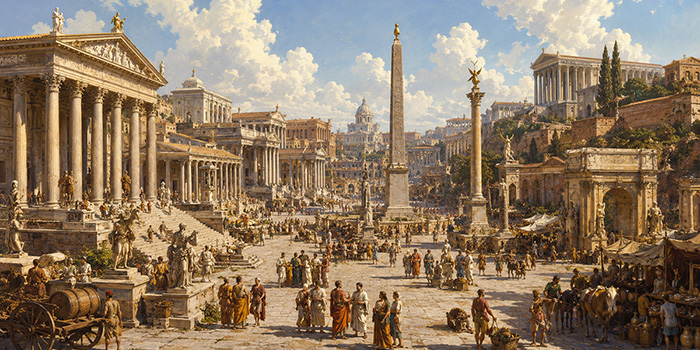
Rome became an immense capital. Emperors built forums, temples, baths, amphitheatres, and triumphal arches. The Colosseum hosted gladiatorial contests, animal hunts, and other public spectacles.
Notable emperors included Trajan, under whom the Empire reached its greatest territorial extent; Hadrian, who strengthened the frontiers; and Marcus Aurelius, remembered for his philosophical writings.
Roman Society and Culture
Roman society was highly hierarchical. At the top stood the emperor, senators, and great families. Below them were the equestrians, ordinary citizens, freed people, and enslaved people.
Enslaved people worked in homes, fields, mines, workshops, and government administration. Some were eventually freed, but many lived under extremely harsh conditions.
The family was placed under the authority of the father. Women had no political rights, but some managed property, ran businesses, or exercised considerable social influence.
The Romans worshipped many gods, including Jupiter, Juno, Minerva, and Mars. They also adopted religious cults from Greece, Egypt, and the Middle East. Roman law, architecture, literature, and the Latin language remain among the civilization’s most important legacies.
Christianity in the Empire
Christianity emerged during the first century in the Roman province of Judea. Its followers spread their faith throughout the cities of the Empire, aided by Roman roads and the widespread use of Greek and Latin.
Christians refused to worship the traditional gods or honour the emperor as divine. They were sometimes persecuted, although these persecutions were neither constant nor uniform.
In 313, Constantine granted Christians freedom of worship. By the end of the fourth century, Christianity had become the official religion of the Empire and gradually transformed its institutions and culture.
The Crises of the Third Century
During the third century, the Empire entered a period of severe instability. Emperors succeeded one another rapidly after coups and assassinations. Civil wars weakened both the army and public finances.
The frontiers were threatened by Germanic peoples in the north and by the Persian Empire in the east. Epidemics, inflation, and declining trade deepened the crisis.
Diocletian restored a measure of stability near the end of the century. He divided the government among several rulers, strengthened the army, and reformed taxation. Constantine later established a new capital at Constantinople in 330.
The Division and Decline of the West
After the death of Theodosius I in 395, the Empire was permanently divided into an eastern half, governed from Constantinople, and a western half, ruled from Italy. The East was wealthier and better defended, while the West had more limited resources.
The decline of the Western Roman Empire did not result from a single cause:
-
Civil wars weakened imperial authority.
-
Military and administrative expenses became increasingly heavy.
-
Taxes rose while the economy slowed.
-
The army relied more heavily on soldiers of foreign origin.
-
Germanic peoples crossed the frontiers and settled within the Empire.
-
The separation of East and West limited their ability to act together.
In 410, the Visigoths sacked Rome. In 455, the Vandals also captured and plundered the city. These events shocked the Roman world, even though Rome was no longer the political capital.
In 476, the Germanic leader Odoacer deposed Romulus Augustulus, generally considered the last emperor of the Western Roman Empire. The Eastern Roman Empire, later called the Byzantine Empire, survived until the fall of Constantinople in 1453.
Quiz questions preview
-
Which Roman emperor, recognized by the Senate on March 18, 37 AD, is famous for his cruelty and eccentricity?
Domitian | Nero | Commodus | Caligula -
Which Roman emperor legalized Christianity in 313 AD?
Constantine I | Augustus | Diocletian | Theodosius I -
Which person is considered the legendary founder of Rome?
Nero | Augustus | Caesar | Romulus -
Which emperor made Christianity the official religion of the Roman Empire?
Constantine I | Theodosius I | Valentinian I | Julian -
Which Roman general crossed the Rubicon in 49 BC, triggering a civil war?
Augustus | Sulla | Pompey | Julius Caesar