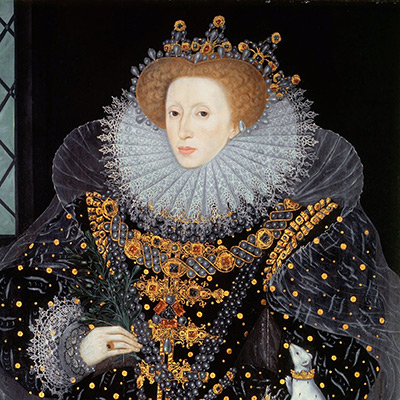

In the Time of Elizabeth I — Topic Guide
When Elizabeth I came to the English throne in 1558, the kingdom was divided by religious conflict, financially weakened, and threatened by powerful neighbors. The daughter of Henry VIII and Anne Boleyn, she had herself experienced disgrace, suspicion, and imprisonment. Her forty-four-year reign stabilized the monarchy, encouraged remarkable cultural development, and turned England into an ambitious maritime power, although war, poverty, and religious persecution remained widespread.
A Birth at the Heart of the Tudor Dynasty
-
Elizabeth was born on September 7, 1533, at the Palace of Placentia in Greenwich.
-
She was the daughter of King Henry VIII and his second wife, Anne Boleyn.
-
Henry VIII had broken with the authority of the pope largely because he wanted his first marriage annulled and hoped to obtain a male heir.
-
Elizabeth’s birth disappointed those who had expected a boy capable of securing the succession of the Tudor dynasty.
-
Anne Boleyn was accused of adultery and treason and executed in 1536, before Elizabeth had reached the age of three.
-
After her mother’s death, Elizabeth was declared illegitimate and lost her immediate place in the line of succession.
-
Henry VIII nevertheless restored her to the succession in 1544, after her half-brother Edward and half-sister Mary.
An Exceptional Education
-
Elizabeth received a humanist education normally reserved for princes and the most privileged members of the nobility.
-
She studied Latin, Greek, French, Italian, philosophy, rhetoric, history, and theology.
-
She mastered several languages well enough to read ancient texts, translate works, and communicate with foreign ambassadors.
-
Her Protestant tutors helped shape her religious beliefs, although she generally remained cautious about expressing them.
-
Her intelligence, memory, and command of language later became essential instruments of her political authority.
-
From an early age, she learned to conceal her opinions and choose her words carefully in a court where a poor decision could lead to disgrace or death.
The Reigns of Edward VI and Mary I
-
After Henry VIII’s death in 1547, his young son Edward VI became king and encouraged a more clearly Protestant transformation of the Church of England.
-
Elizabeth was briefly involved in a scandal surrounding Thomas Seymour, who behaved toward her in an ambiguous and reckless manner.
-
After Edward VI’s death in 1553, Mary I, the daughter of Catherine of Aragon, came to the throne.
-
Mary restored Roman Catholicism and married the future King Philip II of Spain, a union that was deeply unpopular with many English people.
-
Elizabeth, a Protestant and the presumed heir, became an unwilling rallying point for Mary’s opponents.
-
After Thomas Wyatt’s rebellion in 1554, she was suspected of involvement and imprisoned in the Tower of London.
-
She was released for lack of evidence but remained under surveillance for part of her sister’s reign.
Accession to the Throne
-
Mary I died without children on November 17, 1558, and Elizabeth became queen at the age of twenty-five.
-
Her accession was welcomed by much of the population, which had grown tired of religious persecution and Spanish influence.
-
She was crowned at Westminster Abbey on January 15, 1559.
-
Elizabeth inherited an indebted kingdom, a fragile administration, and a society deeply divided between Catholics and Protestants.
-
She chose experienced and generally loyal advisers, including William Cecil, who remained one of her chief ministers for nearly forty years.
-
She took an active part in government affairs, read reports, questioned her ministers, and often postponed irreversible decisions.
The Elizabethan Religious Settlement
-
In 1559, Elizabeth introduced a series of measures that restored a Church of England independent from Rome.
-
The Act of Supremacy gave her the title of Supreme Governor of the Church of England, a formulation considered more acceptable than Supreme Head.
-
The Act of Uniformity imposed a common prayer book and required the population to attend services of the established Church.
-
Elizabeth initially tried to avoid the most extreme religious positions and placed greater importance on public obedience than on private belief.
-
Catholics nevertheless faced increasing surveillance and punishment, especially after Pope Pius V excommunicated the queen in 1570.
-
Catholic missionaries were arrested, tortured, or executed when they were regarded as political agents threatening the monarchy.
-
Protestant Puritans, who wanted to eliminate more practices inherited from Catholicism, also faced the queen’s opposition.
A Queen Who Refused to Marry
-
From the beginning of her reign, Parliament and her advisers urged Elizabeth to marry and produce an heir.
-
Several European princes were considered, including Philip II of Spain, Archduke Charles of Austria, and Francis, Duke of Anjou.
-
Elizabeth used marriage negotiations for many years as a diplomatic tool without ever making a final commitment.
-
She had a particularly close relationship with Robert Dudley, Earl of Leicester, whose company she had enjoyed since her youth.
-
The mysterious death of Dudley’s wife, however, made a marriage politically almost impossible.
-
By remaining unmarried, Elizabeth retained control of her government and avoided sharing authority with a husband.
-
She gradually developed the image of the Virgin Queen, entirely devoted to her kingdom and symbolically married to her people.
The Court and the Exercise of Power
-
Elizabeth’s court was both a political center, a place of entertainment, and an arena of rivalry among the nobility.
-
Courtiers sought offices, land, commercial monopolies, and personal access to the sovereign.
-
Elizabeth deliberately encouraged competition among her favorites to prevent any one man from becoming too powerful.
-
Her principal advisers included William Cecil, his son Robert Cecil, and Francis Walsingham, who managed an extensive intelligence network.
-
The queen regularly undertook journeys known as royal progresses, during which she stayed in the homes of wealthy subjects and appeared before the public.
-
Official portraits presented her as a young, majestic, and almost timeless sovereign even as she grew older.
-
Her authority rested as much on ceremony, language, and prestige as on military force.
Mary, Queen of Scots, and the Catholic Plots
-
Mary, Queen of Scots, was Elizabeth’s cousin and had a dynastic claim to the English throne.
-
As a Catholic and a descendant of Henry VII, she was regarded by some as the legitimate sovereign instead of Elizabeth.
-
Driven from power in Scotland, Mary fled to England in 1568, hoping to receive her cousin’s support.
-
Elizabeth instead kept her under guard for nearly nineteen years because her presence encouraged Catholic conspiracies.
-
Several plots to overthrow or assassinate Elizabeth were organized around Mary’s claim to the throne.
-
Francis Walsingham’s network intercepted messages showing that Mary had approved the Babington Plot against Elizabeth.
-
Mary was tried for treason and executed in 1587, despite the English queen’s hesitation.
-
Her execution worsened tensions with the Catholic powers of Europe and gave Philip II of Spain an additional reason to intervene.
The Conflict with Spain
-
The Spain of Philip II was one of the greatest military, colonial, and financial powers of the sixteenth century.
-
Relations with England deteriorated because of religious differences, English support for the Dutch rebels, and attacks on Spanish ships.
-
English sailors such as Francis Drake seized Spanish cargoes with the queen’s more or less official support.
-
In 1585, Elizabeth sent troops to help the United Provinces in their revolt against Spanish rule.
-
Philip II then prepared a huge fleet intended to cross the English Channel, join an army stationed in the Netherlands, and invade England.
-
The Spanish Armada entered the Channel in 1588, but the English ships avoided close combat and relied on their mobility and artillery.
-
English fireships scattered the Spanish fleet off Calais, and violent storms caused further losses during its return.
-
Elizabeth visited her troops at Tilbury and delivered a famous speech in which she declared that she had the body of a weak woman but the heart and courage of a king of England.
-
The defeat of the Armada became a symbol of English power, although the war with Spain continued for the rest of the reign.
Voyages and Maritime Ambitions
-
Elizabeth’s reign coincided with a period of expansion in English navigation and maritime trade.
-
Francis Drake completed the second circumnavigation of the world between 1577 and 1580, after Ferdinand Magellan’s expedition.
-
Elizabeth knighted him aboard his ship, the Golden Hind, despite Spanish protests.
-
Walter Raleigh promoted colonization projects in North America and helped popularize the name Virginia in honor of the Virgin Queen.
-
The Roanoke colony nevertheless failed, and the fate of its inhabitants remains uncertain.
-
English merchants developed commercial links with Russia, the Ottoman Empire, Morocco, and several parts of Asia.
-
In 1600, Elizabeth granted a charter to the English East India Company, which later played a major role in British history.
-
These ventures anticipated the maritime and colonial expansion that accelerated after the queen’s death.
Ireland and the Limits of the Reign
-
English authority remained fragile across much of Ireland, where several local leaders resisted the administration imposed by London.
-
Colonization policies, land confiscations, and religious tensions provoked several rebellions.
-
English forces brutally suppressed the Munster rebellions during the 1570s and 1580s.
-
Beginning in 1594, Hugh O’Neill, Earl of Tyrone, led a major uprising supported by Spain.
-
The queen’s favorite, Robert Devereux, Earl of Essex, was sent to Ireland, but his campaign ended in failure.
-
Essex returned to England without permission, later attempted to raise London in revolt, and was executed in 1601.
-
The war in Ireland placed a heavy financial burden on the kingdom and was only nearly concluded at the time of Elizabeth’s death.
English Society Under Elizabeth
-
England’s population grew rapidly during the sixteenth century, placing considerable pressure on land, housing, and food supplies.
-
Inflation reduced purchasing power, while the poor harvests of the 1590s worsened poverty and hunger.
-
Agricultural changes and the enclosure of certain common lands drove many people toward the towns and cities.
-
London experienced dramatic growth and became a major political, commercial, and cultural center.
-
Social differences remained considerable among the nobility, rural landowners, artisans, servants, and the poor.
-
The Poor Laws of 1598 and 1601 gradually required parishes to organize relief for the needy and distinguish between those able and unable to work.
-
Epidemics, especially outbreaks of plague, regularly caused thousands of deaths and sometimes forced the closure of theaters and public places.
Theater, Literature, and the Arts
-
Elizabeth’s reign coincided with one of the great periods of English literature and theater.
-
William Shakespeare wrote comedies, tragedies, and history plays that attracted audiences from several social classes.
-
Christopher Marlowe also shaped Elizabethan theater with works such as Doctor Faustus.
-
The poet Edmund Spenser celebrated the monarchy and chivalric ideals in The Faerie Queene.
-
Permanent theaters were built around London, including the Globe, associated with Shakespeare’s company.
-
Female roles were played by boys or young men because women were not legally permitted to perform on public English stages.
-
Music, celebrations, tournaments, poetry, and elaborate clothing also occupied an important place at court.
-
The period is often called the Elizabethan Age, although much of its cultural prestige was created or strengthened after the queen’s death.
Europe and the World in Elizabeth’s Time
-
Europe was deeply divided by the consequences of the Protestant Reformation and the response of the Catholic Church.
-
France was torn apart by the Wars of Religion between Catholics and Protestant Huguenots from 1562 to 1598.
-
The Dutch provinces revolted against Philip II of Spain and laid the foundations of the future Dutch Republic.
-
The Ottoman Empire remained a major Mediterranean and European power even after the death of Suleiman the Magnificent in 1566.
-
In India, the Mughal emperor Akbar expanded his empire and attempted to govern a population made up of many cultures and religions.
-
China was ruled by the Ming dynasty, while Japan was going through the final stages of unification under Oda Nobunaga, Toyotomi Hideyoshi, and Tokugawa Ieyasu.
-
The Spanish and Portuguese empires dominated much of the trade linking Europe, the Americas, Africa, and Asia.
-
European conquest was disrupting Indigenous societies in the Americas, which had already been devastated by disease, warfare, and colonial exploitation.
-
The transatlantic slave trade was expanding and increasingly linked European commercial growth to the forced deportation of millions of Africans.
-
The spread of printing encouraged the circulation of religious, political, scientific, and literary texts.
-
The Gregorian calendar was adopted by several Catholic countries in 1582, but Protestant England continued to use the Julian calendar for many years.
-
The work of Copernicus, Tycho Brahe, and other scholars was gradually challenging the traditional understanding of the Universe.
The Final Years and the Succession
-
During the final years of her reign, Elizabeth lost several of her oldest advisers and faced war, economic hardship, and rivalry at court.
-
Her public image remained powerful, but her government faced growing criticism over taxes, commercial monopolies, and favoritism.
-
She refused until the end to publicly name an heir, fearing that a recognized successor would become the center of new conspiracies.
-
Elizabeth died at Richmond Palace on March 24, 1603, at the age of sixty-nine.
-
She left no children and was the last monarch of the Tudor dynasty.
-
James VI of Scotland, the son of Mary, Queen of Scots, succeeded her as James I of England.
-
This succession united the crowns of England and Scotland under the same monarch without yet legally uniting the two kingdoms.
-
Elizabeth was buried in Westminster Abbey in a tomb she shares with her half-sister Mary I.
Quiz questions preview
-
Which work published in 1516 by Thomas More describes an ideal society located on an imaginary island?
Imagination | Thoughts | Essays | Utopia -
What is the name of the law that recognized Elizabeth I as Supreme Governor of the Church of England?
The Act of Uniformity | The Act of Succession | The Act of Supremacy | The Act of Toleration -
Which of these people was a contemporary of Elizabeth I?
William Shakespeare | Jean-Baptiste Racine | Antonio Vivaldi | Jean de La Fontaine -
Which of these great composers was not yet famous during the Elizabethan era?
Orlando Gibbons | Thomas Tallis | William Byrd | John Dowland -
What famous playhouse was built during the reign of Elizabeth I?
The Swan Theatre | The Globe Theatre | The Blackfriars Theatre | The Rose Theatre

