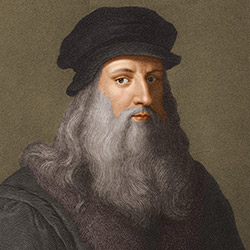

In the Time of Leonardo da Vinci — Topic Guide
When Leonardo da Vinci was born in 1452, Italy was divided into rival city-states and principalities competing for the finest artists, engineers, and scholars. The rediscovery of ancient texts, the rise of printing, and closer observation of nature were gradually transforming the arts and the pursuit of knowledge. A painter of exceptional talent, Leonardo also studied the human body, the movement of water, the flight of birds, machines, and architecture. His relatively small body of completed work and his thousands of drawings made him the most famous embodiment of the spirit of the Renaissance.
A Birth Near Florence
-
Leonardo was born during the night of April 14 to 15, 1452, in Vinci, a small town within the territory of the Republic of Florence.
-
His full name, Leonardo di ser Piero da Vinci, simply meant “Leonardo, son of Ser Piero, from Vinci.” The expression “da Vinci” was therefore not a family name in the modern sense.
-
He was the illegitimate son of Ser Piero, a Florentine notary, and a young woman named Caterina. His parents did not marry each other.
-
Leonardo grew up mainly within his father’s family, between Vinci and Florence, surrounded by the landscapes, waterways, and rock formations of Tuscany.
-
Because he had been born outside marriage, he could not easily enter his father’s profession as a notary, which probably helped direct him toward an artistic and technical career.
Training in Verrocchio’s Workshop
-
During his adolescence, Leonardo entered the Florentine workshop of Andrea del Verrocchio, one of the city’s most important artists.
-
Verrocchio was a painter, sculptor, goldsmith, and metalworker, allowing his pupil to discover several disciplines in the same environment.
-
Renaissance workshops operated as collective enterprises in which the master, assistants, and apprentices participated in different stages of the same work.
-
Leonardo learned drawing, painting, color preparation, perspective, modeling, sculpture, and the design of decorative objects.
-
He probably contributed to some of Verrocchio’s works, including The Baptism of Christ, in which an angel and part of the landscape are traditionally attributed to him.
-
In 1472, Leonardo was admitted to the Florentine Guild of Saint Luke, which represented painters, although he continued working in his master’s workshop for some time.
The Early Florentine Works
-
Leonardo’s earliest paintings already reveal his attention to human expressions, landscapes, and subtle transitions between light and shadow.
-
The portrait of Ginevra de’ Benci, painted during the 1470s, presents the young Florentine woman before a misty landscape and a juniper bush that refers to her name.
-
Leonardo applied extremely thin layers of paint and even smoothed certain passages with his fingers to eliminate overly sharp outlines.
-
The Annunciation and The Adoration of the Magi reveal his interest in gestures, psychological reactions, and the complex organization of groups.
-
The Adoration of the Magi, commissioned in 1481, remained unfinished when Leonardo left Florence for Milan.
-
His tendency to multiply his studies, continually revise his compositions, and abandon certain projects became a recurring feature of his career.
The Departure for Milan
-
Around 1482, Leonardo left Florence to enter the service of Ludovico Sforza, who ruled the Duchy of Milan.
-
In a famous letter addressed to the duke, he emphasized his abilities as a military engineer, bridge builder, weapons designer, and specialist in fortifications.
-
Only at the end of this presentation did he mention that he could also paint and sculpt.
-
This approach shows that a court artist was not limited to producing paintings but could also design buildings, festivities, machines, and military devices.
-
Leonardo remained in Milan for approximately seventeen years, one of the most productive periods of his career.
An Artist and Engineer at the Sforza Court
-
In the service of the Sforza family, Leonardo produced portraits, decorations, theatrical settings, and architectural projects.
-
He designed machines for court festivities, where mechanical effects, costumes, and elaborate staging demonstrated the duke’s wealth.
-
He studied canals, hydraulic systems, fortifications, and various methods for moving or lifting heavy loads.
-
His military drawings include giant weapons, armored vehicles, mobile bridges, and different siege machines.
-
Many of these projects remained theoretical studies and were never built in the form Leonardo proposed.
-
The spectacular nature of his inventions also helped impress princes who might finance his work.
The Virgin of the Rocks
-
In Milan, Leonardo received a commission for an altarpiece intended for a religious brotherhood, whose central panel became The Virgin of the Rocks.
-
The scene brings together the Virgin Mary, the infant Jesus, the young John the Baptist, and an angel within an almost unreal rocky landscape.
-
The pyramidal arrangement of the figures creates a stable composition despite the complexity of the gestures and glances.
-
Leonardo avoided rigid outlines and used light to create the impression that the figures gradually emerge from the shadows.
-
Two principal versions of the painting survive, one in the Louvre and the other in the National Gallery in London.
The Last Supper
-
Between approximately 1495 and 1498, Leonardo painted The Last Supper on a wall of the refectory of the convent of Santa Maria delle Grazie in Milan.
-
The work represents the moment when Jesus announces that one of his apostles will betray him.
-
Rather than showing motionless figures, Leonardo arranged the apostles in groups disturbed by surprise, anger, doubt, and fear.
-
The body and head of Christ form the geometric and emotional center of the composition.
-
The perspective lines of the ceiling and walls appear to extend the real space of the refectory and direct the viewer’s attention toward Jesus.
-
Leonardo experimented with a method different from traditional fresco painting so that he could work slowly and revise details.
-
This technique proved fragile, and the painting began to deteriorate soon after its completion.
-
Despite numerous restorations and major losses, The Last Supper remains one of the most influential religious images in Western history.
The Sforza Equestrian Monument
-
Ludovico Sforza commissioned Leonardo to design an enormous equestrian monument honoring his father, Francesco Sforza.
-
Leonardo studied the anatomy and movement of horses for many years in order to create a monumental and convincing animal.
-
He produced numerous drawings and completed a large clay model that impressed his contemporaries.
-
The bronze intended for the statue was instead used to manufacture cannons when Milan was threatened by French armies.
-
The monument was therefore never cast, making it one of the great unfinished projects of his career.
-
The horse studies produced for the commission nevertheless influenced his drawings and later equestrian projects.
The Fall of Ludovico Sforza
-
In 1494, King Charles VIII of France invaded the Italian Peninsula, beginning a long period of warfare among European powers.
-
In 1499, the French captured Milan and overthrew Ludovico Sforza.
-
Deprived of his patron, Leonardo left the city and traveled to Mantua and Venice before returning to Florence.
-
In Mantua, he produced a famous drawing of Isabella d’Este, one of the most important patrons of the Renaissance.
-
In Venice, he proposed technical and defensive solutions intended to protect the city from a possible attack.
-
These movements illustrate the dependence of artists on princes, governments, and shifting alliances.
In the Service of Cesare Borgia
-
In 1502, Leonardo entered the service of Cesare Borgia, son of Pope Alexander VI and a military commander seeking to establish his authority in central Italy.
-
He received the title of architect and military engineer and inspected fortresses, roads, and defensive systems.
-
Leonardo traveled through Romagna and Tuscany, producing highly precise topographical and hydrographic surveys.
-
His map of Imola shows the city from above in an almost circular plan, without using the perspective normally employed by artists.
-
These works demonstrate that drawing could serve art, military strategy, cartography, and regional planning.
-
Leonardo left Borgia’s service when the latter’s political power began to weaken.
The Return to Florence
-
After returning to Florence, Leonardo was welcomed as one of the most famous painters in Italy.
-
The city was also home to other outstanding artists, including Michelangelo, who was younger than Leonardo and possessed a very different temperament.
-
The Florentine government asked both men to create vast murals in the Hall of the Great Council of the Palazzo Vecchio.
-
Leonardo was to depict the Battle of Anghiari, while Michelangelo worked on the Battle of Cascina.
-
Both projects remained unfinished, but their drawings were admired and copied by several generations of artists.
-
The rivalry between Leonardo and Michelangelo came to symbolize the artistic competition that stimulated the Florentine Renaissance.
The Mona Lisa
-
Around 1503, Leonardo began the portrait of Lisa Gherardini, wife of the Florentine merchant Francesco del Giocondo.
-
The work, now known as The Mona Lisa or La Gioconda, presents the young woman seated before a vast landscape of mountains, paths, and waterways.
-
The three-quarter position, visible hands, and gaze directed toward the viewer helped renew Renaissance portraiture.
-
Leonardo used sfumato, a succession of almost imperceptible transitions that softens the outlines of the face and produces the famous shifting smile.
-
The landscape is not merely decorative, since it appears to establish continuity between the human body, water, rocks, and the forces of nature.
-
Leonardo kept the painting with him, apparently continued to revise it, and later brought it to France.
-
The Mona Lisa now belongs to the Louvre Museum and has become one of the most famous works of art in the world.
Milan, Rome, and the Final Years in Italy
-
In 1506, Leonardo returned to Milan, which was then controlled by the French, and worked for the city’s new rulers.
-
He continued his scientific studies, anatomical dissections, and several paintings begun earlier.
-
Beginning in 1513, he lived in Rome under the protection of Giuliano de’ Medici, brother of Pope Leo X.
-
Rome then brought together Michelangelo, Raphael, and many artists employed on major papal projects.
-
Leonardo nevertheless received fewer important commissions than his younger rivals and devoted much of his time to experiments.
-
He studied mirrors, optics, machines, and various methods of using solar heat.
The Move to France
-
In 1516, Leonardo accepted the invitation of King Francis I and permanently left Italy.
-
He settled at the manor of Clos Lucé, near the royal château of Amboise in the Loire Valley.
-
The king granted him the title of First Painter, Engineer, and Architect to the King.
-
Leonardo brought several works with him, including The Mona Lisa, The Virgin and Child with Saint Anne, and Saint John the Baptist.
-
He worked on projects involving festivities, buildings, and regional planning, although his health and the reduced use of his right hand limited his activities.
-
Francis I greatly admired him and visited him, demonstrating the new prestige achieved by certain Renaissance artists.
-
Leonardo died in Amboise on May 2, 1519, at the age of sixty-seven.
A New Way of Painting
-
Leonardo regarded painting as an intellectual discipline capable of uniting geometry, optics, anatomy, and the observation of nature.
-
He studied the way light falls on surfaces and how the atmosphere alters forms and colors across distance.
-
Sfumato allowed him to replace rigid outlines with transitions resembling smoke.
-
His figures do not merely pose but appear to think, react, and communicate through their eyes, hands, and body movements.
-
He gave great importance to what he called the “motions of the soul,” meaning the visible signs of inner emotions.
-
His compositions profoundly influenced Raphael, Milanese painters, and many artists of later generations.
-
Leonardo completed relatively few paintings, but several permanently transformed Western art.
The Drawings and Notebooks
-
Leonardo constantly used drawing to record an observation, analyze a problem, or develop an idea.
-
His notebooks address painting, geometry, anatomy, mechanics, architecture, botany, water, and flight.
-
He often worked on separate sheets that he carried with him before they were later gathered into notebooks or collections.
-
Leonardo, who was left-handed, frequently wrote from right to left in mirror writing, which could be read more easily with the help of a mirror.
-
This writing was not necessarily a secret code, since it may simply have allowed him to write without dragging his hand across wet ink.
-
His pages often combine a highly precise image with sentences, lists, calculations, and brief personal remarks.
-
Much of this material was not published during his lifetime, which limited its direct influence on the scholars and engineers of his era.
The Study of the Human Body
-
Leonardo considered anatomical knowledge essential to the convincing representation of the human body.
-
He participated in dissections and studied bones, muscles, organs, blood vessels, and fetal development.
-
His drawings show the body from several angles and sometimes use cross-sections or successive layers.
-
He made remarkable observations about the spine, skull, muscles, heart, and the functioning of cardiac valves.
-
Some of his interpretations nevertheless remained influenced by ancient medical knowledge and by the limited number of bodies he could examine.
-
His planned complete anatomical treatise was never finished or published.
-
His drawings nevertheless established a new standard of precision in the scientific representation of the body.
The Vitruvian Man
-
Around 1490, Leonardo produced the drawing now known as The Vitruvian Man.
-
He drew inspiration from a text by the Roman architect Vitruvius concerning the ideal proportions of the human body.
-
The drawing superimposes two positions of the same man, whose arms and legs fit within a circle and a square.
-
It therefore connects human anatomy, geometry, and the proportions used in architecture.
-
The image was originally a small private study rather than a work intended for exhibition.
-
Much later, it became a universal symbol of humanism, science, and the ideal of the Renaissance man.
Water, the Earth, and Nature
-
Leonardo observed whirlpools, waves, currents, and erosion in order to understand the movement of water.
-
He sometimes compared rivers and their tributaries to the vessels that carry blood through the human body.
-
His notebooks contain projects for canals, dams, pumps, irrigation systems, and machines intended to raise water.
-
His maps combine waterways, terrain, roads, and human settlements within a coherent representation of the land.
-
He understood that seashells found in mountains could not simply have been deposited by the biblical Flood but revealed ancient transformations of the Earth.
-
He also studied plants, trees, clouds, rocks, and the effects of the atmosphere on landscapes.
-
For Leonardo, nature was not a collection of isolated objects but a system of interconnected forces and movements.
The Dream of Flight
-
Leonardo closely observed wings, feathers, and the movements of birds.
-
He drew several flying machines whose wings were to be powered by human strength.
-
His projects include devices resembling gliders, parachutes, and a large aerial screw often compared to a helicopter.
-
Human muscular power would generally not have been sufficient to operate these machines as he designed them.
-
Leonardo nevertheless understood several principles related to air resistance, balance, and wing movement.
-
His Codex on the Flight of Birds, written around 1505-1506, brings together his observations on flight and his mechanical reflections.
-
These studies reveal his desire to imitate nature without merely copying the outward form of animals.
Collaborators and Heirs
-
Leonardo worked with assistants and pupils who accompanied him during his travels and participated in his workshop.
-
Gian Giacomo Caprotti, known as Salaì, entered his service at a very young age and remained in his circle for many years.
-
Francesco Melzi, who came from a Milanese family, became one of his most faithful pupils and accompanied him to France.
-
After Leonardo’s death, Melzi inherited most of his manuscripts and attempted to organize his notes on painting.
-
The later dispersal of the sheets and notebooks made his work more difficult to understand.
-
Several works once attributed to Leonardo are now considered products of his workshop or his followers.
-
His influence nevertheless extended far beyond the limited number of paintings that can be attributed to him with certainty.
Italy in Leonardo’s Time
-
The Italy of Leonardo was not a unified country but a collection of states that included Florence, Milan, Venice, the Papal States, and the Kingdom of Naples.
-
Florence was officially a republic, but the Medici family exercised considerable political and economic influence.
-
Milan was ruled by the Sforza family, Venice by a merchant oligarchy, and Rome by popes who also acted as territorial rulers.
-
Princes, wealthy families, religious brotherhoods, and the Church commissioned paintings, statues, palaces, and monuments to display their prestige.
-
This competition encouraged the work of Leonardo, Botticelli, Bramante, Michelangelo, Raphael, and many other creators.
-
The political balance established in the mid-fifteenth century was shattered by the French invasion of 1494 and the Italian Wars.
-
France and Spain then sought to control the wealthy Italian territories, producing changes of power that directly affected Leonardo’s career.
The Renaissance, Humanism, and Printing
-
Renaissance intellectuals studied Greek and Roman texts in order to renew philosophy, literature, the arts, and knowledge of the world.
-
Humanism placed particular emphasis on human abilities, ancient languages, history, and education.
-
Artists studied ancient works, perspective, geometry, and anatomy in order to represent space and the body with greater coherence.
-
The European invention of movable-type printing in the mid-fifteenth century made it possible to produce and circulate books much more rapidly.
-
Printed editions of ancient works, mathematical treatises, and scientific texts circulated in the cities Leonardo visited.
-
He gradually expanded his education by reading, compiling vocabulary lists, and exchanging ideas with mathematicians such as Luca Pacioli.
-
Drawing became for him a method of investigation as important as reading or writing.
-
The modern separation between art, science, and technology was far less clearly defined than it later became.
A Europe in Transformation
-
Constantinople was conquered in 1453 by the Ottoman sultan Mehmed II, one year after Leonardo’s birth.
-
The Ottoman Empire strengthened its authority in the Balkans, Anatolia, and the eastern Mediterranean before conquering Syria and Egypt in 1516-1517.
-
Venetian merchants maintained important commercial relations with the Mamluks, Ottomans, and other powers of the Islamic world.
-
In 1492, Ferdinand of Aragon and Isabella of Castile completed the conquest of the Muslim kingdom of Granada and financed Christopher Columbus’s voyage.
-
Portuguese expeditions gradually sailed around Africa, and Vasco da Gama reached India by sea in 1498.
-
Ferdinand Magellan’s expedition left Spain in 1519, the year of Leonardo’s death, and later completed the first circumnavigation of the globe.
-
These voyages expanded European geographical knowledge but also opened a period of conquest, colonization, and exploitation.
-
In 1517, Martin Luther publicly criticized certain practices of the Church, marking the beginning of the Protestant Reformation.
The World in Leonardo’s Time
-
China was ruled by the Ming dynasty, which experienced considerable economic and cultural development.
-
In Iran, Shah Ismail founded the Safavid dynasty in 1501 and made Shiite Islam the official religion of his new state.
-
In West Africa, the Songhai Empire controlled vast trade routes, while Timbuktu became an important center of Islamic scholarship.
-
In central Mexico, the Mexica Empire, commonly called the Aztec Empire, dominated much of Mesoamerica from its capital, Tenochtitlan.
-
Hernán Cortés arrived in Tenochtitlan in 1519, the same year Leonardo died in France.
-
In the Andes, the Inca Empire was extending its authority across much of western South America.
-
These societies possessed their own political, scientific, religious, and artistic traditions, independently of the transformations taking place during the European Renaissance.
-
Leonardo’s world was therefore already connected through vast commercial networks, even though populations on different continents still knew very little about one another.
Quiz questions preview
-
What hint casts some doubt on the artistic commission of the painting "Ginevra de' Benci"?
The simple and peasant brown dress | The absence of luxurious jewellery | Laurel and twig emblem on the back of the canvas | The black scarf around the neck -
Who ruled the Duchy of Milan when Leonardo arrived in 1482?
Gian Galeazzo Sforza | Galéas Marie Sforza | Ludovico Sforza | Francesco Sforza -
In which work does Leonardo present a blend of his military genius and his appreciation of the animal kingdom?
The crossbow | The scythed chariot | The aerial screw | The mirror polishing machine -
What was Leonardo's legendary contribution to the theatrical production of Baldassare Taccone's "La Danae" in 1496?
Jupiter's flaming halos | Hiding the musicians behind the machines | The lifting machine for the flight of Mercury | The starry sky -
Vinci is located… ?
North of Empoli | All the answers are good | East of Pisa | West of Florence

