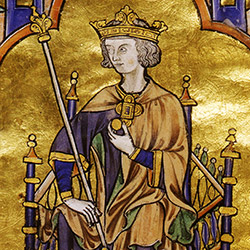

In the Time of Saint Louis — Topic Guide
When Louis IX became King of France in 1226, he was only twelve years old and still had to strengthen royal authority against the great lords. Deeply religious, committed to justice, and inspired by the ideal of crusade, he gradually transformed the French monarchy into a more respected and better-organized institution. His reign was marked by the kingdom’s prosperity, the development of royal justice, the construction of the Sainte-Chapelle, and two disastrous military expeditions. Canonized after his death, he entered history as Saint Louis.
A Childhood Within the Capetian Dynasty
-
Louis was born on April 25, 1214, in Poissy, near Paris.
-
He was the son of King Louis VIII, known as Louis the Lion, and Blanche of Castile, a granddaughter of Eleanor of Aquitaine.
-
His paternal grandfather, Philip Augustus, had greatly expanded the royal domain and strengthened the power of the Capetian dynasty.
-
Louis received a strict religious education but was also prepared to govern, administer justice, and command an army.
-
Blanche of Castile had a decisive influence on his moral and political education.
-
According to tradition, she taught him that he should prefer death to knowingly committing a serious sin.
-
Louis was not originally expected to rule, but the death of his elder brother Philip made him heir to the throne.
A Twelve-Year-Old King
-
Louis VIII died on November 8, 1226, after a reign of only three years.
-
Louis IX was crowned king at Reims on November 29, 1226, when he was only twelve years old.
-
His mother, Blanche of Castile, governed during his minority and later remained one of his principal advisers.
-
Several great lords attempted to take advantage of the king’s youth to weaken royal authority.
-
Blanche succeeded in dividing the opposition, obtaining the support of certain towns, and maintaining control of the royal administration.
-
The young king gradually became involved in decisions and campaigns intended to restore order.
-
The feudal revolts were brought under control, confirming the stability of the Capetian dynasty.
Marriage to Margaret of Provence
-
Louis IX married Margaret of Provence in 1234, when he was twenty years old.
-
Margaret was the daughter of Count Raymond Berengar V of Provence and Beatrice of Savoy.
-
The marriage strengthened the French monarchy’s ties with the principalities of southeastern France.
-
Louis and Margaret had eleven children, several of whom reached adulthood.
-
Their eldest surviving son, Philip, succeeded his father as Philip III.
-
Margaret accompanied Louis during the Seventh Crusade and played an important role at Damietta while the king was in captivity.
-
Relations between Margaret and Blanche of Castile were often difficult because the queen mother retained great influence over her son.
-
Louis remained deeply attached to his wife, although he generally placed his religious and royal duties first.
The Strengthening of Royal Power
-
Louis IX continued the strengthening of the monarchy begun by his Capetian predecessors.
-
The territory directly controlled by the king now covered a significant part of the kingdom, although powerful princes still retained their own lands.
-
Bailiffs in the north and seneschals in the south administered royal lands, dispensed justice, and collected revenue.
-
Louis required his representatives to act honestly and avoid abuses against the population.
-
He sent royal investigators into the provinces to receive complaints against agents of the Crown.
-
Some officials were punished, replaced, or ordered to repay money obtained unlawfully.
-
The king sought to reduce private wars between lords and increasingly impose the arbitration of royal justice.
-
His government helped transform the king from merely the most powerful lord into the kingdom’s supreme authority.
The King as Judge
-
Louis IX placed exceptional importance on justice, which he considered one of his principal Christian duties.
-
He personally received petitioners and listened to cases brought before him.
-
His friend and biographer Jean de Joinville wrote that the king sometimes dispensed justice beneath an oak tree in the forest of Vincennes.
-
This scene became one of the most famous images of the reign, although royal justice mainly depended on institutions and specialized officials.
-
Subjects were increasingly able to appeal to the king’s court when they challenged a judgment issued by a local lord.
-
The royal court gradually became more specialized, encouraging the development of the Parlement of Paris as a supreme court.
-
Louis ordered that judgments be supported by evidence and restricted certain feudal practices, including judicial duels.
-
He also sought to protect the weakest members of society, particularly widows, orphans, and the poor, in accordance with his Christian understanding of kingship.
-
His reputation as an impartial ruler spread beyond the borders of the kingdom and led some foreign princes to ask him to settle their disputes.
Government Reforms
-
Louis IX issued several ordinances intended to improve the conduct of royal officials and the morality of the kingdom.
-
The ordinances of 1254 were adopted after his return from crusade and condemned corruption, blasphemy, prostitution, gambling, and administrative abuse.
-
Royal officials were forbidden to accept gifts that might influence their decisions.
-
The king strengthened control over coinage and tried to encourage the use of royal money throughout the kingdom.
-
Coins issued by great lords continued to exist, but royal currency gradually gained prestige and stability.
-
Royal archives and financial accounts were preserved more carefully, improving the continuity of government.
-
Important decisions were discussed with advisers, jurists, churchmen, and great lords gathered around the king.
-
Louis did not create the French state by himself, but his reign accelerated the transformation of the feudal monarchy into a more centralized government.
The Lusignan Revolt
-
In 1241, Louis IX granted the County of Poitiers to his brother Alphonse.
-
This decision provoked the opposition of Hugh X of Lusignan, a powerful lord of Poitou, and his wife Isabella of Angoulême.
-
The rebels received support from King Henry III of England, who hoped to recover territories lost by his father.
-
Louis personally led the royal army into western France.
-
He won an important victory at Taillebourg in July 1242 and then forced his opponents to submit.
-
Henry III withdrew without restoring English power in the former Plantagenet territories.
-
The victory strengthened Louis IX’s authority and showed that the great vassals could no longer easily challenge the monarchy.
Peace with England and Aragon
-
Louis IX generally preferred negotiation to territorial conquest when he believed a lasting peace was possible.
-
In 1258, the Treaty of Corbeil settled several old claims between France and the Kingdom of Aragon.
-
Louis abandoned certain French claims to Catalonia, while James I of Aragon gave up several theoretical rights in southern France.
-
In 1259, Louis concluded the Treaty of Paris with King Henry III of England.
-
The English king formally renounced the territories lost by his family in Normandy, Anjou, Touraine, and Maine.
-
Louis restored or confirmed certain territories in southwestern France to Henry III, for which the English king was required to pay him homage.
-
Some French advisers considered these concessions too generous.
-
Louis nevertheless believed that a fair agreement was preferable to continuing a conflict inherited from earlier generations.
Faith at the Center of the Reign
-
Louis IX attended religious services every day and placed great importance on prayer, fasting, and penance.
-
He practiced a more austere form of devotion than was normally expected of a sovereign.
-
He served poor people at his table, washed their feet, and funded hospitals, hospices, and religious communities.
-
He particularly supported the mendicant orders, including the Franciscans and Dominicans.
-
Royal charity strengthened his reputation as a Christian ruler, but it also reflected a deeply held personal conviction.
-
Louis believed that a king should govern according to the teachings of the Church and help prepare his subjects for spiritual salvation.
-
He built or supported numerous religious institutions, including Royaumont Abbey.
-
His faith largely explains his desire to participate personally in the Crusades.
The Sainte-Chapelle and the Relics
-
The Latin emperor of Constantinople, Baldwin II, sought to sell several relics in order to finance his government.
-
Louis IX acquired the Crown of Thorns, believed to have been worn by Jesus during the Passion.
-
The relic arrived in France in 1239 and was received with great ceremony.
-
The king himself took part in the procession, barefoot and simply dressed, to demonstrate his humility.
-
He later obtained other relics associated with the Passion, including a fragment of the True Cross.
-
Louis had the Sainte-Chapelle built on the Île de la Cité in Paris to house this prestigious collection.
-
Consecrated in 1248, the chapel is one of the masterpieces of Gothic architecture.
-
Its immense stained-glass windows mainly depict episodes from the Bible and transform the interior into a vast wall of light.
-
Possession of these relics increased the religious prestige of Paris and presented the French monarchy as a privileged protector of Christendom.
The Seventh Crusade
-
In 1244, Louis became seriously ill and vowed to go on crusade if he survived.
-
He decided to attack Egypt, which was regarded as the center of Muslim power in the region.
-
The king left France in 1248 with a large army and spent several months on the island of Cyprus.
-
The crusaders landed in Egypt in June 1249 and quickly captured the city of Damietta.
-
Instead of immediately continuing their advance, they waited several months before marching toward Cairo.
-
The army had to move through the Nile Delta, where rivers, disease, and supply difficulties slowed the expedition.
-
At Mansurah, the crusaders initially achieved some success but later suffered heavy losses.
-
Robert of Artois, the king’s brother, was killed after launching a reckless attack into the city.
-
Weakened by battle, disease, and famine, the French army was eventually forced to retreat.
The King’s Captivity
-
Louis IX was captured with a large part of his army in April 1250.
-
He was held by Egyptian forces along with several members of the French nobility.
-
The king’s release required the return of Damietta and the payment of a substantial ransom.
-
Margaret of Provence, who had remained at Damietta, helped maintain order and protect the crusaders’ interests during her husband’s captivity.
-
Louis impressed some of his captors with his calmness, dignity, and refusal to panic.
-
After his release, he did not immediately return to France.
-
He remained in the Holy Land for several years to strengthen the fortifications of Christian cities and negotiate the release of other prisoners.
-
He stayed in Acre, Caesarea, Jaffa, and Sidon, among other places.
-
The death of Blanche of Castile in 1252 eventually forced Louis to consider returning to his kingdom.
-
He came back to France in 1254 after an absence of about six years.
The Consequences of the Crusade
-
The Seventh Crusade was a military failure and was extremely costly for the monarchy and the participating families.
-
Louis viewed the defeat as a trial sent by God rather than a reason to abandon his ideal.
-
After returning, he intensified his efforts at moral and administrative reform.
-
He attempted to correct injustices committed by his officials before his departure.
-
His long absence had not caused the kingdom to collapse, demonstrating the growing strength of the Capetian administration.
-
His personal prestige remained high despite his capture and the failure of the expedition.
-
Contemporaries admired his piety, perseverance, and conduct in captivity more than his abilities as a military strategist.
Louis IX and Jewish Communities
-
Louis IX’s deep Christian faith was accompanied by strong hostility toward Judaism.
-
In 1240, a religious disputation was organized in Paris between Jewish representatives and Christian theologians concerning the Talmud.
-
The trial led to the condemnation of many Jewish manuscripts.
-
In 1242, thousands of volumes of the Talmud were publicly burned in Paris.
-
The king also imposed economic and religious restrictions on the kingdom’s Jewish communities.
-
He encouraged their conversion to Christianity and supported certain measures against moneylending at interest.
-
In 1269, he ordered Jews to wear a distinctive badge known as the rouelle.
-
These policies demonstrate that Saint Louis’s reputation for justice did not extend equally to all his subjects.
-
They were part of the religious intolerance of the Christian Middle Ages, but Louis enforced them with particular conviction.
Relations with Muslims and the Mongols
-
Louis viewed the crusade as a religious war intended to protect the holy places and Christian communities of the East.
-
He did not hesitate to fight Muslim powers, but he could also negotiate with their representatives when he considered it necessary.
-
During his stay in the East, he exchanged embassies with various rulers of the region.
-
Europeans hoped at the time to form an alliance with the Mongols, who were advancing across Asia and also threatening several Muslim states.
-
Louis sent religious envoys and ambassadors to Mongol rulers.
-
These missions did not produce the hoped-for military alliance.
-
They nevertheless helped increase European knowledge of Central Asia and the Far East.
The Eighth Crusade and the King’s Death
-
Despite the failure of the Seventh Crusade, Louis IX decided to organize another expedition.
-
In 1270, he departed with several members of his family, including his sons Philip and John Tristan.
-
The army headed toward Tunis in North Africa rather than directly toward Egypt or the Holy Land.
-
Louis probably hoped to secure the conversion or alliance of the ruler of Tunis and use the territory as a strategic base.
-
The expedition was quickly struck by heat, lack of water, and a severe epidemic.
-
John Tristan died of illness, and Louis himself soon became seriously ill.
-
The king died near Tunis on August 25, 1270.
-
Tradition states that his final words concerned Jerusalem.
-
His son Philip became king as Philip III the Bold.
-
The crusade ended with an agreement with the ruler of Tunis without achieving any significant military result.
Canonization and the Memory of Saint Louis
-
From the time of his death, Louis IX was presented as a model Christian king.
-
Testimonies about his life, miracles, and reputation for holiness were gathered as part of an official investigation.
-
Pope Boniface VIII canonized him in 1297, twenty-seven years after his death.
-
Louis IX then officially became Saint Louis.
-
He is the only king of France to have been canonized by the Catholic Church.
-
Jean de Joinville, who had accompanied the king on crusade, wrote an important biography entitled The Life of Saint Louis.
-
The French monarchy long used his memory to present kingship as a sacred, just, and protective institution.
-
Many churches, cities, and institutions were placed under his patronage, including the American city of St. Louis.
-
His reign remains associated with royal justice, Gothic architecture, and the ideal of Christian monarchy, but also with the Crusades and religious persecution.
France in the Time of Saint Louis
-
Thirteenth-century France was not yet a unified state in the modern sense.
-
The king directly governed the royal domain, while great lords administered their own principalities and owed him feudal loyalty.
-
Language varied considerably from one region to another, and Latin remained the language of the Church, education, and much of the administration.
-
Most of the population lived in the countryside and worked in agriculture.
-
Harvests directly determined living conditions, and a poor season could cause hunger or a sudden rise in prices.
-
Cities such as Paris, Rouen, Orléans, Reims, Toulouse, and Montpellier experienced significant growth.
-
Artisans and merchants organized themselves into guilds, while fairs encouraged trade between different parts of Europe.
-
Paris became one of the largest cities in the West and the kingdom’s main political, intellectual, and religious center.
The Church, Universities, and Gothic Culture
-
The Catholic Church occupied a central place in daily life, education, assistance to the poor, and the legitimacy of political power.
-
Bishops, abbots, and monasteries controlled vast properties and exercised considerable political influence.
-
Universities developed in Paris, Oxford, Bologna, and several other European cities.
-
The University of Paris was especially renowned for the study of theology and philosophy.
-
The Dominican Thomas Aquinas, a contemporary of Louis IX, sought to reconcile Aristotle’s philosophy with Christian doctrine.
-
The form of thought known as scholasticism relied on rigorous textual analysis, disputed questions, and logical reasoning.
-
Gothic architecture reached its height with great cathedrals, high vaults, flying buttresses, and vast stained-glass windows.
-
The cathedrals of Chartres, Amiens, Reims, and Beauvais reflect the religious and technical ambition of the period.
-
Illuminated manuscripts, sculptures, reliquaries, and stained glass conveyed religious stories to a largely illiterate population.
Europe in the Thirteenth Century
-
The pope and the Holy Roman emperor regularly clashed over their authority within the Christian world.
-
Emperor Frederick II, a cultured and controversial ruler, entered into bitter conflicts with the papacy.
-
In England, Henry III faced opposition from his barons, who sought to limit his decisions and expenditures.
-
This crisis led to the reforms of Simon de Montfort and a major civil war during the 1260s.
-
In the Iberian Peninsula, the Christian kingdoms continued the Reconquista at the expense of Muslim territories.
-
Ferdinand III of Castile captured Córdoba and Seville, among other cities.
-
Italian maritime republics such as Venice and Genoa dominated part of Mediterranean trade.
-
Merchants transported spices, silk, metals, wine, textiles, and many other goods between Europe, Africa, and Asia.
-
The Crusades remained a powerful ideal, but the Christian territories of the Near East became increasingly difficult to defend.
The World in the Time of Saint Louis
-
The Mongol Empire, founded by Genghis Khan, became the largest contiguous land empire in history during the thirteenth century.
-
Mongol armies conquered much of Central Asia, China, Persia, and Eastern Europe.
-
In 1258, the Mongols captured Baghdad and ended the Abbasid caliphate based there.
-
In Egypt, the Mamluks seized power and became the principal opponents of both the crusaders and the Mongols in the Near East.
-
Sultan Baybars strengthened the Mamluk state and conquered several Christian strongholds in the Holy Land.
-
In China, the Mongols led by Kublai Khan were gradually completing the conquest of the Song dynasty.
-
Japan repelled a first Mongol invasion attempt in 1274, a few years after the death of Louis IX.
-
In West Africa, the Mali Empire was expanding through the gold trade and the trans-Saharan routes.
-
In the Americas, Mesoamerican and Andean civilizations continued to develop without direct contact with Europe.
-
Improved trade routes made travel easier for merchants, missionaries, and ambassadors between Europe and Asia.
-
A few years after Louis IX’s reign, the Venetian merchant Marco Polo began the journey that would make his name famous in Europe.
Quiz questions preview
-
While remaining neutral, Louis IX tried, in vain, to reconcile these two powers in order to end their conflict.
The Holy Roman Empire and the Kingdom of Denmark | The Holy Roman Empire and the Byzantine Empire | The Holy Roman Empire and the Kingdom of England | The Holy Roman Empire and the Papacy -
During the Seventh Crusade, they killed the Ayyruid Sultan of Egypt who held Louis IX prisoner and took power.
The Berbers | The Abbasids | The Mamluks | The Turks -
Biographer of Saint Louis, his testimony was decisive during the investigation for the canonization of the French king.
Jean de Joinville | Jacques Bretel | Geoffroi de Paris | Philippe de Novare -
These believers were victims of the extreme piety and unwavering Catholic faith of Louis IX during his reign.
Jews | All these answers | Muslims | Cathars -
Religious order which Louis and his mother Blanche identify with and to which they contribute to the creation of abbeys.
The Cistercian order | The Order of the Benedictines | The Order of the Franciscans | The Dominican order

