Retrospective 1974 — Topic Guide
The year 1974 was marked by major political upheavals and significant international instability. In the United States, the Watergate scandal forced Richard Nixon to resign in a historic first. Portugal ended decades of dictatorship, while Cyprus faced a serious crisis. Culturally, ABBA conquered Europe, Muhammad Ali regained his world title, and American cinema continued its profound transformation.
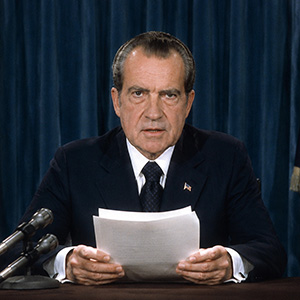
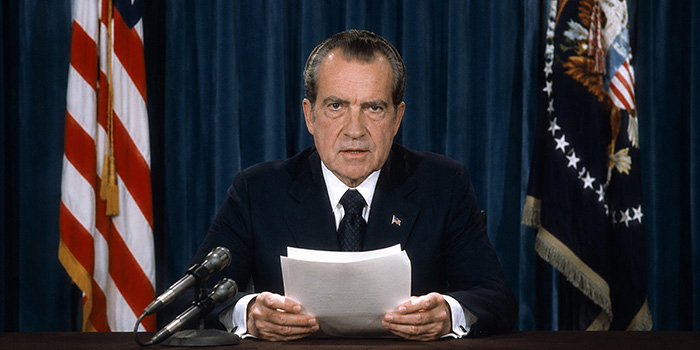
Richard Nixon Resigns Over Watergate
The Watergate scandal reached its climax in 1974.
Since 1972, the Nixon administration had been implicated in a political espionage affair linked to the break-in at Democratic Party offices in the Watergate complex in Washington.
Investigations gradually revealed efforts by the White House to cover up the affair. Recordings of presidential conversations became particularly damaging.
Facing the near certainty of impeachment proceedings, Richard Nixon announced his resignation on August 8, 1974, and officially left office the following day.
He became the first U.S. president to resign.
Vice President Gerald Ford succeeded him. On September 8, Ford granted Nixon a full presidential pardon for any federal crimes he may have committed while in office, a decision that proved extremely controversial.
The Carnation Revolution in Portugal
On April 25, 1974, a military coup ended nearly half a century of authoritarian rule in Portugal.
Officers united within the Armed Forces Movement overthrew the government of Marcelo Caetano, successor to António de Oliveira Salazar.
The population quickly joined the soldiers in the streets. Flowers, especially red carnations, were placed in the barrels of rifles, giving the revolution its name.
The movement led to a transition toward democracy and accelerated Portuguese decolonization in Africa.
Angola, Mozambique, Guinea-Bissau, and other Portuguese territories gradually moved toward independence.
The Cyprus Crisis
In July 1974, Cyprus was plunged into a serious political and military crisis.
A coup supported by the Greek military junta overthrew Cypriot president Archbishop Makarios III. The coup leaders wanted to bring the island closer to Greece.
Turkey intervened militarily a few days later, claiming that it intended to protect the Turkish Cypriot population.
Turkish forces eventually took control of a large part of the northern section of the island.
The crisis caused major population displacements and left Cyprus divided between a mainly Greek area in the south and a Turkish area in the north. This division remains one of the Mediterranean region’s longest-running unresolved conflicts.
Giscard d’Estaing Becomes President of France
In France, President Georges Pompidou died on April 2, 1974, while still in office.
A presidential election was quickly organized.
Valéry Giscard d’Estaing, a centre-right candidate, faced Socialist François Mitterrand in the second round. Giscard d’Estaing won by a narrow margin and became president of the Republic at the age of 48.
His arrival in office was associated with a desire to modernize French society.
Several important reforms would be adopted during his presidency, including the lowering of the age of majority to 18 in 1974.
India Becomes a Nuclear Power
On May 18, 1974, India carried out its first underground nuclear test in the Rajasthan desert.
The operation was code-named “Smiling Buddha.”
India officially described the explosion as a peaceful nuclear experiment, but the test clearly demonstrated its ability to develop a nuclear weapon.
The country thus became the first state outside the five major recognized nuclear powers of the time to conduct such a test.
The event altered the strategic balance in South Asia and contributed to the future nuclear rivalry between India and Pakistan.
Muhammad Ali Regains His Title
On October 30, 1974, Muhammad Ali faced George Foreman in Kinshasa, Zaire, now the Democratic Republic of the Congo.
The fight, nicknamed the “Rumble in the Jungle,” became one of the most famous sporting events of the twentieth century.
Foreman, the heavyweight world champion, was considered the favourite. Ali, however, adopted an unexpected strategy known as the “rope-a-dope,” allowing Foreman to tire himself out by throwing punches while Ali leaned against the ropes.
In the eighth round, Ali attacked and knocked Foreman out.
Seven years after being stripped of his title for refusing induction into the U.S. military, Muhammad Ali once again became heavyweight champion of the world.
ABBA Triumphs at Eurovision
On April 6, 1974, the Swedish group ABBA won the Eurovision Song Contest with “Waterloo.”
The victory truly launched the international career of the group, composed of Agnetha Fältskog, Björn Ulvaeus, Benny Andersson, and Anni-Frid Lyngstad.
ABBA went on to become one of the most popular pop groups in history, with songs such as “Mamma Mia,” “Fernando,” “Dancing Queen,” and “Take a Chance on Me.”
The year 1974 also marked the rise of disco, which would become one of the major musical phenomena of the second half of the 1970s.
A Strong Year for Cinema
Cinema produced several major successes in 1974.
Francis Ford Coppola released “The Godfather Part II,” the sequel to his celebrated 1972 film. The movie parallels the rise of Vito Corleone with the reign of his son Michael.
It would win six Academy Awards, including Best Picture.
Coppola also directed “The Conversation,” a thriller starring Gene Hackman.
Roman Polanski directed “Chinatown,” starring Jack Nicholson and Faye Dunaway, while Mel Brooks enjoyed major success with the comedies “Blazing Saddles” and “Young Frankenstein.”
The Rubik’s Cube Is Invented
In 1974, Hungarian professor Ernő Rubik developed a puzzle made up of smaller movable cubes.
Originally designed to help his students understand movement in three-dimensional space, the object was first marketed in Hungary as the “Magic Cube.”
A few years later, it became known as the Rubik’s Cube and achieved spectacular worldwide success.
Notable Births and Deaths
Several important figures were born in 1974:
-
Actor Christian Bale was born on January 30.
-
Actress Penélope Cruz was born on April 28.
-
Singer Alanis Morissette was born on June 1.
-
Singer Nelly was born on November 2.
-
Actor Leonardo DiCaprio was born on November 11.
The year was also marked by several notable deaths:
-
Georges Pompidou died on April 2.
-
Duke Ellington died on May 24.
-
Charles Lindbergh died on August 26.
-
Film producer Samuel Goldwyn died on January 31.
Quiz questions preview
-
Which football team won the Super Bowl VIII?
Pittsburgh Steelers | Dallas Cowboys | Minnesota Vikings | Miami Dolphins -
This film by Francis Ford Coppola won the Palme d'Or at the Cannes Film Festival in 1974.
The Conversation | (The Godfather: Part II) | The Rain People | Apocalypse Now -
Who was Mohammad Reza Pahlavi?
The Shah of Iran | The Emir of Syria | The Shiite Ayatollah | The Sheikh of Arabia -
Who succeeded Golda Meir as Prime Minister of Israel on June 3, 1974?
Anwar Sadat | Yitzhak Rabin | Menahem Begin | Benjamin Netanyahu -
What major sporting event took place in West Germany in 1974?
FIFA World Cup | Summer Olympics | Ali-Foreman boxing match | Rugby World Cup

