Retrospective 2015 — Topic Guide
The year 2015 was marked by deadly terrorist attacks, the war in Syria, and a major migration crisis. It also saw the adoption of the Paris Agreement on climate change, an international agreement on Iran’s nuclear program, and several scientific advances. In Canada, Justin Trudeau’s election ended nearly ten years of Conservative government.
The Attacks in France
On January 7, gunmen attacked the offices of the satirical newspaper Charlie Hebdo in Paris. Twelve people were killed, including several well-known cartoonists. In the days that followed, a police officer was murdered and a hostage-taking occurred at a kosher supermarket.
The slogan “Je suis Charlie” became an international symbol of solidarity and support for freedom of expression.
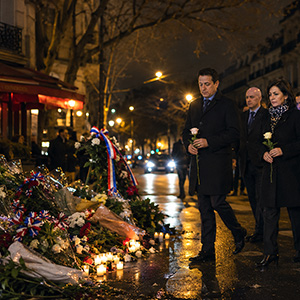
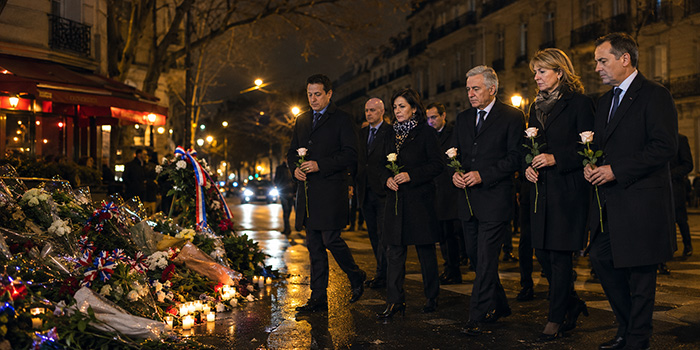
On November 13, Paris and Saint-Denis were struck by a series of coordinated attacks. The attackers targeted cafés, the Stade de France, and the Bataclan concert hall. One hundred and thirty people were killed. The Islamic State group claimed responsibility.
The War in Syria and the Islamic State Group
The Syrian civil war continued, while the Islamic State group still controlled large areas of Syria and Iraq. An international coalition carried out air strikes against its positions.
In September, Russia intervened directly in Syria to support the government of Bashar al-Assad.
The Islamic State group also destroyed ancient monuments in Palmyra and murdered Syrian archaeologist Khaled al-Asaad. These acts caused widespread outrage because of the site’s historical importance.
The Migration Crisis in Europe
Hundreds of thousands of people fled Syria, Afghanistan, Iraq, and other regions affected by war or poverty. Many attempted to reach Europe by crossing the Mediterranean or travelling through the Balkans.
In September, a photograph of the body of young Syrian boy Alan Kurdi, found on a beach in Turkey, shocked public opinion. It became one of the defining images of the crisis.
Germany decided to accept a large number of refugees, while European countries debated borders, asylum policies, and the sharing of responsibilities.
Diplomacy and International Politics
On July 14, Iran and six major powers reached an agreement on Iran’s nuclear program. Iran agreed to limit certain activities and permit inspections in exchange for the gradual easing of sanctions.
The United States and Cuba continued their diplomatic rapprochement. In July, the two countries officially restored relations and reopened their embassies after more than half a century of separation.
In Greece, the debt crisis led to difficult negotiations with European creditors. A referendum rejected the proposed conditions, but Alexis Tsipras’s government later accepted a new financial assistance program accompanied by austerity measures.
A New Political Era in Canada
On October 19, Justin Trudeau’s Liberal Party won the federal election and formed a majority government. Stephen Harper’s Conservatives left office after nearly ten years in power.
Justin Trudeau became prime minister on November 4. His first cabinet included an equal number of women and men, a decision that attracted considerable attention.
The Liberal campaign promised, among other things, infrastructure investment, a new environmental approach, and the admission of Syrian refugees.
Rights and Social Change
On June 26, the United States Supreme Court recognized same-sex marriage throughout the country. The decision in Obergefell v. Hodges represented a major milestone for gay rights.
In Saudi Arabia, women participated in municipal elections for the first time as both voters and candidates.
The year was also marked by growing attention to police violence and racial inequality in the United States, particularly through the Black Lives Matter movement.
The Paris Agreement on Climate Change
The COP21 climate conference took place in Paris from November 30 to December 12. Nearly 200 countries adopted the Paris Agreement, which aimed to keep global warming well below 2°C and pursue efforts to limit it to 1.5°C.
The agreement represented a major diplomatic achievement, although its commitments depended largely on national policies.
Disasters and Scandals
On April 25, a powerful earthquake struck Nepal. Nearly 9,000 people were killed, and many historic buildings were destroyed, especially in the Kathmandu Valley.
On March 24, a Germanwings aircraft crashed in the French Alps. Investigators concluded that the co-pilot had deliberately caused the crash, killing all 150 people on board.
In September, Volkswagen admitted that it had installed software designed to manipulate emissions tests in millions of diesel vehicles. The scandal led to lawsuits, recalls, and a serious loss of public trust.
Science, Space, and Technology
On July 14, the New Horizons spacecraft flew past Pluto after a journey of more than nine years. It transmitted the first detailed images of the dwarf planet and its moons.
In September, researchers announced evidence suggesting that salty water might temporarily flow on the surface of Mars.
Apple released the Apple Watch, while Microsoft launched Windows 10. Streaming services, smartphones, and social media played an increasingly important role in cultural habits.
Cinema, Music, and Television
Star Wars: The Force Awakens revived the famous saga and became a huge commercial success. Jurassic World, Inside Out, and Mad Max: Fury Road were also among the year’s notable films.
Adele achieved worldwide success with her album 25 and the song “Hello.” Taylor Swift, The Weeknd, Drake, and Justin Bieber were also among the year’s most popular artists.
On television, streaming platforms increased their influence through original series and gradually changed viewing habits.
Major Sporting Events
The FIFA Women’s World Cup was held in Canada. The United States won the tournament by defeating Japan 5–2 in the final.
New Zealand won the Rugby World Cup for the second consecutive time. In tennis, Novak Djokovic won three Grand Slam tournaments, while Serena Williams won the first three majors of the year.
In football, FC Barcelona won the Champions League. In Formula One, Lewis Hamilton captured his third world championship.
Quiz questions preview
-
Who was the Supreme Leader of Iran's Islamic Revolution in 2015?
Ali Khamenei | Mohammad Khatami | Mahmoud Ahmadinejad | Hassan Rohani -
Which hashtag was used on social media to support the victims of the November 13 attacks in Paris?
France Unie | Paris Libre | Pray for Paris | Solidarité -
Who won the Oscar for Best Director?
Wes Anderson | Alejandro González Iñárritu | Richard Linklater | Bennett Miller -
Which film was the biggest box office success of the year?
Star Wars: Episode VII – The Force Awakens | Fast and Furious 7 | Avengers: Age of Ultron | Jurassic World -
In which calendar was the year 5776 celebrated on September 14, 2015?
The Coptic calendar | The Chinese calendar | The Julian calendar | The Hebrew calendar

