The Age of Discovery — Topic Guide
The Age of Discovery profoundly transformed relations between continents. From the 15th to the 17th century, European navigators opened new maritime routes to Africa, Asia, and the Americas. These voyages expanded geographic knowledge, but they also led to conquest, colonization, exploitation, and lasting upheaval on a global scale.
Why Venture into the Unknown?
By the end of the Middle Ages, Europeans already knew of Africa and Asia through travellers’ accounts, maps, and trade. Spices, silk, precious stones, and other Eastern goods had long circulated through networks linking Asia, the Middle East, and Europe.
European kingdoms nevertheless sought more direct routes to these riches. Middlemen and long distances made goods expensive. Rulers therefore hoped to control new trade routes and increase their power.
Political rivalry also played an important role. Portugal and Spain were the first major participants in this maritime expansion, soon followed by England, France, and the Dutch Republic. Monarchs financed expeditions in the hope of gaining territory, resources, and prestige.
Religion was another motivation. Several expeditions officially aimed to convert the peoples they encountered to Christianity. The search for wealth, political ambition, and the desire to spread the faith were often closely connected.
Advances in Navigation
Long ocean voyages became possible through technical improvements and the accumulation of knowledge drawn from several cultures.
Navigators used the compass, the astrolabe, and other instruments to estimate a ship’s position. Nautical charts showed known coastlines, ports, and hazards. Observing the stars, winds, and currents remained essential.
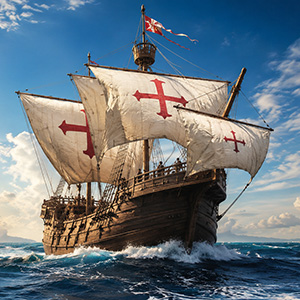
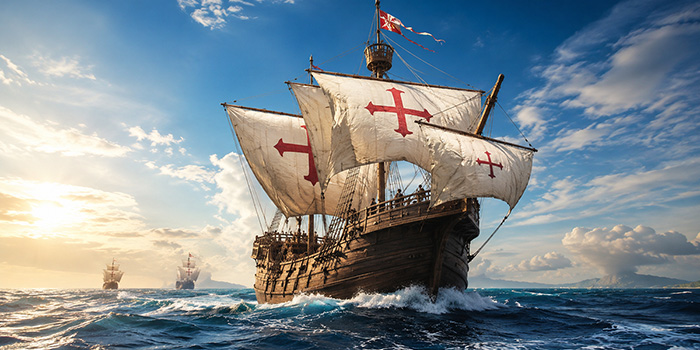
Ships also evolved. The caravel was light and manoeuvrable and could sail against the wind more effectively than many earlier vessels. Larger ships, including carracks, could carry more cargo, water, and supplies.
These journeys remained extremely dangerous. Crews faced storms, shipwrecks, hunger, disease, and conflict on board. Scurvy, caused by a lack of vitamin C, killed many sailors during long voyages.
Portugal Rounds Africa
Portugal devoted much of the 15th century to the gradual exploration of the African coast. Its navigators sought a maritime route to the Indian Ocean and Asian markets.
Bartolomeu Dias reached the southern tip of Africa in 1488. The cape was named the Cape of Good Hope because sailing around it confirmed that a route to the Indian Ocean was possible.
In 1498, Vasco da Gama reached India after rounding Africa. His expedition established a direct maritime route between Europe and Asia.
The Portuguese later built trading posts and fortresses along the coasts of Africa and Asia. They attempted to control the spice trade by imposing their military presence in the Indian Ocean. Their empire depended less on conquering vast inland territories than on controlling ports and trade routes.
Christopher Columbus and the Americas
Christopher Columbus proposed reaching Asia by sailing west across the Atlantic Ocean. He greatly underestimated the circumference of the Earth and did not know that a continent lay in his path.
Supported by the Spanish monarchs, he left the Iberian Peninsula in 1492 and reached islands in the Caribbean. Convinced that he had arrived near Asia, he called the inhabitants he encountered “Indians.”
These lands were obviously not unknown to the people who lived there. The Americas had been inhabited for thousands of years and were home to numerous, organized, and diverse societies. The word “discovery” therefore mainly reflects the European point of view.
Columbus’s voyages opened the way for a permanent Spanish presence. They were followed by conquest, the creation of colonies, and the seizure of land and resources.
Dividing the World
Spain and Portugal quickly attempted to divide their areas of expansion. The Treaty of Tordesillas, signed in 1494, established an imaginary line across the Atlantic. Lands on one side were assigned to Portugal, while those on the other were granted to Spain.
This division was made without consulting the peoples who already inhabited those territories. It nevertheless allowed Portugal to claim Brazil, while Spain established a vast empire across much of the Americas.
Other European powers did not always recognize the agreement. England, France, and the Dutch Republic launched their own expeditions and later established colonies in the Americas, Africa, and Asia.
The First Voyage Around the World
In 1519, Ferdinand Magellan left Spain at the head of an expedition seeking a western route to the Spice Islands. He passed through the strait that now bears his name and entered a vast ocean that he called the Pacific because of the calm waters encountered at the beginning of the crossing.
Magellan was killed in the Philippines in 1521. The expedition continued under the leadership of Juan Sebastián Elcano. Only one of the five original ships returned to Spain in 1522.
This voyage completed the first known circumnavigation of the globe. It demonstrated the immense size of the Earth and proved that the oceans could be linked by a continuous maritime route.
Exchanges Between Continents
Transatlantic voyages caused a vast transfer of plants, animals, people, and diseases, often called the Columbian Exchange.
Europeans introduced horses, cattle, pigs, wheat, and sugar cane to the Americas. In return, American products such as potatoes, corn, tomatoes, cocoa, and tobacco spread to other parts of the world.
These exchanges profoundly transformed agriculture and diet. Potatoes became an essential crop in several parts of Europe, while corn spread throughout Africa and Asia.
Diseases, however, had catastrophic consequences. Smallpox, measles, and other infections brought by Europeans devastated many Indigenous populations that had no immunity to them.
Conquest and Colonization
Spanish conquistadors took advantage of political divisions, alliances with certain Indigenous peoples, and the spread of disease to overthrow major empires.
Hernán Cortés participated in the conquest of the Aztec Empire, while Francisco Pizarro seized control of the Inca Empire. Europeans gradually imposed new administrations, exploited resources, and attempted to convert local populations.
Colonization led to the destruction or transformation of many Indigenous institutions, traditions, and social structures. Despite resistance, societies throughout the Americas were profoundly altered.
The Growth of the Slave Trade
The development of colonies and plantations greatly increased the demand for labour. European powers then organized the mass deportation of enslaved Africans to the Americas.
The transatlantic slave trade tore millions of people from their families and societies. Captives endured horrific conditions during the crossing and were then forced to work on plantations, in mines, or in households.
This system generated enormous profits for merchants and colonial powers. Its human, economic, and social consequences are still felt centuries later.
A New Representation of the World
Exploration gradually improved maps and geographic knowledge. Europeans developed a better understanding of the shape of the continents, the size of the oceans, and the diversity of peoples.
Travel accounts encouraged scientific curiosity, but they also reinforced prejudice and colonial ambition. Distant territories were often described through a European perspective that judged other societies according to European values.
The Age of Discovery was therefore more than a period of exploration. It marked the beginning of permanent connections between continents, the formation of global empires, and exchanges on an unprecedented scale. It broadened horizons, but it also introduced centuries of domination, exploitation, and conflict.
Quiz questions preview
-
Why did Europeans set out to reach Asia in the 15th century?
To explore unknown territories | To spread Christianity | To escape wars in Europe | To access spices and silks -
Why did Europeans seek to reach Asia by the sea in the 15th century?
To establish military alliances | To colonize new lands | To map unknown regions | To avoid overland routes -
What role did the astrolabe play in maritime exploration in the Age of Discovery?
Communicate with other ships | Determine latitude at sea | Measure ocean depth | Map unknown coasts -
Which country designed the ship known as the caravel in the 15th century?
Spain | Portugal | Holland | France -
In 1524, he was the first European to explore the Atlantic coast of North America on behalf of France.
Giovanni da Verrazzano | Jacques Cartier | John Cabot | René-Robert Cavelier de La Salle