
World War II - Lead-up to the War — Topic Guide
The Second World War did not suddenly erupt in September 1939. It was preceded by nearly twenty years of tension, economic crisis, rearmament, territorial expansion, and the gradual weakening of the international order established after 1918. The Treaty of Versailles, the rise of fascism, the ambitions of Japan and Italy, Hitler’s rise to power, and the hesitation of the Western democracies gradually created the conditions for another world war.
The Treaty of Versailles and German Resentment
Signed in 1919, the Treaty of Versailles officially ended the war between Germany and the Allied powers. It imposed major territorial losses, severe military restrictions, and substantial financial reparations on Germany. Article 231, often called the “war guilt clause,” assigned Germany and its allies responsibility for the damage caused by the war.
For much of the German population, the treaty was experienced as a humiliation. Germany lost Alsace-Lorraine to France, had to cede territory to Poland, and gave up its colonies. Its army was limited to 100,000 men, conscription was prohibited, and the Rhineland had to remain demilitarized. This dissatisfaction did not automatically lead to Nazism, but it created a sense of resentment that Adolf Hitler would later exploit.
A Europe Weakened by the Aftermath of War
The First World War left Europe profoundly weakened. Several empires had collapsed, new borders had been drawn, and new states had appeared in Central and Eastern Europe. These borders did not always correspond neatly to ethnic realities, creating numerous tensions.
The League of Nations was established to promote international cooperation and prevent future wars. From the outset, however, it suffered from major weaknesses. The United States did not join, despite President Woodrow Wilson’s role in its creation, and the organization had no real military force with which to enforce its decisions. Its effectiveness therefore depended largely on the political will of its members.
The Economic Crisis and the Rise of Extremism
The Great Depression that began in 1929 destabilized European societies. In Germany, unemployment reached catastrophic levels and weakened a Weimar Republic already marked by political instability. Moderate parties lost ground to communist and radical nationalist movements.
The National Socialist German Workers’ Party, led by Adolf Hitler, exploited the crisis with great effectiveness. It promised to restore employment, rebuild German power, overturn the Treaty of Versailles, and fight communism. Its propaganda also blamed Jews for a wide range of social and economic problems. In the elections of the early 1930s, the Nazi Party became the country’s leading political force.
Hitler Comes to Power
On January 30, 1933, President Paul von Hindenburg appointed Adolf Hitler chancellor. Several German conservatives believed they could use him while keeping his excesses under control. They completely underestimated his ability to destroy democratic institutions.
After the Reichstag fire in February 1933, civil liberties were suspended and political opponents were arrested. The Enabling Act then allowed Hitler to govern without meaningful parliamentary oversight. Within months, the other political parties were banned and Germany became a one-party dictatorship.
When Hindenburg died in 1934, Hitler combined the offices of president and chancellor and assumed the title of Führer. The Nazi regime now controlled the state, the media, education, and much of German society.
German Rearmament
From the beginning, Hitler regarded the military restrictions imposed by Versailles as unacceptable. The regime therefore quickly launched a major rearmament program. The German air force, the Luftwaffe, was developed in secret before its existence was officially announced.
In 1935, Hitler restored compulsory military service and announced a massive expansion of the army. These measures openly violated the Treaty of Versailles. France and Britain protested but took no military action to stop them.
This lack of response encouraged Hitler. He gradually concluded that the Western democracies wanted to avoid another war almost at any cost and that he might be able to reshape the European order without immediately provoking armed conflict.
Japan in Manchuria
Meanwhile, the international balance was also being threatened in Asia. Japan, an expanding industrial and military power, sought additional territory and resources. In 1931, the Japanese army occupied Manchuria, a vast region of northeastern China, and created the puppet state of Manchukuo.
The League of Nations condemned the aggression but took no action capable of forcing Tokyo to withdraw. Japan eventually left the organization in 1933. The crisis exposed the League’s inability to enforce collective security and created a precedent closely watched by other expansionist regimes.
Mussolini and the Conquest of Ethiopia
Benito Mussolini’s Fascist Italy also pursued an imperialist policy. Mussolini had ruled the country since 1922 and dreamed of building a Mediterranean and African empire capable of recalling the grandeur of ancient Rome.
In October 1935, Italy invaded Ethiopia, one of the few African states that remained independent. Italian forces possessed overwhelming military superiority and used chemical weapons among other methods. Addis Ababa fell in May 1936.
The League of Nations imposed economic sanctions on Italy, but they were too weak to halt the invasion. Britain and France were reluctant to take measures that might push Mussolini closer to Hitler. The result was the opposite of what they intended: Fascist Italy gradually moved toward closer cooperation with Nazi Germany.
The Remilitarization of the Rhineland
In March 1936, Hitler took one of the greatest risks of his early years in power by sending German troops into the Rhineland, a region that was supposed to remain demilitarized under the postwar agreements.
The German army was not yet strong enough or prepared to fight France. Hitler even issued instructions for a withdrawal if French forces intervened. Yet Paris took no military action, while London partly regarded the Germans as merely moving troops into their own territory.
The success of the operation greatly increased Hitler’s prestige and altered the strategic balance in Europe. Germany could now fortify its western frontier, and Hitler became increasingly convinced that the democracies would continue to accept faits accomplis.
The Spanish Civil War
The Spanish Civil War, which began in 1936, quickly became an arena of conflict between rival ideologies. The Nationalists led by General Francisco Franco rebelled against the Republican government and received military support from Germany and Italy. The Soviet Union supported the Republicans, while foreign volunteers fought in the International Brigades.
For Hitler, the conflict provided an opportunity to test equipment and tactics. The German Condor Legion took part in several air operations, including the bombing of Guernica in 1937, which became a symbol of violence against civilian populations.
Britain and France officially adopted a policy of non-intervention. Franco’s final victory in 1939 did not turn Spain into an active military ally of the Axis during the Second World War, but it confirmed the weakening of democratic and left-wing forces in Europe.
The Rome-Berlin Axis and the Anti-Comintern Pact
Cooperation among the dictatorships accelerated during this period. In 1936, Mussolini described relations between Rome and Berlin as an “axis” around which Europe might revolve. The expression would later give rise to the term “Axis powers.”
That same year, Germany and Japan signed the Anti-Comintern Pact, officially directed against the Communist International and, more broadly, Soviet influence. Italy joined in 1937. These agreements did not yet form the full military alliance that would exist during the war, but they showed the gradual emergence of a camp made up of revisionist and expansionist powers.
The Anschluss with Austria
Hitler had long wanted to unite Germany and Austria, the country of his birth, within a single German state. An earlier Nazi attempt to destabilize Austria had failed in 1934, partly because Mussolini then opposed German expansion toward the south.
The situation had changed four years later. In March 1938, under intense German pressure and amid growing activity by Austrian Nazis, the government in Vienna lost control of the situation. German troops entered Austria without resistance and were welcomed enthusiastically by a significant part of the population. Hitler proclaimed the Anschluss, the union of Austria with the Reich.
Once again, France and Britain did not intervene. Germany gained several million inhabitants, additional economic resources, and a stronger strategic position in Central Europe.
The Sudetenland and the Czechoslovak Crisis
After Austria, Hitler turned his attention to Czechoslovakia. Created after the First World War, the country contained a large German-speaking minority in the Sudetenland. Hitler presented himself as the defender of these populations and demanded their incorporation into the Reich.
The crisis became particularly dangerous in September 1938. Czechoslovakia possessed a substantial army, modern fortifications, and a developed arms industry. It was also allied with France. A European war appeared possible.
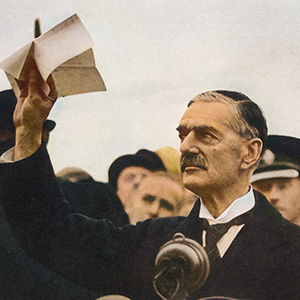
British Prime Minister Neville Chamberlain nevertheless sought to avoid conflict through negotiation. Together with France, Italy, and Germany, he took part in the Munich Conference at the end of September 1938. Czechoslovakia itself had little real say in the decision concerning its own territory.
The Munich Agreement and Appeasement
The Munich Agreement allowed Germany to annex the Sudetenland. Chamberlain returned to London claiming to have secured “peace for our time.” The agreement became the defining symbol of the policy known as “appeasement,” followed by Britain and, to a lesser extent, France.
Appeasement cannot be explained simply by weakness or naivety. Memories of the First World War remained extremely painful, public opinion was strongly pacifist, and British leaders knew that their country was not fully prepared for another major war. Some also regarded several German demands as possible corrections to the harsher aspects of the Treaty of Versailles.
Munich nevertheless represented a major victory for Hitler. Czechoslovakia lost its border defences and a significant part of its industrial resources without Germany having to fight a war.
Hitler Destroys Czechoslovakia
In March 1939, Hitler took a step that profoundly changed perceptions of his ambitions. German troops occupied Prague and the remaining Czech territories, while Slovakia became formally independent but closely tied to Germany.
This occupation could no longer be justified as an effort to unite German-speaking populations. Hitler had seized territory inhabited mainly by non-Germans. For London and Paris, it became clear that his ambitions extended far beyond revision of the Treaty of Versailles.
Britain and France gradually abandoned the policy of concessions and guaranteed the independence of Poland, which now appeared to be Germany’s next target.
The Polish Question
Hitler demanded, among other things, the return of Danzig, a largely German-speaking city under League of Nations supervision, as well as German access across the Polish Corridor separating East Prussia from the rest of the Reich.
The Polish government rejected these demands, fearing that one concession would lead to a gradual loss of sovereignty similar to what had happened to Czechoslovakia. Hitler then began preparing an invasion.
The main diplomatic uncertainty concerned the Soviet Union. Poland lay geographically between Germany and the USSR, and an alliance between Moscow and the Western powers could force Hitler to fight on several fronts.
The Nazi-Soviet Pact
On August 23, 1939, the announcement of the Nazi-Soviet Pact caused enormous surprise. Nazi Germany and the communist Soviet Union, whose ideologies appeared irreconcilable and which had denounced one another for years, signed a non-aggression treaty.
For Hitler, the agreement reduced the danger of an immediate two-front war and gave him freedom to attack Poland. For Stalin, it provided time to strengthen the Red Army while temporarily pushing the German threat farther away.
Most importantly, the treaty included a secret protocol dividing parts of Eastern Europe into German and Soviet spheres of influence. Poland was to be partitioned between them, while the Soviet Union received freedom of action in several other territories in the region.
The Invasion of Poland
On September 1, 1939, German forces invaded Poland. The attack combined armoured divisions, infantry, and air power in an effort to disrupt enemy defences and communications rapidly. Germany’s early campaigns in the war would soon become associated with the term “Blitzkrieg,” or lightning war.
This time, Britain and France refused to retreat. After issuing an ultimatum to Berlin, both countries declared war on Germany on September 3.
On September 17, in accordance with the secret arrangements reached with Hitler, the Soviet Union invaded eastern Poland. Caught between the two powers, the Polish army was defeated within weeks and the country was partitioned between Germany and the USSR.
The European war that British and French leaders had tried to avoid for years had now begun. The international system created after 1918 had collapsed under the combined weight of expansionist ambitions, the failure of collective security, and a succession of concessions that had allowed aggressive powers to alter the balance of power step by step.
Quiz questions preview
-
When was the armistice signed that ended the fighting in World War I?
November 11, 1919 | May 8, 1918 | November 11, 1918 | May 8, 1919 -
What was the German-Soviet Pact signed on August 23, 1939, in Moscow?
An arms sales contract | A non-aggression treaty | A free trade agreement | A protocol of alliance -
In what year did Adolf Hitler come to power?
1933 | 1931 | 1935 | 1929 -
He helped to transcribe and formulate Hitler's thoughts, which were dictated, to create what would become "Mein Kampf".
Albert Speer | Joseph Goebbels | Rudolf Hess | Martin Bormann -
In what year did Benito Mussolini obtain full powers and establish a Fascist dictatorship in Italy?
1922 | 1926 | 1918 | 1930

