Genesis: The Gabriel Years — Topic Guide
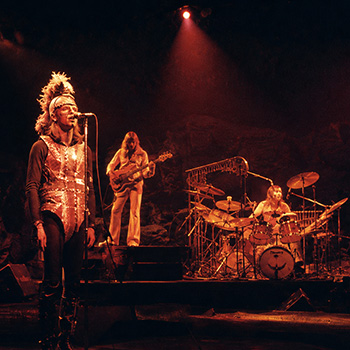
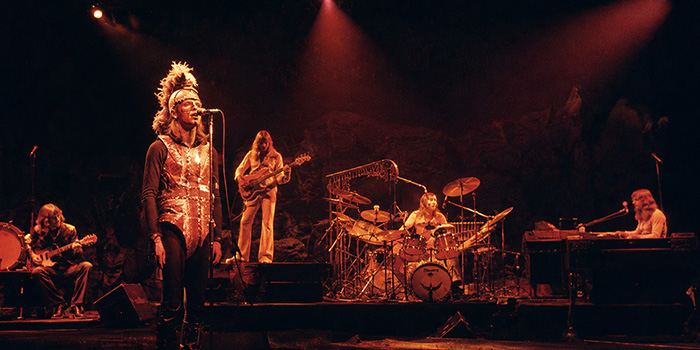
Between 1967 and 1975, Genesis evolved from a student band into one of the major forces of British progressive rock. With Peter Gabriel on vocals, Tony Banks on keyboards, Mike Rutherford on bass and guitars, and later Steve Hackett and Phil Collins, the group developed complex music built around long compositions, pastoral atmospheres, powerful passages, and unusual narratives. On stage, Gabriel’s costumes and characters soon added a theatrical dimension that became central to the group’s identity.
The Beginnings at Charterhouse
Genesis was formed in 1967 by young musicians attending Charterhouse, a prestigious English school. Peter Gabriel, Tony Banks, Mike Rutherford, and Anthony Phillips had played in different student groups before they began writing music together. Their initial goal was not necessarily to become a performing band; they saw themselves mainly as songwriters who might provide material for other artists.
Producer Jonathan King, himself a former Charterhouse student, became interested in their early demos and suggested the name Genesis. Under his direction, they recorded From Genesis to Revelation, released in 1969. The album consisted of relatively short songs to which King added string arrangements. Still strongly influenced by late-1960s pop, the music sounded very different from the style that would soon make the band famous. The record attracted little attention, and Genesis quickly parted ways with its first producer.
Trespass and the Search for an Identity
Freed from that initial commercial direction, the group began favouring longer compositions and less conventional structures. Trespass, released in 1970, truly marked the birth of the progressive Genesis sound. Acoustic guitars, organ, and Tony Banks’s Mellotron created moods that could be delicate or solemn, while the songs developed stories and musical ideas over much longer stretches.
The album culminated in The Knife, a far more aggressive piece that quickly became a concert highlight. This musical evolution, however, coincided with a major crisis: Anthony Phillips, whose guitar work and compositions had contributed greatly to the early sound, left the group. Genesis briefly considered breaking up before deciding to continue and search for new musicians.
Phil Collins and Steve Hackett
Phil Collins joined Genesis as drummer in 1970. An excellent technician, he brought greater rhythmic flexibility to the band, but he also possessed a remarkable singing voice that allowed him to strengthen the vocal harmonies. His voice was therefore part of the Genesis sound long before he became the group’s lead singer after Gabriel’s departure.
Steve Hackett completed the lineup in 1971. His approach to guitar often emphasized texture, effects, and atmosphere rather than the kind of flashy playing traditionally associated with rock. With Gabriel, Banks, Rutherford, Hackett, and Collins, the lineup later regarded as the classic formation of the band’s progressive era was now in place. It would remain intact until Peter Gabriel left.
Nursery Cryme and a Distinctive World
The first album by this lineup, Nursery Cryme, appeared in 1971 and established the identity of Genesis far more clearly. The stories became strange and sometimes macabre, while the music shifted abruptly from very gentle acoustic passages to powerful instrumental sections. The Musical Box is the clearest example: the piece tells a grotesque story involving murder, supernatural aging, and desire while moving over roughly ten minutes between delicacy and violence.
The Return of the Giant Hogweed, which imagines an invasive plant turning against humanity, reflects the group’s taste for fantasy mixed with British humour. Phil Collins also took lead vocals on the short piece For Absent Friends. Although the album did not yet make Genesis a major success in Britain, the group began building a loyal following, especially in parts of Europe such as Italy.
Peter Gabriel Creates a Stage Persona
Early Genesis concerts presented a practical problem: several songs required the musicians to change or retune their instruments. Peter Gabriel began telling stories to the audience during these pauses. What started as a way to fill silence gradually became an integral part of the show. His absurd or mysterious tales sometimes introduced the songs and helped create a world around the band that extended beyond the music itself.
Gabriel soon took the idea much further by appearing in makeup and costumes. The fox head worn with a red dress during The Musical Box became one of his first famous images. Other characters followed: the flower from Supper’s Ready, Britannia, and the old man who appears at the end of The Musical Box. Gabriel was no longer simply singing the lyrics; he was embodying the stories and turning some of the compositions into scenes of rock theatre.
This development attracted enormous attention from photographers and the press. It helped Genesis gain recognition, but it also created a lasting ambiguity. Audiences could easily assume that Gabriel was the leader or principal creative force in the group, even though the music was largely the result of collective work by Banks, Rutherford, Hackett, Collins, and Gabriel.
Foxtrot and Supper’s Ready
With Foxtrot in 1972, Genesis reached another level. The album opens with Watcher of the Skies, dominated by Tony Banks’s imposing Mellotron introduction, and ends with a work that would become emblematic: Supper’s Ready.
Running for more than twenty minutes and divided into several sections, Supper’s Ready brings together much of what defines Genesis from this period. Acoustic passages sit beside complex rhythms, humorous moments, and a tremendously powerful conclusion. The lyrics move from an almost domestic scene to fantastical and apocalyptic visions filled with religious references.
On stage, Gabriel used several visual transformations to accompany the story. The song therefore became both a musical high point of progressive rock and one of the band’s great theatrical set pieces. It perfectly illustrates Genesis’s ambition: no longer treating the song as a form limited to a few minutes, but as a space in which genuine narrative and extended instrumental development could unfold.
A Truly Collective Sound
Gabriel’s spectacular presence should not obscure the way Genesis created its music. Tony Banks played a central role in the harmonies and keyboard developments, while Mike Rutherford moved between bass and guitars and contributed significantly to the musical structures. Steve Hackett brought a highly distinctive guitar style, and Phil Collins gave the band the rhythmic power needed to navigate particularly complex changes of metre.
This combination distinguished Genesis from other major British progressive groups such as Yes, King Crimson, or Emerson, Lake & Palmer. While some bands placed greater emphasis on individual virtuosity, Genesis often focused on building atmosphere. Even long instrumental passages generally served a dramatic or narrative progression. The music could move from English pastoral moods to fantasy, humour, unease, or theatrical eruption.
Selling England by the Pound
Released in 1973, Selling England by the Pound is often regarded as one of the peaks of the Gabriel era. Its title and several of its songs reflect on an England in transition, caught between traditional heritage and modern consumer society. The band retains its taste for fantasy, but its world moves somewhat closer to contemporary concerns.
Dancing with the Moonlit Knight plays with symbols and expressions of British identity, while Firth of Fifth is distinguished by Tony Banks’s piano introduction and Steve Hackett’s long melodic guitar solo. I Know What I Like (In Your Wardrobe) gave the band its first genuine British chart success and showed that Genesis could condense its style into a more accessible song. Phil Collins again sang lead on More Fool Me.
The album also marked a period in which Genesis began reaching a much wider audience without abandoning the complexity that had defined it. The band toured more extensively, and its shows became increasingly elaborate. Gabriel’s growing fame as a stage personality, however, strengthened the impression that he occupied a separate place within a group that still functioned creatively as a collective.
The Lamb Lies Down on Broadway
In 1974, Genesis undertook its most ambitious project with The Lamb Lies Down on Broadway, a double album built entirely around a single story. The central character, Rael, is a young Puerto Rican living in New York who is drawn into a mysterious world and passes through a succession of trials while searching for his brother John.
The setting represented a major break from the British, mythological, or pastoral references of earlier records. New York, the street, sexuality, bodily transformation, and the search for identity gave the work a more urban and sometimes disturbing atmosphere. Gabriel wrote most of the story and lyrics, while the music was developed mainly by the other members with his participation.
The album includes In the Cage, Back in N.Y.C., The Carpet Crawlers, and The Colony of Slippermen. Its deliberately strange narrative is not always easy to follow, but the work pushes the idea of the album as a unified whole rather than a simple collection of songs to its furthest point.
A Tour Turned into Total Theatre
For the The Lamb Lies Down on Broadway tour, Genesis made an unusual decision: to perform the entire double album in sequence. Audiences therefore experienced a recent work rather than a concert built mainly around familiar favourites.
Gabriel portrayed Rael for most of the show, while costumes, projections, and visual effects accompanied the different stages of the character’s journey. The enormous Slipperman costume became one of the most famous images of this period. The production was technically complex and left relatively little room for improvisation because the music had to remain synchronized with the visual elements.
The tour represented the culmination of the theatrical Genesis of the Gabriel years. It also revealed the limits of a system in which the singer had to tell the story, perform the songs, and carry an increasingly elaborate stage production at the same time.
Peter Gabriel Leaves
The making of The Lamb came during a difficult period for Gabriel. He wanted greater freedom to pursue projects outside the band, while family problems also led him to reconsider his priorities. The disproportionate attention the media gave him compared with the other members further intensified an existing sense of discomfort.
Gabriel eventually decided to leave Genesis, while agreeing to complete the The Lamb Lies Down on Broadway tour. His departure became public in 1975. To much of the press and public, it seemed difficult to imagine Genesis without the man whose costumes, stories, and stage presence had come to define the group’s image.
The four remaining members nevertheless chose to continue. After considering several possible singers, they discovered that Phil Collins could take on the lead role himself. A Trick of the Tail, released in 1976, then opened a new chapter in the history of Genesis.
A Defining Period
The “Gabriel years” represent only one part of Genesis’s long career, but they established much of the band’s artistic identity. In the space of a few albums, the group evolved from tentative pop into an immediately recognizable form of progressive rock built on collective composition, long musical structures, and an exceptional sense of narrative.
Peter Gabriel gave that music a stage incarnation that remains inseparable from the period, but Foxtrot, Selling England by the Pound, and The Lamb Lies Down on Broadway also demonstrate the fundamental importance of Banks, Rutherford, Hackett, and Collins in creating the Genesis sound. It is precisely the meeting of this collective writing with Gabriel’s theatrical imagination that makes the 1967–1975 period one of the most distinctive chapters in the history of progressive rock.
Quiz questions preview
-
What is the title of Genesis' first studio album, released in 1969?
Genesis | From Genesis to Revelation | Tresspass | Nursery Cryme -
Which Paul Whitehead cover shows a fox in a red dress?
A Trick of the Tail | Trespass | Selling England by the Pound | Foxtrot -
What's the only song whose lyrics weren't written by Peter Gabriel on “The Lamb Lies Down on Broadway”?
The Light Dies Down on Broadway | In the Cage | The Colony of Slippermen | Anyway -
Complete the title: “... with the knight in the moonlight”.
Battling | Dancing | Fighting | Marching -
Where does the Genesis band come from?
Australia | United Kingdom | United States | Ireland

