Musical Instruments — Topic Guide
Musical instruments have accompanied human societies for thousands of years. They transform breath, movement, tension, or vibration into organized sound. Used to celebrate, pray, tell stories, dance, or wage war, they reflect the materials available, the traditions of a people, and the ways in which emotions are expressed.
The Origins of Instrumental Music
The earliest instruments probably developed from simple objects. Clapping hands, stones, pieces of wood, shells, or bones could produce rhythms and a variety of sounds.
Very ancient flutes made from bone show that prehistoric humans did more than simply make noise. They drilled holes in precise locations to produce different pitches.
Drums and rattles probably played an important role in early communities. They could be made from relatively accessible materials, while their volume made it possible to bring people together during ceremonies, dances, or gatherings.
The Main Families of Instruments
Instruments are often classified according to the way they produce sound. The main families are strings, winds, and percussion, to which electric and electronic instruments are now added.
In string instruments, sound comes from the vibration of one or more strings. These may be plucked, bowed, or struck. The length, thickness, and tension of a string affect the pitch.
Wind instruments use a vibrating column of air. The musician may blow directly into a tube, make a reed vibrate, or produce sound with the lips. The length of the tube and the opening or closing of holes change the notes.
Percussion instruments produce sound when they are struck, shaken, or rubbed. Some produce a definite pitch, while others are mainly used to create rhythm or sound texture.
Strings and the Control of Vibration
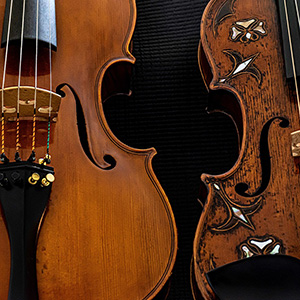
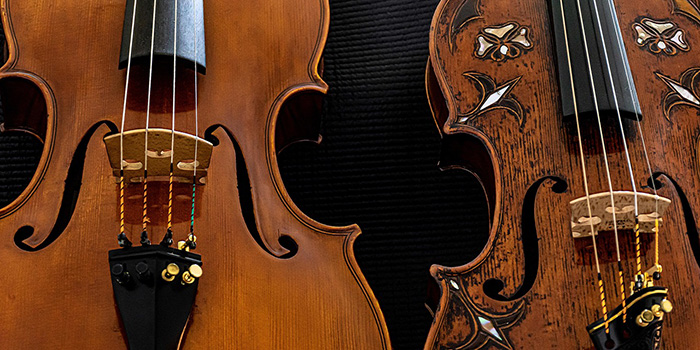
String instruments exist in a great variety of forms. Harps, lyres, lutes, violins, guitars, and zithers all rely on the same general principle, but their construction and playing techniques differ considerably.
Early strings could be made from plant fibres or animal materials. Craftspeople later used metals, followed by synthetic materials capable of producing louder or more stable sounds.
The bow made it possible to sustain the vibration of strings and produce a continuous sound. It played an essential role in the development of the violin and viol families, as well as many traditional instruments.
The piano is also a string instrument, even though it has a keyboard. When the musician presses a key, a mechanism activates a hammer that strikes a string.
Breath and Wind Instruments
Wind instruments are among the oldest musical instruments. A simple hollow tube can produce sound when air is directed against its edge. Adding holes makes it possible to change the length of the air column and play different notes.
Flutes produce sound without a reed. Clarinets, oboes, and bassoons use one or two thin reeds that vibrate when the musician blows.
Brass instruments, such as the trumpet, horn, and trombone, take their name from the material traditionally used to make them, but their sound is mainly produced by the vibration of the musician’s lips. The shape of the tube, valves, or slide makes it possible to alter the notes.
The power of wind instruments made them useful in ceremonies, armies, and long-distance communication. Trumpets, horns, and conch shells could announce an arrival, give a signal, or accompany a procession.
The Rhythm of Percussion
Percussion instruments are found in almost every culture. They may accompany dancing, support singing, mark a ceremony, or transmit messages.
Drums generally use a membrane stretched over a resonating body. Their sound depends on the size of the instrument, the tension of the skin, and the area that is struck.
Other percussion instruments rely on the vibration of the material itself. Bells, cymbals, gongs, xylophones, and castanets do not require a membrane.
Rhythm helps musicians play together and dancers coordinate their movements. In some ensembles, percussion does more than provide accompaniment: it directs the entire structure of the music.
Instruments Connected to Cultures
An instrument is more than its physical form. It may be associated with a region, religion, social class, or national identity.
Some instruments accompany prayers and sacred ceremonies. Others are connected to popular celebrations, weddings, funerals, or stories passed down orally. They may also symbolize power, as in the case of large trumpets and drums used in royal courts.
The methods used to build and play an instrument are often passed from one generation to the next. Craftspeople develop precise techniques for selecting wood, shaping metal, stretching a skin, or adjusting a reed.
This transmission does not prevent change. An instrument adopted by another culture may be modified, tuned differently, or incorporated into a new musical style.
The Movement and Evolution of Instruments
Trade, migration, and conquest encouraged instruments to spread from one region to another. Related forms can sometimes be found in areas separated by great distances.
The lute, for example, gave rise to or contributed to the development of several string instruments. Reed, bowed, and keyboard instruments also evolved through contact between different traditions.
Western orchestras gradually became organized around standardized instrument families. Their size, tuning, and construction became more consistent so that large ensembles could play together accurately.
At the same time, popular traditions preserved local instruments with distinctive sounds. Many were later incorporated into jazz, rock, film music, and contemporary works.
Electricity and Electronic Sound
In the 20th century, electric amplification transformed music. A guitar could now produce a much louder sound and be altered through effects.
Microphones, loudspeakers, and recording studios also changed the way musicians performed. A very soft sound could be amplified, layered, or modified after it was recorded.
Synthesizers do more than amplify an acoustic vibration. They generate or alter electrical signals to create an enormous range of timbres. Computers and digital instruments can now imitate existing sounds or invent entirely new ones.
These technologies did not replace traditional instruments. Instead, they joined, blended with, and extended them.
Between Technique and Expression
Learning an instrument requires precise physical skills, but technique is only a means. Two musicians may play the same notes and produce very different interpretations.
Touch, breath, intensity, rhythm, and silence give sound its personality. The instrument thus becomes an extension of the musician’s body and sensitivity.
Whether made from bone, skin, wood, metal, or electronic circuits, instruments respond to the same fundamental need: transforming sound into a form of expression capable of bringing people together, creating emotion, and passing on a culture.
Quiz questions preview
-
Which instrument, specific to European music, combines a keyboard with plucked strings?
Celesta | Vibraphone | Pianoforte | Harpsichord -
Which bellows instrument was central to Astor Piazzolla’s tango nuevo?
Double bass | Violin | Bandoneon | Piano -
Which vibrating element is attached to the mouthpiece of several wind instruments to produce sound?
Slide | Reed | Bevel | Piston -
Which people perfected the didgeridoo long before Europeans arrived on their land?
South African Zulus | Inuit of Canada | Aboriginal Australians | Maori of New Zealand -
Which 17th-century Italian luthier is famous for crafting violins of unmatched quality?
Giorgio Vasari | Giuseppe Guarneri | Jean-Baptiste Vuillaume | Antonio Stradivari