Woodstock Festival — Topic Guide
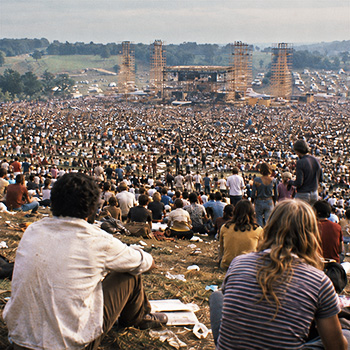
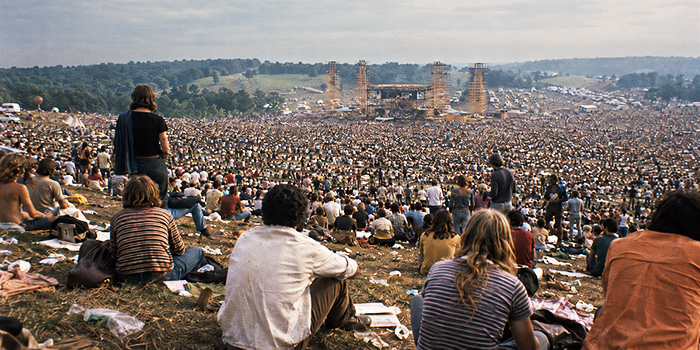
The Woodstock Festival took place from August 15 to 18, 1969, on a farm in Bethel, New York State. Conceived as a major musical gathering, it became one of the most iconic events of the 1960s counterculture. Despite an overwhelmed organization, heavy rain, enormous traffic jams, and inadequate facilities, several hundred thousand people attended performances that became legendary. Woodstock remains associated with the ideals of peace, freedom, community, and protest embraced by part of the American youth.
The Context of the 1960s
-
The United States was undergoing a period of profound social and political change.
-
The civil rights movement was fighting segregation and racial discrimination.
-
The Vietnam War was generating growing opposition, particularly among young people.
-
Student protests, feminist movements, and challenges to traditional authority were gaining strength.
-
Hippie culture promoted peace, individual freedom, communal living, and the rejection of materialism.
-
Rock music became a major form of expression for this generation.
-
Artists openly addressed war, freedom, sexuality, drugs, and social conflict.
-
Festivals such as Monterey in 1967 and the Isle of Wight in 1968 demonstrated that a large audience existed for outdoor musical gatherings.
The Creation of the Festival
-
The project was launched by four young American entrepreneurs: John Roberts, Joel Rosenman, Artie Kornfeld, and Michael Lang.
-
John Roberts and Joel Rosenman had the financial resources needed to support the venture.
-
Artie Kornfeld worked in the music industry and knew several artists and record companies.
-
Michael Lang had already helped organize the Miami Pop Festival in 1968.
-
The organizers initially wanted to create a recording studio in the Woodstock area, where several musicians lived.
-
The town of Woodstock was already known as a place frequented by artists, including Bob Dylan.
-
The project gradually evolved into the organization of a large music and arts festival.
-
The event’s official name was the Woodstock Music and Art Fair.
-
The slogan “Three Days of Peace and Music” presented the festival as three days devoted to peace and music.
Why the Festival Did Not Take Place in Woodstock
-
Despite its name, the festival did not take place in the town of Woodstock.
-
The organizers first considered a site near Woodstock, but they were unable to obtain the necessary permits.
-
They then selected an industrial property in the town of Wallkill, New York State.
-
Wallkill residents quickly opposed the festival.
-
Local authorities adopted regulations that made it impossible to hold the event there.
-
Less than a month before the festival, the organizers had to find a new location.
-
A farmer named Max Yasgur finally agreed to rent part of his farm in Bethel.
-
The property included a broad natural slope facing a lower area where the stage could be built.
-
The landscape formed a kind of natural amphitheatre capable of accommodating an enormous crowd.
-
The organizers kept the name Woodstock because it had already been used in advertisements and on tickets.
Max Yasgur and the Bethel Farm
-
Max Yasgur was a dairy farmer who owned a large farm in the region.
-
He did not necessarily share the lifestyle of the young festivalgoers, but he defended their right to gather peacefully.
-
His decision to rent his land created tensions with some local residents.
-
During the festival, he went onstage to address the crowd.
-
He congratulated the participants for showing that a very large number of young people could gather without major violence.
-
Yasgur’s farm became inseparable from the history of Woodstock.
-
The festival site is now located near the Bethel Woods Center for the Arts.
A Rushed Organization
-
The late change of location left very little time to prepare the site.
-
The organizers had to build a stage, install the sound system, and prepare access roads.
-
They also had to provide fences, ticket booths, parking areas, toilets, medical stations, and food services.
-
Several facilities were still unfinished when the first festivalgoers arrived.
-
The organizers had to choose between completing the fences and finishing the stage.
-
They gave priority to the stage so the concerts could take place.
-
The absence of complete fencing quickly made it impossible to control admission.
-
The festival, which was supposed to require paid admission, effectively became a free event.
-
This situation caused major financial losses for the promoters.
A Much Larger Crowd Than Expected
-
The organizers originally hoped to attract approximately 50,000 people.
-
Ticket sales quickly revealed that public interest was much greater.
-
Approximately 186,000 tickets were sold before the festival opened.
-
The crowd on the site is generally estimated at around 400,000 people.
-
Some estimates are higher, but it is impossible to determine the exact number.
-
Hundreds of thousands of other people gave up trying to reach the site because of the traffic jams.
-
Roads throughout the region were blocked for several kilometres.
-
Many participants abandoned their cars and continued on foot.
-
The artists themselves sometimes had difficulty reaching the stage.
-
Some musicians and equipment had to be transported by helicopter.
Living Conditions at the Site
-
The crowd greatly exceeded the capacity of the planned facilities.
-
Food and water supplies quickly became insufficient.
-
There were too few toilets to meet the needs of the audience.
-
Rain turned part of the site into an enormous field of mud.
-
Many festivalgoers slept directly on the ground, under blankets or makeshift shelters.
-
Despite the difficulties, the event remained relatively peaceful.
-
Local residents supplied food and essential products.
-
Community organizations also helped support the festivalgoers.
-
Doctors, nurses, and volunteers treated injuries, illnesses, and reactions related to drug use.
-
The United States military provided helicopters and medical assistance, even though many participants opposed the Vietnam War.
The Role of the Hog Farm
-
The Hog Farm was a hippie community led by activist and comedian Wavy Gravy.
-
The organizers asked the group to help with security and public reception.
-
The group preferred to speak of a “Please Force” rather than a police force.
-
Its members attempted to defuse conflicts through dialogue and humour.
-
They distributed free food, including meals made with rice and vegetables.
-
They also cared for festivalgoers who had taken drugs and were experiencing difficult reactions.
-
Their approach contributed to the peaceful and communal image of the festival.
The Beginning of the Festival
-
The festival was scheduled to begin on Friday, August 15, 1969, in the late afternoon.
-
Several artists scheduled to open the event were delayed by traffic.
-
Richie Havens was sent onstage earlier than planned because he was one of the few musicians available.
-
He had to extend his performance while the organizers searched for the following performers.
-
After playing much of his repertoire, he improvised a song around the word “Freedom.”
-
This performance became one of Woodstock’s most famous moments.
-
The first day was mainly devoted to folk and acoustic performers.
The Friday Performers
-
Richie Havens officially opened the festival.
-
Sweetwater performed after him with a mixture of rock, classical music, and psychedelic music.
-
Bert Sommer, Tim Hardin, and Melanie were also among the first day’s performers.
-
Arlo Guthrie performed folk songs marked by humour and social protest.
-
Joan Baez closed the evening while several months pregnant.
-
Onstage, she spoke about her husband, David Harris, who was imprisoned for refusing military service.
-
Her performance reinforced the festival’s political and pacifist dimension.
Saturday and the Rise of Rock Music
-
The second day began on Saturday, August 16, and continued throughout the night.
-
Quill, Country Joe McDonald, and Santana were among the day’s early performers.
-
Santana was still relatively unknown to the general public at the time of the festival.
-
The group’s energetic performance greatly contributed to launching its international career.
-
The band notably performed Soul Sacrifice, featuring a long solo by drummer Michael Shrieve.
-
John Sebastian performed alone, although he was not officially scheduled.
-
Keef Hartley Band, The Incredible String Band, Canned Heat, and Mountain followed.
-
Grateful Dead gave a performance disrupted by technical and electrical problems.
-
Creedence Clearwater Revival played late at night before a tired audience.
-
The group was already highly successful, but its appearance would long remain only weakly associated with the popular memory of Woodstock.
Janis Joplin
-
Janis Joplin performed with the Kozmic Blues Band during the night from Saturday to Sunday.
-
She was already one of the most famous singers in American rock music.
-
Her powerful, raspy voice embodied the blues rock of the late 1960s.
-
She performed songs including Piece of My Heart and Ball and Chain.
-
Joplin later expressed dissatisfaction with her performance.
-
Several excerpts from her concert were omitted from the original film about the festival.
-
Her appearance nevertheless remains one of the symbols of the major rock stars who performed at Woodstock.
Sly and the Family Stone
-
Sly and the Family Stone took the stage in the middle of the night.
-
The group included Black and white musicians, as well as men and women, which was still unusual at the time.
-
Its music combined rock, soul, funk, and rhythm and blues.
-
The group transformed its concert into a large collective participation.
-
The crowd joined the band in chants and refrains.
-
The performance is often considered one of the most energetic of the festival.
-
It helped strengthen the group’s reputation.
The Who
-
The British band The Who performed early on Sunday morning.
-
It presented a large portion of its rock opera Tommy.
-
The performance was marked by the energy of Roger Daltrey, Pete Townshend, John Entwistle, and Keith Moon.
-
Political activist Abbie Hoffman briefly interrupted the concert to speak about imprisoned activist John Sinclair.
-
Pete Townshend quickly forced him off the stage.
-
As the group played, the sun began to rise.
-
The performance of See Me, Feel Me at sunrise became one of the festival’s defining images.
Jefferson Airplane
-
Jefferson Airplane was supposed to play during the night, but delays pushed its performance to Sunday morning.
-
Singer Grace Slick introduced the concert as music for people who had not yet gone to sleep.
-
The group was one of the major figures of San Francisco psychedelic rock.
-
It performed songs including Somebody to Love and White Rabbit.
-
Its performance closed a long sequence of concerts that had begun the previous day.
Sunday and the Delays
-
Rain and technical difficulties continued to disrupt the schedule.
-
Joe Cocker opened the main Sunday program.
-
His intense version of the Beatles song With a Little Help from My Friends became one of the festival’s greatest moments.
-
Shortly after his concert, a violent thunderstorm forced the organizers to suspend the performances.
-
Country Joe and the Fish resumed the program afterward.
-
Ten Years After impressed the audience with a fast performance of I’m Going Home.
-
The Band, a group associated with Bob Dylan, also performed at the festival.
-
Johnny Winter, Blood, Sweat & Tears, and Crosby, Stills, Nash & Young performed during the night.
Crosby, Stills, Nash & Young
-
Woodstock was one of the first public appearances by Crosby, Stills, Nash & Young.
-
The group brought together David Crosby, Stephen Stills, Graham Nash, and Neil Young.
-
The musicians were already known for their previous careers, but the group itself was new.
-
Stephen Stills admitted onstage that they were extremely nervous.
-
The concert included both an acoustic section and an electric section.
-
Neil Young generally refused to be filmed during his electric performance.
-
The appearance helped establish the group as one of the important musical acts of its era.
Jimi Hendrix and the End of the Festival
-
Jimi Hendrix was the festival’s main advertised star.
-
He was scheduled to perform on Sunday evening, but delays pushed his concert to Monday morning, August 18.
-
Much of the audience had already left the site when he took the stage.
-
He performed before several tens of thousands of people, only a fraction of the weekend’s crowd.
-
Hendrix was accompanied by a new group called Gypsy Sun and Rainbows.
-
His performance lasted approximately two hours.
-
He performed a transformed version of the American national anthem, The Star-Spangled Banner.
-
His guitar imitated sounds that could evoke explosions, sirens, and the chaos of war.
-
The performance is often interpreted as a criticism or evocation of the Vietnam War.
-
Hendrix ended the festival with an instrumental version of Hey Joe.
The Artists Who Did Not Attend
-
Several important artists of the period did not participate in Woodstock.
-
Bob Dylan lived near the town of Woodstock, but he did not perform at the festival.
-
He instead chose to participate in the Isle of Wight Festival, held shortly afterward in England.
-
The Beatles no longer gave public concerts and did not take part in the event.
-
The Rolling Stones were also absent.
-
Led Zeppelin declined the invitation because its management preferred not to have the group included in such a large program.
-
The Doors also turned down the offer.
-
Joni Mitchell was scheduled to participate, but her management feared she would become trapped in traffic before an important television appearance.
-
She later wrote the song Woodstock based on accounts from her partner Graham Nash and images shown in the media.
The Music and Diversity of the Program
-
The program included more than thirty artists and groups.
-
It featured folk, blues, rock, psychedelic rock, soul, funk, and jazz rock.
-
Several performers were already famous, while others used Woodstock as a springboard.
-
The festival reflected a period when the boundaries between musical genres were especially open.
-
It featured both Black and white artists, although the lineup remained predominantly white.
-
Performances were frequently extended because of the many delays.
-
Technical problems, fatigue, and weather conditions made the quality of the concerts uneven.
-
Some performances considered disappointing at the time received little attention in the official memory of the festival.
Deaths and Births
-
Despite the size of the crowd and the difficult conditions, the number of deaths remained limited.
-
Three deaths are generally associated with the festival.
-
One participant died after being accidentally run over by a tractor while sleeping in a field.
-
Other deaths were related to a fall and drug use.
-
Thousands of people received treatment for minor injuries, illnesses, or reactions to drugs.
-
Stories claiming that several babies were born directly on the site have not been clearly confirmed.
-
Pregnant women were, however, transported to hospitals during the event.
Drug Use
-
Marijuana and psychedelic drug use were widespread during the festival.
-
The organizers and members of the Hog Farm issued warnings when dangerous substances circulated through the crowd.
-
A famous announcement warned participants about poor-quality “brown acid.”
-
Drug-related medical interventions were numerous but did not cause general panic.
-
The presence of drugs contributed to Woodstock’s libertarian image.
-
It also fuelled criticism from those who saw the festival as a symbol of moral disorder.
The Documentary Film
-
The documentary Woodstock, directed by Michael Wadleigh, was released in 1970.
-
The film showed the concerts, the crowd, the traffic jams, living conditions, and the work of the organizers.
-
It frequently used split screens to show several images at once.
-
The young filmmaker Martin Scorsese participated in editing the film.
-
The documentary won the Academy Award for Best Documentary Feature.
-
Its enormous success played an essential role in creating the Woodstock legend.
-
Millions of people who had not attended the festival discovered the event through the film.
-
The documentary highlighted certain performances while almost completely omitting others.
-
The collective memory of Woodstock therefore depends greatly on the choices made during the editing process.
The Festival Album
-
Several albums were produced from recordings made at the festival.
-
The first official album was released in 1970.
-
It included songs, announcements made from the stage, and sounds from the crowd.
-
Record sales helped reduce the organizers’ financial losses.
-
Other albums and expanded editions were released later.
-
The recordings made it possible to discover performances absent from the original documentary.
-
Woodstock thus became a musical event that was constantly rereleased and reinterpreted.
A Financial Disaster That Became a Cultural Success
-
The festival cost much more than expected.
-
The fact that admission became effectively free deprived the organizers of much of their anticipated revenue.
-
Expenses related to the artists, facilities, security, and emergency services accumulated.
-
The organizers ended the event heavily in debt.
-
The success of the film, albums, and related products eventually allowed them to recover part of their losses.
-
Woodstock became much more profitable as a cultural symbol than as an event held on the site.
The Birth of a Legend
-
Woodstock was quickly presented as proof that an enormous crowd could live together peacefully.
-
The expression “Woodstock Nation” described a generation associated with peace, music, and the rejection of traditional values.
-
The reality of the festival was more complicated than its idealized image.
-
Participants endured hunger, rain, lack of sleep, and poor sanitary conditions.
-
Many local residents were unhappy about the damage, traffic congestion, and disorder.
-
Not all the musical performances were exceptional.
-
The documentary and photographs mainly preserved the most spectacular and positive moments.
-
The Woodstock legend therefore rests as much on collective memory as on the event itself.
Woodstock and the Vietnam War
-
The Vietnam War formed an essential backdrop to the festival.
-
Several artists and participants expressed their opposition to the conflict.
-
Country Joe McDonald led the crowd in a chant openly hostile to the war.
-
Joan Baez spoke about her husband’s imprisonment for refusing military service.
-
Jimi Hendrix’s performance of the American national anthem is often associated with the violence of the war.
-
The festival was not, however, a political demonstration organized around a specific program.
-
Its pacifism was expressed mainly through songs, speeches, and the general behaviour of the crowd.
The Site After the Festival
-
The grounds were covered with mud, garbage, abandoned tents, and immobilized vehicles.
-
Cleaning the site required considerable work.
-
Max Yasgur had to restore his farm after the festivalgoers departed.
-
He sold the property a few years later.
-
The site gradually became a place of remembrance.
-
Monuments and commemorative plaques recall the event.
-
The Bethel Woods Center for the Arts opened nearby in 2006.
-
It includes a performance venue and a museum devoted to Woodstock and the 1960s.
The Legacy of Woodstock
-
Woodstock remains one of the most famous music festivals in history.
-
It symbolizes the height of hippie culture and the American counterculture.
-
It helped establish the large outdoor festival as a major form of musical presentation.
-
It demonstrated the economic and cultural importance of young audiences.
-
Its images continue to influence the representation of festivals, youth, and protest movements.
-
The festival is constantly referenced in films, books, songs, advertisements, and exhibitions.
-
Its name has become synonymous with an enormous musical gathering, freedom, and collective idealism.
-
Woodstock also represents the contradictions of its era: pacifism and war, community and commerce, freedom and disorder, idealism and material reality.
Quiz questions preview
-
This band didn't play at Woodstock.
Crosby, Stills, Nash and Young | The Who | Free | Grateful Dead -
He is the only artist to have presented two concerts at the festival.
Joe Cocker | Johnny Winter | Arlo Guthrie | Country Joe McDonald -
It was only the second time this group had performed together when they gave their concert at Woodstock.
The Incredible String Band | Canned Heat | Santana | Crosby, Stills, Nash and Young -
Who performed "Somebody to Love" at the festival?
The Byrds | Jefferson Airplane | Janis Joplin | Jerry Garcia -
Who played "Voodoo Child (Slight Return)" during the festival?
Santana | Neil Young | Aerosmith | Jimi Hendrix

