Climate and Weather — Topic Guide
Weather describes atmospheric conditions observed over the short term, while climate refers to trends established over several decades. Temperature, precipitation, winds, and pressure directly influence our daily lives. Studying them helps forecast the weather, understand the world’s regions, and measure the changes currently affecting the planet.
The Difference Between Weather and Climate
Weather refers to the state of the atmosphere in a specific place over a short period. It can change within a few hours or from one day to the next. It includes temperature, precipitation, wind, humidity, atmospheric pressure, and cloud cover.
Climate instead refers to the average weather conditions of a region over a long period, generally several decades. It includes averages, but also normal variations and extreme events.
A cold day therefore does not prove that the climate is cooling. Similarly, one very hot day is not enough to demonstrate climate change. Climatologists study long sets of data to distinguish temporary fluctuations from lasting trends.
Earth’s Atmosphere
The atmosphere is the layer of gases surrounding Earth. It protects life, retains some heat, and allows clouds, winds, and precipitation to form.
Most weather phenomena occur in the troposphere, the lowest layer of the atmosphere. It contains most of the air and nearly all atmospheric water vapour.
The atmosphere is composed mainly of nitrogen and oxygen. It also contains argon, carbon dioxide, water vapour, and other gases in smaller amounts.
Temperature and Pressure
Air temperature mainly depends on the energy received from the Sun. It also varies according to the time of day, season, latitude, altitude, and type of surface.
The Sun first heats Earth’s surface, which then warms the air above it. Oceans warm and cool more slowly than continents. Coastal regions therefore often experience more moderate temperatures.
Atmospheric pressure is the force exerted by the weight of the air. A high-pressure area, known as an anticyclone, is often associated with stable weather. A low-pressure area, known as a depression, is more likely to produce clouds and precipitation.
Temperature is measured with a thermometer, while pressure is measured with a barometer.
Winds
Wind is the movement of air caused mainly by differences in pressure. Air moves from areas of high pressure toward areas of low pressure.
Earth’s rotation deflects air movements and helps organize the major prevailing winds.
Winds can occur on different scales:
-
Sea and land breezes result from temperature differences between land and water.
-
Prevailing winds transport air masses over great distances.
-
Jet streams are fast-moving winds high in the atmosphere.
-
Gusts are sudden and temporary increases in wind speed.
Wind speed is measured with an anemometer, while its direction is shown by a weather vane.
Humidity, Clouds, and Precipitation
Humidity refers to the amount of water vapour in the air. When the air cools sufficiently, this vapour condenses into droplets or ice crystals.
Clouds form when moist air rises, cools, and reaches saturation. Their shape and altitude provide clues about changing weather conditions.
The main cloud types include:
-
Cirrus clouds, which are thin and high.
-
Cumulus clouds, which are puffy and often associated with fair weather when they remain small.
-
Stratus clouds, which form low, uniform layers.
-
Cumulonimbus clouds, which are large storm clouds.
Precipitation occurs when droplets or crystals become heavy enough to fall. Depending on temperature and atmospheric conditions, it may take the form of rain, snow, drizzle, ice pellets, freezing rain, or hail.
Air Masses and Fronts
An air mass is a large portion of the atmosphere with relatively uniform temperature and humidity.
When an air mass moves, it carries its properties into other regions. A front is the boundary where two different air masses meet.
A cold front forms when a mass of cold air pushes warmer air aside. It may cause intense showers, thunderstorms, and a rapid drop in temperature.
A warm front forms when warm air moves above a colder air mass. It often produces widespread clouds and more continuous precipitation.
Thunderstorms and Tornadoes
A thunderstorm develops when warm, moist air rises rapidly through an unstable atmosphere. It forms a cumulonimbus cloud that may reach a very high altitude.
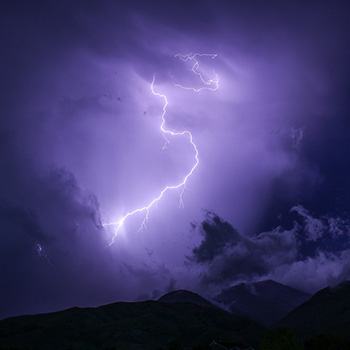
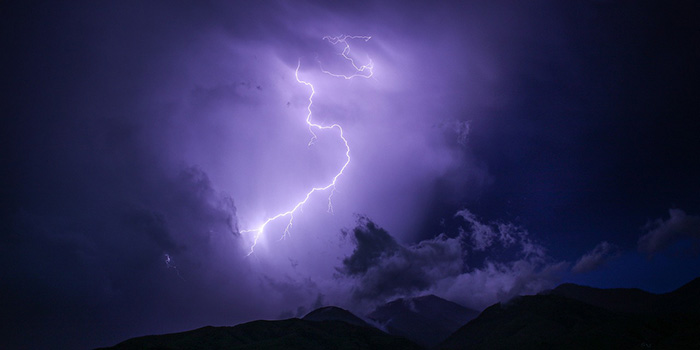
Lightning consists of electrical discharges within clouds or between a cloud and the ground. The heat from lightning suddenly expands the air and produces thunder.
Thunderstorms may bring heavy rain, hail, strong gusts, flash floods, and sometimes tornadoes.
A tornado is a rotating column of air extending from a storm cloud to the ground. It can produce extremely violent winds over a narrow area. Its intensity is assessed from the damage it causes.
Tropical Cyclones
Tropical cyclones are vast storms that form over warm ocean waters. They are called hurricanes in the North Atlantic, typhoons in the northwestern Pacific, and cyclones in other regions.
They draw their energy from the ocean’s heat and moisture. The most powerful storms have a relatively calm eye surrounded by an eyewall, where the strongest winds and heaviest precipitation are concentrated.
Their main dangers include violent winds, heavy rain, flooding, landslides, and storm surges that raise sea levels near coastlines.
Extreme Weather Events
Extreme events are rare or unusually intense compared with the normal conditions of a region.
They include:
-
Heatwaves and cold waves.
-
Droughts.
-
Torrential rain.
-
Floods.
-
Snowstorms and ice storms.
-
Sandstorms.
-
Wildfires encouraged by heat, drought, and wind.
The danger depends as much on the vulnerability of populations as on the intensity of the event. A well-prepared region can reduce losses through warning systems, strong infrastructure, and emergency plans.
Weather Observation and Forecasting
Meteorologists collect data at ground level, in the atmosphere, over the oceans, and from space.
They use:
-
Thermometers to measure temperature.
-
Barometers to measure pressure.
-
Anemometers to measure wind speed.
-
Rain gauges to measure precipitation.
-
Weather balloons to observe the upper atmosphere.
-
Radar to track rain and storms.
-
Satellites to observe clouds and weather systems.
Forecasts rely on numerical models that simulate changes in the atmosphere. Short-term forecasts are generally more reliable than those covering several days because small errors can grow over time.
The Main Climate Zones
The world’s climates can be grouped into broad categories.
The main types are:
-
Tropical climates, which remain warm throughout the year.
-
Dry climates, where precipitation is limited.
-
Temperate climates, which have variable seasons.
-
Continental climates, which experience large temperature differences.
-
Polar climates, where temperatures remain very low.
-
Mountain climates, which are influenced by elevation and relief.
Each category includes several variations. A tropical climate may remain wet throughout the year or have a distinct dry season. A temperate climate may be oceanic, Mediterranean, or continental.
Factors That Influence Climate
A region’s climate depends on several factors.
Latitude determines the angle at which sunlight reaches the surface. Regions near the equator generally receive more energy than polar regions.
Higher elevations usually have lower temperatures. Relief also influences winds and precipitation. A mountain range can block moist air and create a drier region on its opposite side.
Proximity to oceans often moderates temperatures. Ocean currents transport heat or cold and influence the climates of coastal regions.
Prevailing winds, vegetation, snow cover, and soil type also play a role.
The Seasons
The seasons are mainly caused by the tilt of Earth’s axis as the planet travels around the Sun.
When the Northern Hemisphere is tilted toward the Sun, it receives more direct sunlight and experiences summer. At the same time, the Southern Hemisphere experiences winter. Six months later, the situation is reversed.
The seasons are therefore not caused by the distance between Earth and the Sun.
Near the equator, temperatures vary less throughout the year. Seasons there are often defined more by rainfall than by temperature.
Natural Climate Variations
Earth’s climate has always experienced natural variations. Volcanic eruptions, changes in solar activity, and slow shifts in Earth’s orbit can influence temperatures.
The oceans also produce natural cycles. El Niño is a periodic warming of part of the equatorial Pacific Ocean. It changes rainfall, winds, and temperatures in many regions.
La Niña generally represents a cooler phase of the same system. These phenomena last for several months or a few years and are distinct from climate trends measured over several decades.
Climate Change
The global climate is warming mainly because of the increase in greenhouse gases produced by human activities.
Carbon dioxide comes largely from burning coal, oil, and natural gas. Methane is released by agriculture, waste, and fossil fuel extraction, among other sources.
These gases trap some of the heat that would otherwise leave Earth. The greenhouse effect is a natural process essential to life, but strengthening it causes additional warming.
Observed changes include:
-
Rising average temperatures.
-
More intense heatwaves.
-
Melting glaciers.
-
Rising sea levels.
-
Changes in precipitation.
-
More severe droughts in some regions.
-
An increase in certain forms of extreme rainfall.
-
Changes in ecosystems.
Not every weather event is directly caused by climate change. Warming can, however, alter an event’s probability, duration, or intensity.
Adapting to Change
Climate change affects agriculture, health, water resources, infrastructure, and natural environments.
Adaptation involves reducing risks and preparing societies for changes that are already occurring or expected.
It may include:
-
Creating warning systems.
-
Improving urban drainage.
-
Protecting coastlines.
-
Planting trees in cities.
-
Adapting agricultural crops.
-
Building more resilient infrastructure.
Reducing greenhouse gas emissions instead aims to limit the future scale of warming. Both approaches are complementary.
Quiz questions preview
-
What impact do heatwaves have on forests?
Forest fires increase | Tree growth acceleration | Lower CO2 levels in the air | Humidity increases -
Is it true that lightning never strikes the same place twice?
Yes | It depends on the type of storm | It depends on the region | No -
Can the outside temperature be determined by counting the seconds between lightning and thunder?
Yes | Only in winter | Only at altitude | No -
Which ocean is statistically the most active for the formation of tropical cyclones?
Pacific Ocean | Indian Ocean | Arctic Ocean | Atlantic Ocean -
Which forest is particularly at risk from drought and fires linked to global warming?
Taïga | Amazonia | Black Forest | European temperate forests

