Popes and the Papacy — Topic Guide
Since the earliest centuries of Christianity, the bishop of Rome has held a special place within the Catholic Church. Regarded as the successor of the apostle Peter, the pope exercises religious authority over Catholics throughout the world. Over the course of history, however, the papacy has extended far beyond the strictly spiritual sphere: it has governed territories, confronted rulers, endured crises, initiated reforms and played a role in the major political and social upheavals of its time.
The Origins of the Papacy
-
The word “pope” comes from the Greek pappas, an affectionate term meaning “father.”
-
During the earliest centuries of Christianity, the title of pope could be given to several bishops before gradually becoming reserved for the bishop of Rome in the West.
-
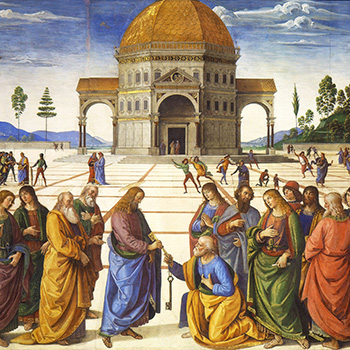
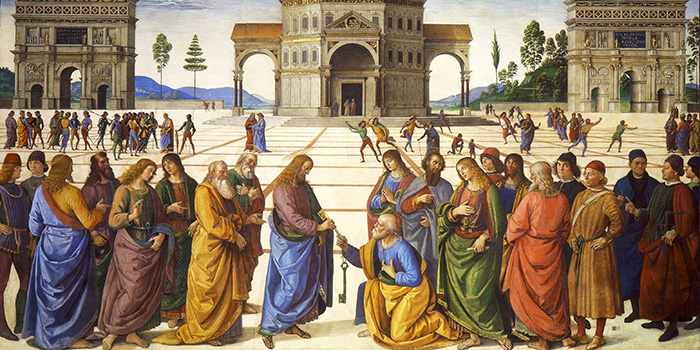
Catholic tradition regards the apostle Peter as the first bishop of Rome and, consequently, as the first pope.
-
According to the Gospels, Jesus entrusted Peter with a special responsibility among his disciples by declaring that he would build his Church upon this “rock.”
-
The first popes carried out their ministry in a Roman Empire where Christians were periodically persecuted.
-
Several of the earliest bishops of Rome are traditionally regarded as martyrs, although historical information about them is sometimes limited.
-
After Christianity was legalized by Emperor Constantine in the fourth century, the bishop of Rome gained increasing influence.
-
The fall of the Western Roman Empire in the fifth century also allowed the popes to assume greater political and administrative responsibilities.
The Pope’s Role and Powers
-
The pope is the bishop of Rome and the leader of the Catholic Church.
-
He is also known as the supreme pontiff, the Roman pontiff or the Holy Father.
-
His authority is exercised mainly in matters of doctrine, Church discipline, the appointment of bishops and the government of the Holy See.
-
The pope may publish different types of documents, including encyclicals, apostolic letters, exhortations and apostolic constitutions.
-
An encyclical is generally a formal letter addressing an important doctrinal, moral or social issue.
-
The dogma of papal infallibility does not mean that the pope can never make a mistake.
-
Infallibility applies only to certain solemn declarations concerning faith or morals when the pope speaks officially on behalf of the entire Church.
-
This doctrine was defined in 1870 during the First Vatican Council.
-
The pope traditionally wears a ring called the “Fisherman’s Ring,” in reference to the occupation of the apostle Peter.
-
After the death or resignation of a pope, his ring is officially invalidated to prevent new documents from being authenticated in his name.
The Election of the Pope
-
The pope is elected by the cardinals gathered in a conclave.
-
The word “conclave” comes from the Latin cum clave, meaning “with a key,” because the electors were once locked away until they succeeded in choosing a pope.
-
Only cardinals who have not reached the age limit established by Church rules may participate in the vote.
-
In principle, any baptized Catholic man could be elected pope, but in modern practice, the person chosen is a cardinal.
-
Voting takes place in the Sistine Chapel at the Vatican.
-
A two-thirds majority is normally required to elect the new pope.
-
After each round of voting, the ballots are burned.
-
Black smoke indicates that no candidate has been elected, while white smoke announces the election of a new pope.
-
When the elected candidate accepts the position, he chooses a papal name.
-
The new pope then appears on the central balcony of St. Peter’s Basilica, where he is introduced with the Latin words Habemus Papam, meaning “We have a pope.”
-
The chosen name may honour a predecessor or a saint, or reflect a particular direction that the new pontiff wishes to give to his ministry.
The Papacy in the Middle Ages
-
During the Middle Ages, the popes became both religious leaders and temporal rulers.
-
The Papal States consisted of a group of territories in central Italy governed directly by the pope.
-
Their origin is traditionally associated with the Donation of Pepin in the eighth century, when the Frankish king Pepin the Short transferred several Italian territories to the papacy.
-
The coronation of Charlemagne as emperor by Pope Leo III in the year 800 strengthened the ties between the papacy and imperial power.
-
Relations between popes and rulers were often contentious, particularly when determining who had the right to appoint bishops.
-
The Investiture Controversy placed the papacy in conflict with the Holy Roman Empire during the eleventh and twelfth centuries.
-
Pope Gregory VII confronted Emperor Henry IV and excommunicated him during the crisis.
-
Henry IV was forced to travel to Canossa in 1077 to request that his excommunication be lifted.
-
The popes also played a major role in organizing and preaching the Crusades.
-
In 1095, Pope Urban II issued a call for the First Crusade at the Council of Clermont.
-
In the thirteenth century, Pope Innocent III embodied one of the high points of the papacy’s political and religious power.
Avignon and the Western Schism
-
From 1309 to 1377, the popes resided mainly in Avignon rather than in Rome.
-
This period is known as the Avignon Papacy.
-
The presence of the popes in French territory led to criticism concerning the influence of the French monarchy over the Church.
-
Pope Gregory XI returned the papacy to Rome in 1377.
-
After his death, the disputed election of his successor caused the Western Schism.
-
Between 1378 and 1417, several men simultaneously claimed the title of pope, with some based in Rome and others in Avignon.
-
At one point, three different claimants each maintained that he was the legitimate pope.
-
The Council of Constance ended the crisis by facilitating the election of Martin V in 1417.
-
The schism considerably weakened the prestige of the papacy in Europe.
The Renaissance Popes
-
During the Renaissance, several popes became important patrons of art and architecture.
-
They helped transform Rome into one of Europe’s leading artistic centres.
-
Construction of the new St. Peter’s Basilica began during the pontificate of Julius II in the early sixteenth century.
-
Michelangelo painted the ceiling of the Sistine Chapel at the request of Julius II.
-
Raphael also worked at the Vatican and created several frescoes in the papal apartments.
-
Some Renaissance popes were nevertheless criticized for their taste for luxury, their participation in the Italian Wars or the favouritism they showed toward members of their families.
-
The word “nepotism” comes from the Italian term nepote, meaning “nephew,” and refers to the practice of some popes who entrusted important positions to their relatives.
-
Alexander VI, a member of the Borgia family, remains one of the most controversial popes of this period.
-
The financing of major religious projects, particularly through the sale of indulgences, contributed to the discontent that led to the Protestant Reformation.
The Reformation and Counter-Reformation
-
In 1517, Martin Luther publicly challenged certain practices of the Catholic Church, particularly the sale of indulgences.
-
His movement caused a lasting division within Western Christianity and led to the creation of several Protestant churches.
-
Pope Leo X condemned Luther’s positions, and Luther was excommunicated in 1521.
-
The Catholic Church responded to the Protestant Reformation with a broad movement of renewal known as the Catholic Reformation or Counter-Reformation.
-
The Council of Trent, held in several sessions between 1545 and 1563, clarified Catholic doctrine and reformed the education and discipline of the clergy.
-
The popes also supported new religious orders, including the Society of Jesus, founded by Ignatius of Loyola.
-
The Gregorian calendar was introduced by Pope Gregory XIII in 1582 to correct inaccuracies in the Julian calendar.
The End of the Papal States and the Creation of the Vatican
-
Beginning with the French Revolution, the territorial power of the popes was seriously challenged.
-
Napoleon Bonaparte had Pope Pius VII arrested after a conflict concerning political and religious authority.
-
During the nineteenth century, the movement for Italian unification gradually reduced the territory of the Papal States.
-
In 1870, troops from the Kingdom of Italy seized Rome, bringing the Papal States to an end.
-
For several decades, the popes refused to officially recognize Italian rule over Rome.
-
This situation, known as the “Roman Question,” was resolved in 1929 by the Lateran Treaties.
-
The agreements were concluded between the Holy See and the Italian government led by Benito Mussolini.
-
They created Vatican City State, an independent territory under the sovereignty of the pope.
-
The Vatican is the smallest independent state in the world by area.
-
The Vatican should not be confused with the Holy See: the Vatican is a territory, while the Holy See represents the central authority of the Catholic Church.
The Popes and the Modern World
-
During the twentieth century, the papacy had to respond to world wars, totalitarian regimes, decolonization, the rise of communism and major social transformations.
-
Benedict XV attempted to promote peace during the First World War.
-
Pius XI condemned various aspects of fascism, Nazism and communism in several papal documents.
-
The conduct of Pius XII during the Second World War remains a subject of debate, particularly regarding his public response to the persecution of the Jews.
-
John XXIII convened the Second Vatican Council, which opened in 1962.
-
Vatican II sought to adapt the presentation and certain practices of the Church to the realities of the modern world.
-
It notably encouraged the use of ordinary languages in the liturgy instead of Latin.
-
Paul VI continued and concluded the council after the death of John XXIII.
-
The year 1978 was called the “year of three popes” because of the successive pontificates of Paul VI, John Paul I and John Paul II.
-
John Paul I died after only thirty-three days as pope.
-
John Paul II was the first non-Italian pope elected since the sixteenth century.
-
A native of Poland, he played an important moral and diplomatic role in the opposition to communism in Eastern Europe.
-
John Paul II was seriously wounded in an assassination attempt in St. Peter’s Square in 1981.
-
He survived the attack and later met his assailant in prison.
-
International travel became a major feature of the modern papacy.
-
Modern popes also use radio, television, the Internet and social media to communicate with the faithful.
Papal Symbols and Traditions
-
The papal tiara, a crown composed of three tiers, was used for many years during papal coronations.
-
Paul VI was the last pope to formally wear the tiara, which was subsequently abandoned.
-
The mitre is the liturgical headdress worn by the pope and bishops during certain ceremonies.
-
The papal staff often takes the form of a cross rather than the curved crozier normally used by bishops.
-
The white cassock has become the pope’s characteristic garment.
-
The Pontifical Swiss Guard protects the pope and watches over certain entrances to the Vatican.
-
Founded in the early sixteenth century, it traditionally recruits Swiss Catholic citizens who have received military training.
-
The crossed keys featured on papal coats of arms symbolize the keys to the kingdom of heaven entrusted to the apostle Peter.
-
One key is generally represented in gold and the other in silver, symbolizing spiritual and temporal powers.
-
The coat of arms of Vatican City also includes the papal tiara.
Resignations and Succession
-
A pontificate normally ends with the pope’s death, but a pope may also freely resign from office.
-
A papal resignation becomes valid as soon as it is clearly expressed, without requiring acceptance by another authority.
-
In 1294, Celestine V resigned from the papacy after only a few months.
-
Gregory XII resigned in 1415 to help bring the Western Schism to an end.
-
In 2013, Benedict XVI became the first pope in nearly six centuries to voluntarily resign from office.
-
He cited his declining physical and mental strength as the reason for his decision.
-
After a resignation or death, the period during which the papal office is vacant is known as sede vacante.
-
During this period, the College of Cardinals manages ordinary affairs but cannot exercise all the powers reserved for the pope.
The Challenges of the Modern Papacy
-
The papacy must preserve the doctrines and traditions of the Church while responding to the rapid transformation of modern societies.
-
Debates concern such issues as the role of women, priestly celibacy, sexual morality, the family and the treatment of marginalized people.
-
Scandals involving sexual abuse committed by members of the clergy have seriously damaged public trust in the institution.
-
Modern popes have had to strengthen mechanisms for prevention, reporting and punishment, although considerable criticism remains.
-
The decline of religious practice in several Western countries contrasts with the growth of Catholicism in certain regions of Africa and Asia.
-
Relations with other Christian denominations and other religions occupy an increasingly important place in papal diplomacy.
-
The pope also regularly participates in international discussions concerning war, poverty, migration, environmental protection and human dignity.
-
Despite the loss of its former territorial power, the papacy remains an influential religious and diplomatic institution throughout the world.
Quiz questions preview
-
How do we know that a new pope has been elected?
By ringing of city bells | By a black smoke | By a fanfare | By a white smoke -
Which pope succeeded John Paul I in 1978?
Benedict XV | John XXIV | John Paul II | Paul VII -
Which liturgical staff, topped with a cross, does the pope carry during solemn Masses?
The ferula | The silver rod | The pastoral staff | The crosier -
Which event profoundly reformed the Church’s relations with the modern world?
The Council of Trent | The First Vatican Council | The Second Vatican Council | The Lateran Synod -
Which Church has its headquarters in Vatican City?
Roman United Church | Roman Protestant Church | Roman Orthodox Church | Roman Catholic Church

