
Montreal Canadiens - The Glorious Decade — Topic Guide
During the 1970s, the Montreal Canadiens did more than win: they established a standard of excellence rarely matched in professional sports. With six Stanley Cup championships, an abundance of legendary players, and near-total domination late in the decade, the team became a true institution in Quebec.
A Transition Between Two Generations
At the beginning of the 1970s, the Canadiens were already emerging from two glorious decades. Maurice Richard had been retired for several years, while Jean Béliveau and Henri Richard still represented the club’s great tradition. The organization nevertheless had to prepare a new generation capable of maintaining its exceptionally high standards.
The 1971 championship perfectly symbolized this transition. Jean Béliveau ended his career by winning his tenth Stanley Cup as a player, while Ken Dryden began his own career in spectacular fashion. The young goaltender had played only six NHL games when he became Montreal’s starter in the playoffs. He led the Canadiens to the championship and won the Conn Smythe Trophy before completing his first full season in the League.
That victory connected the old dynasty with the one that was beginning to take shape. Several veterans remained important, but players such as Dryden, Guy Lafleur, Larry Robinson, Steve Shutt, and Bob Gainey gradually transformed the identity of the team.
An Organization Built to Last
The Canadiens’ domination was not based solely on the talent on the ice. It also resulted from the work of Sam Pollock, a general manager renowned for anticipating the team’s needs and acquiring excellent draft choices.
His most famous transaction allowed Montreal to obtain the California Golden Seals’ first overall pick in 1971. The Canadiens used it to select Guy Lafleur. That same draft also brought Larry Robinson, chosen in the second round with another pick Pollock had previously acquired.
The organization had enough depth to introduce young players without immediately placing the entire burden of the team on their shoulders. Rookies learned from veterans who were accustomed to winning, then gradually assumed greater responsibilities. This continuity prevented the Canadiens from depending on a single generation.
Six Championships in One Decade
The Canadiens won the Stanley Cup in 1971 and 1973 before beginning their most impressive period of domination with four consecutive championships from 1976 to 1979. They defeated Chicago in their first two championship runs of the decade, followed by Philadelphia, Boston twice, and the New York Rangers.
The 1973 championship confirmed that the 1971 victory had not been a fortunate accident. Yvan Cournoyer led the playoffs with 15 goals and won the Conn Smythe Trophy. Guy Lafleur was already part of a championship team, but he had not yet become the dominant offensive star who would define the second half of the decade.
The Canadiens did not win the Cup in 1972, 1974, or 1975. These setbacks show that the decade was not an uninterrupted march toward victory. The Boston Bruins and Philadelphia Flyers were among the formidable opponents Montreal had to overcome. The Canadiens nevertheless renewed their lineup and returned to the top with an even more complete team.
Legendary Players at Every Position
Guy Lafleur became the offensive face of the Canadiens. His speed, spectacular rushes, and powerful shot made him one of the most exciting players in the League. After several seasons of adjustment, he began a remarkable run in 1974–1975 and played a central role in the four championships at the end of the decade.
Steve Shutt brought a natural goal-scoring instinct, while Jacques Lemaire excelled at both ends of the rink. Yvan Cournoyer, nicknamed the “Roadrunner” because of his speed, became captain in 1975. Pete Mahovlich, Réjean Houle, Yvon Lambert, Mario Tremblay, and Doug Risebrough also contributed to a deep and varied offence.
Bob Gainey represented another essential type of player. Less spectacular than Lafleur, he excelled in defensive assignments and in neutralizing the opposition’s best forwards. His importance was recognized when he won the Conn Smythe Trophy in 1979.
On defence, Larry Robinson, Serge Savard, and Guy Lapointe formed the famous “Big Three.” Robinson combined physical strength with offensive ability. Savard stood out for his composure and intelligence, while Lapointe played a complete and energetic game. The trio is considered one of the greatest groups of defencemen ever assembled in the NHL.
Behind them, Ken Dryden provided a reassuring presence. His size, positioning, and composure made him appear to control the game. He won all six Stanley Cups captured by Montreal during the decade, along with five Vezina Trophies.
Scotty Bowman’s Complete Style of Hockey
Scotty Bowman became head coach in 1971. Demanding and methodical, he had an exceptional roster at his disposal, but he refused to let his players rely on talent alone.
The Canadiens could attack with speed, control the puck, defend with discipline, and maintain a high tempo throughout a game. Defencemen joined the offence, forwards came deep into their own zone, and every line had a specific role.
This versatility allowed Montreal to adapt to different opponents. The team could respond to the physical play of the Flyers, the offensive talent of the Bruins, or the speed of younger clubs. The Canadiens dominated not only because of their stars, but also because of their structure, depth, and ability to limit mistakes.
The Nearly Perfect Team of 1976–1977
The 1976–1977 season represented the peak of the dynasty. The Canadiens finished the schedule with 60 wins, only eight losses, and 12 ties, for a total of 132 points. They then posted a record of 12 wins and two losses in the playoffs.
Lafleur led the League with 136 points, Steve Shutt scored 60 goals, and Larry Robinson finished the season with a plus-120 rating. Nine members of the team were eventually inducted into the Hockey Hall of Fame.
The statistics reveal the enormous gap between Montreal and its opponents, but they do not entirely explain the strength of the team. The Canadiens could win with spectacular offence or shut down a game completely. Even a brief losing streak was viewed as an unusual event.
Rivalries and Unforgettable Moments
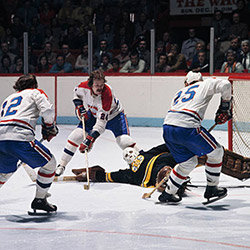
The confrontations with Boston remain among the most memorable moments of the era. The Bruins possessed a powerful and talented team, but Montreal defeated them in the Stanley Cup Final in both 1977 and 1978.
Game 7 of the 1979 semifinal was especially famous. Boston was leading late in the third period when a penalty for too many players on the ice gave the Canadiens a power play. Guy Lafleur tied the game with a powerful shot, and Yvon Lambert scored in overtime. Montreal advanced to the Final and won its fourth consecutive Stanley Cup by defeating the Rangers.
That championship also marked the end of an era. Dryden and Cournoyer retired, Bowman left the organization, and several key players were approaching the final stages of their careers. The following season, the New York Islanders began their own run of four consecutive championships.
A Team at the Heart of Quebec’s Collective Memory
During the 1970s, Canadiens games were much more than simple entertainment. They brought families together around the television or radio and fuelled conversations in schools, workplaces, and neighbourhoods.
French-speaking stars held a particularly important place. Lafleur, Cournoyer, Savard, Lapointe, Lemaire, and many others represented Quebec on hockey’s greatest stage. Their achievements became part of a shared culture passed from one generation to the next.
The glorious decade remains associated with a time when fans expected the Canadiens not only to reach the playoffs, but to win the Stanley Cup. That expectation reflects the magnitude of a dynasty that had turned excellence into a habit.
Quiz questions preview
-
He was the first choice of the Canadiens in the 1978 draft.
Danny Geoffrion | Bobby Smith | Ryan Walter | Dave Hunter -
Who replaced Sam Pollock as general manager of the Canadiens in the summer of 1978?
Al MacNeil | Scotty Bowman | Irving Grundman | Serge Savard -
What jersey number was Glen Sather wearing?
21 | 17 | 27 | 11 -
What jersey number was Mario Tremblay wearing?
11 | 14 | 12 | 8 -
Which team eliminated the Canadians in the semi-finals of the 1975 playoffs?
The Philadelphia Flyers | The Pittsburgh Penguins | The Buffalo Sabres | The New York Islanders

