The Montreal Olympic Games — Topic Guide
From July 17 to August 1, 1976, Montreal hosted the Games of the XXI Olympiad, one of the most significant events in its modern history. These Games left behind images that became iconic, foremost among them Nadia Comăneci’s first “perfect 10,” but also a much more complex legacy. The architectural ambition of the Olympic Park, major cost overruns, the boycott by several African countries, and Canada’s failure to win a gold medal all helped make Montreal 1976 a distinctive edition in Olympic history.
Montreal Wins the Games
When Montreal was awarded the 1976 Olympic Games in May 1970, the city had just emerged from a decade that had profoundly transformed its image. The metro had opened in 1966, and Expo 67 had attracted tens of millions of visitors. Mayor Jean Drapeau wanted to build on that momentum and establish Montreal as a metropolis capable of hosting the world’s largest international events. The city’s bid defeated those of Moscow and Los Angeles, two cities that then represented the major powers of the Cold War.
The choice of Montreal was also a first for Canada, which had never before hosted the Summer Olympic Games. For Jean Drapeau, the event was meant to be both a sporting celebration and a demonstration of modernity. Organizing the Games quickly became inseparable from a vast construction program intended to leave a lasting mark on the eastern part of the city.
The Olympic Park and Its Architectural Ambition
The centrepiece of the project was entrusted to French architect Roger Taillibert. His concept included an enormous elliptical stadium, a velodrome, aquatic facilities, and an inclined tower designed to support a retractable roof. The entire complex was intended to be spectacular and instantly recognizable, breaking with the more conventional stadium designs of the period.
Construction, however, turned into a financial and technical nightmare. Inflation, strikes, design changes, engineering difficulties, and disputes surrounding the work caused costs to soar. The Olympic Stadium was sufficiently advanced to host the Games, but its tower was unfinished and the original roofing system could not function as planned. This gap between the ambition of the project and its actual completion would become one of the enduring symbols of Montreal 1976.
The competitions were not limited to the Olympic Park. Rowing and canoeing events took place at the basin on Île Notre-Dame, developed from facilities originally created for Expo 67. Equestrian events were held in Bromont, while sailing took place in Kingston, Ontario. The Montreal Games were therefore geographically dispersed, even though the Olympic Stadium remained their dominant visual symbol.
The Olympic Village
Near the Olympic Park, two large pyramid-shaped buildings were constructed to house the athletes. The Olympic Village reflected the same architectural ambition as the stadium: to create striking forms and project an image of Montreal as a resolutely modern city.
More than 6,000 athletes from over 90 countries took part in the Games. For several weeks, the Olympic Village became a small international city where athletes from very different political, social, and cultural systems lived side by side. In the middle of the Cold War, this coexistence was part of the Olympic ideal of bringing nations together, even though international tensions remained ever-present.
A Distinctly Canadian Opening Ceremony
The opening ceremony took place on July 17, 1976, before a packed Olympic Stadium. Queen Elizabeth II, in her capacity as Queen of Canada, officially declared the Games open. The organizers sought to give the ceremony a Canadian identity while also emphasizing Montreal’s French-speaking character.
One of the most symbolic moments came when two teenagers, Sandra Henderson and Stéphane Préfontaine, lit the Olympic cauldron together. Henderson was English-speaking and Préfontaine French-speaking; their joint appearance was intended to represent Canada’s two main linguistic communities.
The transportation of the Olympic flame also featured an original technological element. After being lit in Olympia, its signal was transmitted by satellite from Greece to Canada. A new flame was then ignited in Ottawa before continuing its journey to Montreal. The process, widely remarked upon at the time, deliberately combined the ancient tradition of the Games with the image of a modern and technologically advanced Canada.
The African Boycott
The Games were almost immediately affected by a major political crisis. Several African countries demanded that New Zealand be excluded because its national rugby team had toured South Africa, which was then governed under apartheid. Since rugby was not part of the Olympic program and the tour had not been organized under the authority of the International Olympic Committee, the IOC refused to sanction the New Zealand delegation.
In response, numerous African countries withdrew their athletes from the Games. Some delegations were already in Montreal when the decision was made. The boycott deprived the competitions of several outstanding athletes, particularly in track and field, and once again demonstrated how difficult it was to maintain the Olympic ideal of remaining above politics. After the tragedy of Munich in 1972, Montreal 1976 confirmed that the Games had become a stage on which international tensions could be expressed openly.
Nadia Comăneci Changes Gymnastics History
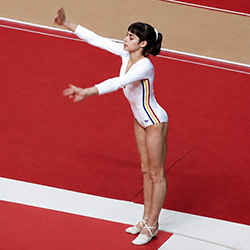
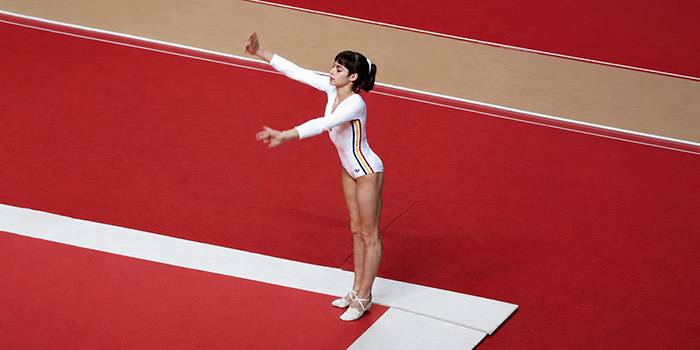
The most famous figure of Montreal 1976 was neither Canadian nor American, but a 14-year-old Romanian gymnast: Nadia Comăneci. On July 18, during her uneven bars routine, she received a score of 10.00, a level of perfection never before awarded in Olympic gymnastics.
The moment immediately produced an image that became legendary. The electronic scoreboards had been designed on the assumption that a perfect score would never be given and were therefore unable to display 10.00 properly. The result appeared as “1.00,” initially causing confusion in the stadium. Comăneci would eventually receive seven perfect scores during the Games.
She won three gold medals, in the individual all-around, uneven bars, and balance beam, as well as a team silver medal and a bronze medal in the floor exercise. Her youth, composure, and extraordinary precision instantly made her an international star. More than any other athlete, she remains associated in the public imagination with the Montreal Games.
Sporting Rivalry Between East and West
The Games took place at the height of the Cold War, when sport had become a symbolic arena of competition between the two blocs. The Soviet Union finished first in the medal standings, while East Germany also achieved exceptional results. The United States remained one of the world’s leading sporting powers, but Soviet and East German success demonstrated the effectiveness of the highly structured training systems developed in communist countries.
This rivalry went far beyond simply counting medals. Every international victory could be presented as proof of the success of a national system. Athletic performance therefore became a tool of political prestige, which partly explains the extraordinary importance both blocs placed on elite sport.
Memorable Performances in Track and Field
The stadium witnessed several remarkable performances. Finland’s Lasse Virén again won both the 5,000 and 10,000 metres, repeating the double he had already achieved at Munich in 1972. His dominance in long-distance running established him as one of the great distance runners of his generation.
Cuba’s Alberto Juantorena achieved a much more unusual double by winning both the 400 and 800 metres. The two distances require different athletic qualities, making his accomplishment particularly impressive. American Edwin Moses won the 400-metre hurdles while setting a world record and began a career that would see him dominate the event for many years.
Sprinter Hasely Crawford won the 100 metres and gave Trinidad and Tobago the first Olympic gold medal in the country’s history.
Canada Misses Out on Gold
Canada’s results produced one of the great paradoxes of the Games. The host nation won eleven medals but none of them were gold. Canada therefore became the first host country in Summer Olympic history to fail to win a single Olympic title on home soil.
The absence of gold did not mean that Canadian athletes were missing from the memorable moments. Greg Joy, in particular, created one of the great local highlights by winning silver in the high jump before an enthusiastic crowd at the Olympic Stadium. Several other medals came in swimming, where Canadian athletes performed well.
The overall result nevertheless remained disappointing. At a time when host nations generally hoped to benefit from the Games by significantly improving their performance, Canada was forced to confront the limitations of its elite sport development system. The experience would later contribute to broader reflection on the support provided to Canadian athletes.
Other Champions Leave Their Mark on Montreal
Several future stars and established champions distinguished themselves in Montreal. American boxer Sugar Ray Leonard won a gold medal before going on to become one of the biggest stars in professional boxing. Cuba’s Teófilo Stevenson retained his Olympic heavyweight title and confirmed his place among the greatest amateur boxers of his era.
In diving, Italy’s Klaus Dibiasi won the men’s 10-metre platform event for the third consecutive Games. In the decathlon, American Bruce Jenner took gold with a world record.
The Montreal Games also marked an important stage in the expansion of the women’s Olympic program. Women’s basketball, handball, and rowing were among the events making their Olympic debut, reflecting the growing place of women in international sport.
Amik, a Canadian Symbol
The official mascot was a black beaver named Amik. The word means “beaver” in an Algonquian language and referred directly to an animal closely associated with Canadian history, particularly the fur trade.
Its design was deliberately simple and graphic. Unlike the more human-like mascots that would become common later, Amik still clearly resembled a stylized animal rather than a cartoon character. It appeared on posters, souvenirs, and the many promotional products created for the Games.
The Weight of the Olympic Debt
After the closing ceremony, sporting success quickly gave way to financial concerns. The actual costs of the project far exceeded the original estimates. Jean Drapeau’s early claim that the Games could essentially pay for themselves proved unrealistic.
The Quebec government had to take over much of the project’s financial management and find ways to repay the accumulated debt. A special tax on tobacco contributed for years to financing the Olympic installations. The debt was not fully paid off until 2006, thirty years after the Games.
This situation had a profound effect on the reputation of Montreal 1976. For decades, the Games were regularly cited as an example of the financial risks associated with major Olympic projects. Their cost also influenced the international debate over whether host cities could realistically make such infrastructure financially sustainable after the competitions ended.
The Fate of the Olympic Stadium
The Olympic Stadium became the most visible symbol of this complicated legacy. Its inclined tower, the central element of Taillibert’s concept, was not completed until the 1980s. Problems with the roof continued for decades and required several major interventions.
The building nevertheless had an important life after the Games. The Montreal Expos played baseball there for many years, the Alouettes used it for certain football games, and major concerts and sporting events were staged there. Its silhouette became inseparable from the Montreal skyline, even though its maintenance and future continued to provoke debate.
Other facilities were adapted more easily. The Olympic Velodrome was converted into the Biodome, one of Montreal’s major scientific and tourist attractions. The basin on Île Notre-Dame continued to host training and competitions, while the aquatic facilities at the Olympic Park remained in use.
A Deeply Montreal Legacy
The 1976 Olympic Games therefore cannot be reduced to their debt, any more than they can be reduced to Nadia Comăneci’s achievements. They belong to a period when Montreal was trying to define itself as a major international city, capable of competing with the world’s leading metropolises through its architecture, infrastructure, and large-scale events.
They left an exceptional physical imprint on the city, but also a lesson about the dangers of overly ambitious projects and unrealistic financial forecasts. From a sporting perspective, they produced performances that entered Olympic history; politically, they were marked by the African boycott; and from a Canadian perspective, they remain associated with the paradox of a host country unable to win a gold medal.
It is precisely this combination of grandeur, athletic achievement, controversy, and lasting consequences that makes the Montreal Games much more than a two-week sporting competition.
Quiz questions preview
-
Between which dates were the Montreal Olympic Games held?
From August 1 to 16, 1976 | From July 17 to August 1, 1976 | From July 10 to 25, 1976 | From July 21 to August 5, 1976 -
Which Soviet gymnast finished fifth in the all-around after winning three titles in Munich?
Ludmilla Tourischeva | Nellie Kim | Elvira Saadi | Olga Korbut -
Of the five American gold-medal boxers, how many later became professional world champions?
4 | 2 | 3 | 5 -
In which sport was Vasily Alekseyev already a legend before winning gold in Montreal?
Wrestling | Judo | Weightlifting | Shot put -
Which venue hosted the boxing bouts before the finals?
Maurice Richard Arena | The Montreal Forum | The Olympic Velodrome | The Claude Robillard Centre

