
The Summit Series — Topic Guide
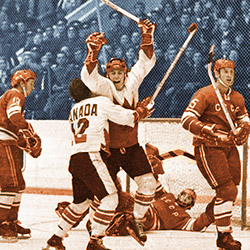
The 1972 Summit Series pitted Canada’s best professional hockey players against the national team of the Soviet Union in eight games. Presented as the ultimate confrontation between two visions of hockey, it became a symbol of the Cold War. Its intensity, dramatic reversals, and spectacular ending made it a defining moment in Canadian sports history.
Two Powers That Barely Knew Each Other
Canada considered itself the unquestioned home of hockey. Its best players competed in the National Hockey League, but they were usually excluded from major international tournaments because they were professionals. The Soviet Union therefore dominated these competitions with players who were officially amateurs but trained year-round within a state-supported system.
The series was intended to provide a true confrontation between the two hockey powers. Four games were scheduled in Canada and four in Moscow. Bobby Orr could not play because of knee injuries, while Bobby Hull was excluded after leaving the NHL for the World Hockey Association.
Two Opposing Styles
The Canadians relied on physical play, quick shots, and individual talent. Accustomed to long professional seasons, however, they arrived with limited preparation and underestimated their opponents.
The Soviets emphasized speed, passing, puck possession, and coordinated movement. Their players had trained together for years. Goaltender Vladislav Tretiak and forwards such as Valeri Kharlamov, Boris Mikhailov, and Alexander Yakushev quickly surprised the Canadian public.
The series forced both sides to reconsider their assumptions. The Canadians discovered a disciplined and creative Soviet team, while the Soviets witnessed the adaptability and resilience of North American professionals.
The Shock of the Canadian Games
The first game took place at the Montreal Forum on September 2. Canada scored two quick goals, but the Soviet Union took control and won 7–3. The defeat shocked a country that had expected an easy victory.
Canada recovered in Toronto with a 4–1 win. The third game, in Winnipeg, ended in a 4–4 tie. In Vancouver, the Soviets won 5–3 and left Canada with two victories, one defeat, and one tie.
Part of the Vancouver crowd booed the Canadian team. Phil Esposito responded in a famous television interview. He said the players were hurt by the public’s reaction and insisted that they were playing with pride for their country.
An Almost Desperate Situation in Moscow
Before travelling to the Soviet Union, Canada played two games in Sweden to become accustomed to the larger European rinks.
In Game 5, the Canadians built a 4–1 lead, but the Soviets scored four unanswered goals and won 5–4. The Soviet Union now led the series with three victories, one defeat, and one tie. Canada had to win the final three games.
Tension increased, and the play became more physical. During Game 6, Bobby Clarke fractured Valeri Kharlamov’s ankle with a controversial slash. Kharlamov, one of the Soviet Union’s best forwards, was unable to regain his full effectiveness.
Paul Henderson’s Three Winning Goals
Canada won Game 6 by a score of 3–2 on a winning goal by Paul Henderson. In Game 7, Henderson again scored the decisive goal with less than three minutes remaining, giving Canada a 4–3 victory.
The series was therefore tied before the final game. The Soviets still held an advantage in total goals, however, meaning that a tie would allow them to claim victory.
Game 8, played on September 28, was extremely tense. The Soviet Union led 5–3 after two periods. In the third period, Phil Esposito narrowed the gap, and Yvan Cournoyer tied the score.
With 34 seconds remaining, Henderson jumped onto the ice, drove toward the net, and took a shot that Tretiak stopped. He recovered the rebound and scored on his second attempt. Canada won 6–5 and captured the series with four victories, three defeats, and one tie.
A National Experience
Millions of Canadians followed the final game on television or radio. In many schools and workplaces, normal activities stopped so people could watch the afternoon broadcast from Moscow.
Henderson’s goal became one of the most famous images in Canadian sports history. It represented national relief and pride after a series that had proved far more difficult than expected.
The event also retained controversial elements. The violence, disputes with officials, and intense nationalism showed that the series had become much more than a simple sporting competition.
A Transformed Game
The Summit Series changed the way Canadians viewed international hockey. It proved that European teams could compete with the best professional players in the NHL.
North American coaches began paying greater attention to Soviet conditioning, passing, and team systems. European teams, in turn, studied Canadian physical play and determination.
The series encouraged later meetings between Soviet and North American clubs, followed by tournaments that brought together the world’s best players, including the Canada Cup. It also helped prepare the way for the growing number of European players who later joined the NHL.
Quiz questions preview
-
How much time was left in the final game when Paul Henderson scored to give Canada the win?
57 seconds | 34 seconds | 21 seconds | 43 seconds -
This star defenseman of Canada did not play any game.
Serge Savard | Guy Lapointe | Brad Park | Bobby Orr -
He wore the number 28 jersey for Canada.
Richard Martin | Marcel Dionne | Stan Mikita | Bobby Clarke -
Which NHL team did Rod Gilbert play for at the time of the Summit Series?
New York Rangers | Montreal Canadiens | Detroit Red Wings | Boston Bruins -
Who was Canada's best goalie with an 87.9% save rate?
Eddie Johnston | Tony Esposito | Bernard Parent | Ken Dryden

