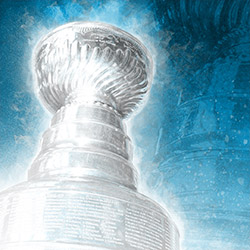

To the Stanley Cup — Topic Guide
The Stanley Cup playoffs represent the ultimate test in North American professional hockey. For nearly two months, the qualifying teams compete in series where intensity, endurance and roster depth become essential. Every victory brings the players closer to the oldest trophy still awarded to a professional sports team in North America.
From Stanley Cup challenges to the NHL playoffs
The Stanley Cup was donated in 1893 by Frederick Arthur Stanley, Governor General of Canada. Originally, it did not belong to any league. It was awarded to the best amateur hockey team in the country and could be contested through challenges issued by other clubs.
As professional hockey developed, teams from different leagues began competing for the trophy. The creation of the National Hockey League in 1917 did not immediately give it exclusive control of the Cup. The NHL champion still had to face the champion of a western league.
Beginning in 1926, only NHL teams competed for the trophy. The playoffs then became the means of determining the League champion and Stanley Cup winner. Their format changed frequently according to the number of teams, the divisions and successive expansions.
The evolution of the format
During the early decades, very few teams participated in the playoffs. Some matchups were played over two games, with the winner determined by the total number of goals. Other series were played as best-of-three, best-of-five or best-of-seven contests.
During the Original Six era, which lasted from 1942 to 1967, four clubs qualified for the playoffs. The first-place team faced the third-place team, while the second-place club played the fourth. The winners then met in the final.
The 1967 expansion, which increased the NHL from six to twelve teams, forced the League to add rounds and reorganize its divisions. The number of playoff participants continued to grow as new teams were added.
Since 1987, all four rounds have been played as best-of-seven series. A team must therefore earn sixteen victories to lift the Stanley Cup.
The modern format includes sixteen teams, with eight from each conference. The top three clubs in each of the four divisions qualify, along with two wild-card teams from each conference. Division winners face the wild-card clubs, while the second- and third-place teams in each division play one another.
A different game from the regular season
The playoffs are not simply an extension of the regular season. The pace is more intense, bodychecking becomes more frequent and mistakes are punished more severely. Because two teams may face each other as many as seven times in two weeks, coaches have several opportunities to adjust their strategies.
Roster depth becomes extremely important. Star players must produce despite constant attention, but supporting players can decide a series by scoring an unexpected goal, blocking shots or neutralizing the opposing team’s best line.
Injuries also accumulate. Players often continue competing despite fractures, sprains or other conditions that are not revealed until after their team has been eliminated. The ability to recover quickly between games becomes almost as important as talent.
Home-ice advantage allows the home team to make the final line change before certain faceoffs. Coaches can therefore attempt to create favourable matchups between their own lines and those of the opposition.
The great dynasties
Several teams dominated the playoffs for extended periods.
The original Ottawa Senators formed the NHL’s first great dynasty. They won four Stanley Cups between 1920 and 1927, during an era when the League champion still had to face teams from western Canada.
The Toronto Maple Leafs won several championships during the 1940s, followed by four more between 1962 and 1967. Their 1967 championship remains the most recent in team history.
The Detroit Red Wings won four Stanley Cups between 1950 and 1955. Gordie Howe, Ted Lindsay, Sid Abel, Red Kelly and Terry Sawchuk were among the pillars of those teams.
The Montreal Canadiens set a record by winning five consecutive championships from 1956 to 1960. They added four more titles in a row between 1976 and 1979. With 24 Stanley Cups, including 23 since the creation of the NHL, Montreal remains the most successful club.
The New York Islanders won four consecutive Stanley Cups from 1980 to 1983. They captured 19 straight playoff series before losing the 1984 final to the Edmonton Oilers.
The Oilers then won five championships between 1984 and 1990. Wayne Gretzky, Mark Messier, Jari Kurri, Glenn Anderson, Paul Coffey and Grant Fuhr turned the playoffs into offensive showcases.
Rivalries intensified by the playoffs
Repeated matchups have fuelled several of the NHL’s greatest rivalries. The Canadiens and Boston Bruins have faced each other in the playoffs more often than any other pair of teams. Their battles have spanned several generations, from Maurice Richard and Gerry Cheevers to Guy Lafleur, Ray Bourque, Patrick Roy and Cam Neely.
The rivalry between Montreal and Toronto is based on the age of the two clubs, their importance in Canada and the many playoff series they contested during the Original Six era.
The Battle of Alberta between the Oilers and Calgary Flames reached its peak during the 1980s, when both teams ranked among the best in the League. The rivalry between Detroit and the Colorado Avalanche became especially violent during the 1990s.
The Pittsburgh Penguins and Washington Capitals frequently met in the playoffs during the careers of Sidney Crosby and Alex Ovechkin. These matchups helped define the rivalry between two of the greatest players of their generation.
Upsets and comebacks
Finishing at the top of the standings does not guarantee a long playoff run. A lower-ranked team can rely on a hot goaltender, disciplined defence or a surge of confidence to eliminate a favourite.
The Presidents’ Trophy, created in 1986, is awarded to the club with the best regular-season record. Its winners do not automatically capture the Stanley Cup, however, which has fuelled a superstition that the trophy brings bad luck.
Only four teams have overcome a three-games-to-none deficit to win a best-of-seven series.
-
The Toronto Maple Leafs completed the first such comeback against Detroit in 1942. It remains the only one achieved in the Stanley Cup Final.
-
The New York Islanders eliminated the Pittsburgh Penguins in 1975.
-
The Philadelphia Flyers came back against Boston in 2010.
-
The Los Angeles Kings eliminated the San Jose Sharks in 2014 before winning the Stanley Cup.
The Edmonton Oilers nearly joined this group in 2024. Trailing the Florida Panthers three games to none in the final, they forced a seventh game but lost the deciding contest.
Overtime and marathon games
No playoff game can end in a tie. If the score remains even after three periods, the teams play full twenty-minute sudden-death periods. The first goal immediately ends the game.
The longest game in playoff history was played in 1936 between the Detroit Red Wings and Montreal Maroons. Mud Bruneteau scored after 116 minutes and 30 seconds of overtime, during the sixth extra period.
In the 1990 final, Petr Klíma gave the Oilers a victory over Boston during the third overtime period. In 1999, Brett Hull also scored in triple overtime to allow the Dallas Stars to win the Stanley Cup against the Buffalo Sabres. The position of his skate in the goal crease created a lasting controversy.
Long overtime games test the endurance of players, goaltenders and even spectators. Teams often shorten their shifts, while every shot, deflection or turnover can end several hours of hockey.
The decisive role of goaltenders
A goaltender can single-handedly transform a series. When scoring chances become less frequent, a few spectacular saves can make the difference between elimination and a championship.
Ken Dryden led the Canadiens to the title in 1971 after playing only six regular-season games. Billy Smith was a central figure in the Islanders’ dynasty. Grant Fuhr guarded the Oilers’ net during their dominant period, while Martin Brodeur won three Stanley Cups with the New Jersey Devils.
Patrick Roy remains one of the most important goaltenders in playoff history. He won the Stanley Cup with Montreal in 1986 and 1993, then with the Avalanche in 1996 and 2001. He is the only player to have won the Conn Smythe Trophy three times.
The Conn Smythe Trophy
Created in 1965, the Conn Smythe Trophy is awarded to the player judged most valuable to his team throughout the playoffs. Unlike regular-season awards, it considers all four rounds rather than only the final.
Jean Béliveau was its first recipient. Bobby Orr, Bernie Parent, Wayne Gretzky, Mario Lemieux and Sidney Crosby each won it twice, while Patrick Roy remains the only three-time winner.
The recipient usually belongs to the championship team, but a few players have won it despite losing in the final. In 2024, Connor McDavid received the award after setting a record with 34 assists in a single playoff year.
In 2026, Jordan Staal won the Conn Smythe Trophy after helping the Carolina Hurricanes defeat the Vegas Golden Knights in six games. At 37, he became the oldest winner in the trophy’s history.
Playoff traditions
The playoffs are surrounded by numerous traditions. Many players stop shaving at the beginning of the tournament and keep their beards until their team is eliminated or wins the championship. The practice became widespread during the 1980s.
At the end of a series, the two teams form lines and shake hands. This custom distinguishes professional hockey from many other sports, as opponents who have just played a series of sometimes highly physical games immediately show one another respect.
Conference champions receive the Prince of Wales Trophy in the East and the Clarence S. Campbell Bowl in the West. Some teams refuse to touch them, believing that only the final trophy matters. Other captains deliberately lift them to reject the superstition.
When the Stanley Cup is won, the NHL commissioner presents it to the captain of the championship team. The captain raises it before passing it to his teammates. Eligible players and members of the organization later have their names engraved on the trophy.
Each champion may also spend one day with the Cup during the summer. The trophy travels to players’ hometowns, hospitals, schools, local arenas and family celebrations.
Records and notable facts
-
The Montreal Canadiens hold the record with 24 Stanley Cup championships.
-
Henri Richard won eleven championships as a player, more than any other hockey player.
-
Montreal won five consecutive Stanley Cups from 1956 to 1960.
-
The Islanders won 19 consecutive playoff series between 1980 and 1984.
-
Wayne Gretzky holds the career playoff records for goals and points.
-
Gretzky recorded 47 points in 1985, the highest total in a single playoff year.
-
Patrick Roy is the only player to have won three Conn Smythe trophies.
-
A team must win four series and sixteen games to become champion.
-
Only four teams have won a series after losing the first three games.
-
The Carolina Hurricanes won their second Stanley Cup in 2026, twenty years after their first championship.
Quiz questions preview
-
Who was the coach of the Colorado Avalanche when they won the Stanley Cup in 2022?
Lindy Ruff | Jon Cooper | Jared Bednar | Dave Tippett -
Which team lost to the Los Angeles Kings in the Stanley Cup Final in 2014?
New York Rangers | Pittsburgh Penguins | Boston Bruins | Philadelphia Flyers -
Who was the coach of the Detroit Red Wings when they won the Stanley Cup in 2002?
Bob Hartley | Scotty Bowman | Ken Hitchcock | Darryl Sutter -
Which of the Original Six teams has not won the Cup for the longest time?
Detroit Red Wings | Toronto Maple Leafs | Montreal Canadiens | New York Rangers -
Who was the coach of the Boston Bruins when they won the Stanley Cup in 2011?
Todd McLellan | Rick Bowness | Peter DeBoer | Claude Julien

