In the Time of Rembrandt — Topic Guide
Rembrandt Harmenszoon van Rijn lived from 1606 to 1669, at the height of the Dutch Golden Age. A painter, printmaker and draftsman, he developed a deeply human style marked by chiaroscuro, biblical scenes, portraits and close observation of emotion. Most of his career unfolded in Amsterdam, then one of Europe's leading commercial and cultural centers.
Rembrandt's life and career
Rembrandt was born in Leiden into a relatively prosperous family. His father was a miller. After training as an artist, he began his career in his hometown before settling in Amsterdam around 1631, when the city was enjoying extraordinary prosperity from maritime trade.
He married Saskia van Uylenburgh in 1634. She appeared repeatedly in his art and became one of his favorite models. The couple had four children, but only their son Titus survived to adulthood. Saskia died in 1642, the same year Rembrandt completed "The Night Watch."
Rembrandt achieved considerable success but later faced serious financial difficulties. An enthusiastic collector of art, costumes, weapons and curiosities, he spent heavily. In 1656, his possessions were inventoried and later sold to pay his creditors. He nevertheless continued working until his death in Amsterdam in 1669.
From the 1630s onward, he generally signed his work simply "Rembrandt." This practice echoed Renaissance masters such as Raphael, Leonardo and Michelangelo, who were also commonly known by their first names.
Painter and printmaker
Rembrandt produced about 400 paintings, nearly 300 etchings and hundreds of drawings. His prints contributed greatly to his reputation because multiple impressions could circulate far beyond the Netherlands.
He became particularly skilled at etching, in which acid bites lines into a varnish-coated copper plate. Rembrandt experimented with shadow, line and successive states of the same plate to achieve different visual effects.
Unlike many European artists of his time, Rembrandt never traveled to Italy or elsewhere abroad to study. He nevertheless absorbed international influences, including the dramatic contrasts of light and darkness associated with Caravaggio.
Portraits and self-portraits
Rembrandt painted many merchants, civic leaders and members of Amsterdam's prosperous middle class. Group portraits were especially popular in the Dutch Republic, particularly among guilds and civic guard companies.
"The Anatomy Lesson of Dr. Nicolaes Tulp," painted in 1632, showed surgeons gathered around the body of an executed man. Tulp demonstrates the muscles and tendons of the forearm. The painting helped establish the young Rembrandt's reputation in Amsterdam.
"The Syndics of the Drapers' Guild," painted in 1662, depicted five officials responsible for inspecting cloth, along with a servant. Their natural poses create the impression that the viewer has suddenly interrupted their meeting.
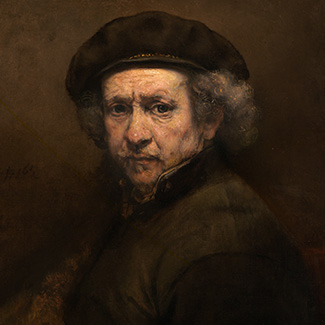
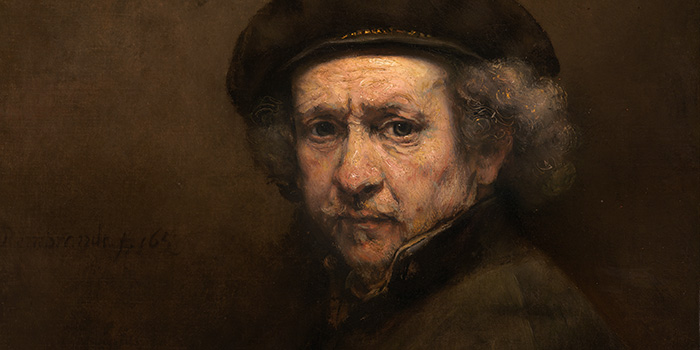
Rembrandt also created numerous painted, drawn and etched self-portraits. From an early age, he used his own face to experiment with expression, light and shadow. Together, these works record his changing appearance over nearly forty years.
Famous works
Completed in 1642, "The Night Watch" portrays a company of Amsterdam civic guards. Rembrandt departed from conventional static group portraits by making the figures appear to be moving into action. The canvas was later trimmed when it was relocated in 1715.
Many of his paintings drew on biblical stories. "The Blinding of Samson" shows the Philistines violently overpowering Samson after Delilah's betrayal. In "Belshazzar's Feast," a mysterious hand writes the message foretelling the king's downfall. "The Return of the Prodigal Son" depicts a father welcoming back his repentant son.
Rembrandt also explored mythology and ancient history. "Danaë" comes from Greek mythology, while "Lucretia" depicts the Roman heroine before her suicide. In "Aristotle with a Bust of Homer," the philosopher rests his hand on the bust of the ancient poet.
Other notable works include "Bathsheba at Her Bath," "Saul and David," "The Slaughtered Ox" and "The Jewish Bride." The latter, painted late in Rembrandt's life, is particularly admired for the tenderness between its two figures.
The Dutch Golden Age
The 17th century brought extraordinary prosperity to the Dutch Republic. Amsterdam became a major commercial and financial center through maritime trade. The Dutch East India Company, founded in 1602, developed a vast trading network throughout Asia.
This prosperity encouraged artistic production. Johannes Vermeer, Frans Hals and Jacob van Ruisdael worked during Rembrandt's lifetime. Diego Velázquez in Spain, Nicolas Poussin in France and Bernini in Rome were also major artistic figures of the century.
Tulip mania became one of the best-known episodes of Dutch economic history. After prices for certain rare bulbs rose dramatically, the market collapsed in 1637.
Writers, musicians and scientists
Rembrandt lived during an exceptionally rich cultural period. Molière, Pierre Corneille, Jean de La Fontaine and John Milton all wrote during his lifetime. Shakespeare and Cervantes died in 1616, when Rembrandt was only nine years old.
Baroque music was also developing rapidly. Claudio Monteverdi played a major role in the rise of opera, while Jean-Baptiste Lully became a leading composer at the court of Louis XIV. The harpsichord was an important keyboard instrument throughout Europe.
Galileo was tried by the Inquisition in 1633. René Descartes, who spent many years in the Netherlands, published "Discourse on the Method" in 1637. Christiaan Huygens discovered Titan, Saturn's largest moon, in 1655. Isaac Newton was born in 1643, when Rembrandt was already an established artist.
Wars and political upheaval
Rembrandt's lifetime overlapped with major political events. The Thirty Years' War ended in 1648 with the Peace of Westphalia, which also confirmed the independence of the Dutch Republic.
In England, Charles I was executed in 1649 after the English Civil Wars. Oliver Cromwell then dominated English politics before the monarchy was restored under Charles II.
Louis XIV became king of France in 1643 at only four years old. By the final years of Rembrandt's life, his reign was beginning to symbolize the growing power of absolute monarchy in France.
In 1664, the English seized New Amsterdam from the Dutch and renamed it New York. Two years later, the Great Fire of London destroyed a large part of the English capital.
Rembrandt's legacy
Rembrandt continued to influence artists long after his death. Vincent van Gogh deeply admired his work, particularly "The Jewish Bride," and discussed that admiration in letters. Édouard Manet also studied Rembrandt and made a study after "The Anatomy Lesson of Dr. Nicolaes Tulp."
The Amsterdam house where Rembrandt lived and worked is now the Rembrandt House Museum. The Rijksmuseum holds the largest collection of his paintings and prints in the Netherlands, including "The Night Watch" and "The Jewish Bride."
Quiz questions preview
-
Which Spanish author died in the same year as Shakespeare, when Rembrandt was 9?
Miguel de Cervantes | Lope de Vega | Francisco de Quevedo | Calderón de la Barca -
What does "The Night Watch" mainly depict?
A militia company | A religious procession | A group of sailors | A royal family -
Which body part does Dr. Tulp dissect in a famous work by Rembrandt?
The chest | The skull | The left forearm | The abdomen -
What is the actual title of this famous Rembrandt work?
The Jewish Bride | The Jewish Wedding | The Jewish Wife | The Jewish Couple -
Which musician born in 1632 was a contemporary of Rembrandt?
Wolfgang Amadeus Mozart | Johann Sebastian Bach | Jean-Baptiste Lully | Frédéric Chopin

