
Must-See Masterpieces of the Louvre — Topic Guide
The Louvre is one of the largest museums in the world and a cultural symbol of Paris. Housed in a former royal palace, it contains works spanning several millennia, from antiquity to the beginning of the modern era. Its collections reveal the evolution of civilizations, beliefs, and artistic forms.
From Royal Palace to Museum
The Louvre began as a fortress built in the late twelfth century under Philip II. It was later transformed and expanded into a royal residence. Francis I installed part of his art collection there, while later monarchs continued to enlarge and embellish the palace.
When Louis XIV moved his court to Versailles, the Louvre increasingly housed academies and artists’ workshops. During the French Revolution, it was converted into a public museum and opened in 1793.
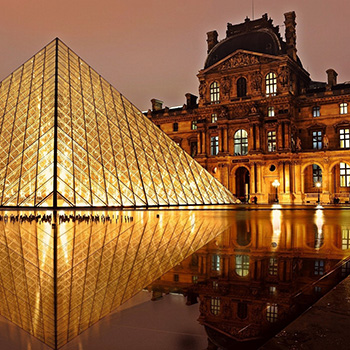
The museum later expanded through acquisitions and archaeological discoveries. The glass pyramid, inaugurated in 1989 in the Cour Napoléon, became a major entrance and a symbol of the union between historic architecture and contemporary design.
Egyptian Antiquities
The Egyptian collections explore daily life, religion, and political power in ancient Egypt. They include statues, sarcophagi, papyri, jewellery, and funerary objects.
The Great Sphinx of Tanis is among the most imposing sculptures in this section. Depicting a lion with a human head, it expresses the power of the pharaoh.
The Seated Scribe is one of the best-known works. Its attentive gaze and naturally represented body contrast with the idealized appearance usually reserved for rulers.
Funerary objects reflect the importance Egyptians placed on the afterlife. They prepared bodies, deposited offerings, and decorated tombs to ensure the survival of the deceased beyond death.
Mesopotamia and the Code of Hammurabi
The Louvre holds important collections from Mesopotamia, the region located between the Tigris and Euphrates rivers.
The Code of Hammurabi is a large stone monument bearing one of the most famous collections of laws from antiquity. The Babylonian king is shown before the god Shamash, who was associated with justice. The text addresses subjects such as trade, family, property, and punishment.
The human-headed winged bulls from the palace of Khorsabad served as symbolic guardians. Their monumental size was intended to impress visitors and display the power of the Assyrian ruler.
Ancient Greece and Rome
The Greek and Roman collections include statues, vases, jewellery, reliefs, and objects from everyday life.
The Venus de Milo, discovered on the Greek island of Milos, probably represents Aphrodite, the goddess of love and beauty. Despite the loss of her arms, the sculpture is admired for its balance and flowing drapery.
The Winged Victory of Samothrace stands at the top of a grand staircase. The winged goddess appears to move against the wind on the prow of a ship. The movement of her wings and clothing gives the sculpture extraordinary force.
Roman sculpture reveals the influence of Greek art, as well as the Roman interest in realistic portraits, emperors, and historical scenes.
Italian Painting
Italian painting occupies a central place in the Louvre. It traces the development of the Renaissance, perspective, and the study of the human body.
Leonardo da Vinci’s Mona Lisa is the museum’s most famous work. The subject’s mysterious smile, the distant landscape, and the delicate transitions between light and shadow contribute to its enduring fascination.
Veronese’s The Wedding Feast at Cana depicts a religious banquet in a magnificent setting. The immense painting includes numerous figures, musicians, and architecture inspired by Venice.
The museum also holds works by Raphael, Titian, Caravaggio, and other Italian masters.
French Painting
The French galleries contain religious, historical, mythological, and political paintings.
Jacques-Louis David’s The Coronation of Napoleon depicts the ceremony held at Notre-Dame Cathedral in Paris in 1804. Its composition transforms the event into a monumental scene designed to glorify the new regime.
Eugène Delacroix’s Liberty Leading the People evokes the July Revolution of 1830. A female figure carrying the French flag leads fighters across the barricades.
Théodore Géricault’s The Raft of the Medusa was inspired by a real shipwreck. Its dramatic composition shows survivors glimpsing the distant hope of rescue.
Sculpture and Decorative Arts
The Louvre is not limited to painting. Its galleries display French and European sculpture, furniture, tapestries, jewellery, and precious objects.
The Marly Horses, created by Guillaume Coustou, depict horses restrained by their handlers. Their powerful movement illustrates French monumental art of the eighteenth century.
The apartments of Napoleon III offer a spectacular setting filled with gilding, chandeliers, painted ceilings, and luxurious furniture. They serve as a reminder that the Louvre was once a palace.
The decorative arts collections include crowns, ivory carvings, enamelwork, and gold and silver objects. They demonstrate the skill of their makers as well as the prestige of their owners.
A Universal Museum
The Louvre’s collections come from widely different periods, cultures, and regions. Their combination makes it possible to compare different ways of representing power, the gods, the human body, and everyday life.
Some works have become global icons, but the museum also preserves thousands of lesser-known objects. Visiting the Louvre is therefore a journey through a large part of the history of art and civilization.
Quiz questions preview
-
Which painting was stolen from the Musée du Louvre on August 21, 1911?
Madonna of the Veil (Raphael) | Mona Lisa (Leonardo da Vinci) | Marriage at Cana (Paul Veronese) | Sabines (Jacques-Louis David) -
What is the second-largest painting displayed in the Louvre, after "The Wedding at Cana" by Veronese?
Liberty Leading the People | The Coronation of Napoleon | The Battle of Alexander | The Raft of the Medusa -
How many artworks are displayed to the general public?
18,000 | 25,000 | 47,000 | 36,000 -
How many kilometers must one walk to visit all the rooms in the Louvre?
7.5 km | 5 km | 10 km | 14.5 km -
What historical event inspired “The Raft of the Medusa”, painted by Théodore Géricault in 1819?
A shipwreck | A revolt | A polar expedition | A naval battle

