
Painters of the European Renaissance — Topic Guide
European Renaissance painters profoundly transformed the way the world was represented. Between the fifteenth and sixteenth centuries, they observed nature more closely, studied the human body, mastered perspective, and rediscovered antiquity. Their works often combined Christian faith, humanism, political power, and the pursuit of beauty.
The Birth of the Renaissance in Italy
The Renaissance took shape in Italy, especially in Florence. Artists sought to move beyond medieval conventions and represent space, bodies, and emotions with greater realism.
Linear perspective created an impression of depth on a flat surface. Painters also studied light, proportions, and anatomy. Religious subjects remained dominant, but they were placed in convincing settings and populated by more human figures.
Wealthy families, cities, and the Church commissioned frescoes, altarpieces, and portraits. Patronage therefore played an essential role in artistic development.
Botticelli and Florentine Poetry
Sandro Botticelli stood out through his elegant figures, flowing lines, and melancholy faces.
In The Birth of Venus and Primavera, he drew on themes from ancient mythology. These paintings show the renewed importance given to Greek and Roman culture.
Botticelli also painted many religious works. His style remained more decorative than strictly realistic, setting him apart from artists who pursued a more scientific representation of the body.
Leonardo da Vinci
Leonardo da Vinci embodied the ideal of the artist-scholar. A painter, engineer, and observer of nature, he studied anatomy, light, movement, and human expressions.
In The Last Supper, he arranged the apostles around Christ in a balanced and dramatic composition. The Mona Lisa is famous for her mysterious smile and for sfumato, a technique that softens outlines and transitions between light and shadow.
Leonardo completed relatively few paintings, but his influence was immense. He demonstrated that painting could rely on both observation and imagination.
Michelangelo and the Power of the Body
Michelangelo considered himself primarily a sculptor, but he also became one of the greatest painters of the Renaissance. His figures have powerful bodies inspired by anatomy and ancient sculpture.
The frescoes on the ceiling of the Sistine Chapel depict the Creation, Adam and Eve, the prophets, and several scenes from Genesis. The Last Judgment presents an intense vision of salvation and damnation.
In Michelangelo’s work, the human body becomes the main means of expressing strength, suffering, and spiritual destiny.
Raphael and Classical Harmony
Raphael was known for the clarity, balance, and gentleness of his compositions. His figures are idealized, yet natural and expressive.
He painted many images of the Virgin and Child, as well as the frescoes in the Vatican rooms. The School of Athensbrings together major thinkers of antiquity within a majestic architectural setting, with Plato and Aristotle at the centre.
Raphael represents the ideal of the High Renaissance: order, perspective, beauty, and harmony between the classical heritage and Christian culture.
Venice and Colour
In Venice, painters gave particular importance to colour, light, and atmospheric effects. Oil paint made it possible to create rich tones and delicate transitions.
Giorgione produced mysterious works in which landscape played an important role. Titian became a major portraitist and colourist. He painted religious, mythological, and political scenes, as well as rulers.
Tintoretto used dynamic compositions and dramatic lighting. Veronese was known for large, sumptuous scenes filled with architecture, fabrics, and figures.
The Renaissance in the Low Countries
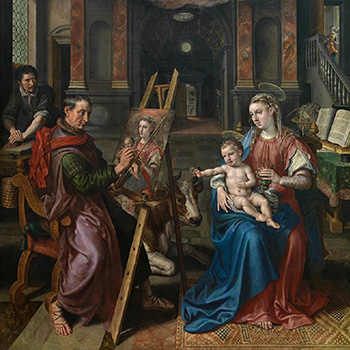
In northern Europe, Flemish painters used oil paint with great precision and filled their works with symbolic details.
Jan van Eyck had a lasting influence on European painting. His portraits and religious scenes depict textures, reflections, and objects with remarkable precision.
Rogier van der Weyden placed greater emphasis on emotion. Hieronymus Bosch created worlds populated by monsters, religious visions, and moral scenes that remain among the most enigmatic of the period.
Dürer, Holbein, and Bruegel
Albrecht Dürer played a major role in the German Renaissance. A painter, draughtsman, and printmaker, he combined the northern attention to detail with Italian studies of proportion and perspective.
Hans Holbein the Younger became famous for his precise portraits of the English court, including that of Henry VIII.
Pieter Bruegel the Elder observed rural life, the seasons, and popular activities. His scenes of peasants, harvests, and children’s games show that the Renaissance was not limited to princes, saints, and ancient heroes.
France and Spain
In France, kings attracted Italian artists and developed a refined courtly art. The School of Fontainebleau combined elegance, mythology, and elaborate decoration.
In Spain, Italian influence encountered a strong religious tradition. El Greco, born in Crete and trained in Italy, worked in Toledo. His elongated figures, intense colours, and spiritual visions moved away from classical balance.
Major Themes and Innovations
Renaissance painters mainly represented:
-
Biblical stories and the lives of saints.
-
The gods, heroes, and legends of antiquity.
-
Portraits of princes, merchants, and humanists.
-
Landscapes and scenes of everyday life.
-
The human body, studied through anatomy and proportion.
Fresco remained important for walls and ceilings, while oil painting spread from wooden panels to canvas. Prints also made it possible to circulate images and artistic styles widely across Europe.
Quiz questions preview
-
Who painted «Lamentation over the Dead Christ», famous for its dramatic foreshortening?
Antonello da Messina | Piero della Francesca | Andrea Mantegna | Giovanni Bellini -
Which Mannerist painter is best known for his portraits of the Medici court?
Bronzino | Pontormo | Parmigianino | Tintoretto -
Who painted «The Four Seasons», forming faces with plants and other objects?
Hieronymus Bosch | Parmigianino | Giuseppe Arcimboldo | Pieter Bruegel the Elder -
Who painted the two versions of «The Virgin of the Rocks» housed in Paris and London?
Leonardo da Vinci | Giorgione | Andrea del Verrocchio | Raphael -
Which Greek-born painter created «The Nobleman with His Hand on His Chest»?
Alonso Sánchez Coello | El Greco | Juan Pantoja de la Cruz | Luis de Morales

