Vatican, Between Faith and Masterpieces — Topic Guide
The Vatican is at once the smallest sovereign state in the world, the seat of the Roman Catholic Church and one of the greatest artistic centres in history. Enclosed within the city of Rome, it brings together places of worship, palaces, museums, gardens and works created by some of the greatest artists of the Renaissance. Its power does not rest on the size of its territory or population, but on its religious, diplomatic and cultural influence.
The Birth of Vatican City State
-
Vatican City is an independent state located within the city of Rome.
-
Its area is approximately 44 hectares, making it the smallest sovereign state in the world.
-
The present state was created in 1929 by the Lateran Treaties.
-
These agreements ended the “Roman Question,” a conflict that had opposed the papacy and the Kingdom of Italy for several decades.
-
They were signed on behalf of Pope Pius XI and the Italian government led by Benito Mussolini.
-
Vatican City gives the pope territorial independence, allowing him to exercise his religious authority freely.
-
Vatican City should not be confused with the Holy See.
-
Vatican City is a territory, while the Holy See represents the central authority of the Catholic Church.
-
The Holy See maintains diplomatic relations with many countries and possesses international legal status.
The Seat of the Catholic Church
-
The pope is the bishop of Rome and the leader of the Catholic Church.
-
He normally resides at the Vatican and performs his main religious and administrative duties there.
-
The Vatican hosts major papal celebrations, public audiences, canonizations and other important ceremonies.
-
Millions of pilgrims travel there each year to pray, attend Mass or see the pope.
-
St. Peter’s Square can accommodate enormous gatherings of worshippers from around the world.
-
The Vatican also houses the offices of the Roman Curia, which assists the pope in governing the Church.
-
Decisions made at the Vatican may concern doctrine, the appointment of bishops, diplomatic relations and the general administration of the Church.
Saint Peter and the Christian Origins
-
Catholic tradition holds that the apostle Peter was martyred in Rome during the first century.
-
He is believed to have been crucified during the reign of Emperor Nero.
-
According to tradition, his tomb lies beneath the present St. Peter’s Basilica.
-
The basilica’s name recalls the role of Peter, who is regarded by the Catholic Church as the first pope.
-
Archaeological excavations beneath the basilica revealed an ancient Roman necropolis.
-
The site gradually became a place of pilgrimage for early Christians.
-
Emperor Constantine had the first basilica built on the site during the fourth century.
-
This ancient basilica was replaced many centuries later by the present building.
St. Peter’s Basilica
-
St. Peter’s Basilica is one of the most important places of worship in Christianity.
-
Its construction began in 1506 and continued for more than a century.
-
Several major architects participated in the project, including Bramante, Raphael, Michelangelo and Carlo Maderno.
-
The building was consecrated in 1626.
-
Its monumental scale was intended to express the spiritual power of the Church and the greatness of the Christian faith.
-
The basilica can accommodate tens of thousands of people.
-
Its layout, chapels, tombs and works of art make it both a religious monument and an immense museum.
-
Several popes are buried there.
-
Major ceremonies, including some Christmas and Easter Masses and papal funerals, are held there.
Michelangelo’s Dome
-
Michelangelo played a decisive role in the design of the basilica’s dome.
-
He took over the project when he was already elderly and worked to simplify the earlier plans.
-
The dome dominates the Vatican skyline and is one of the great symbols of Rome.
-
Its structure was completed after Michelangelo’s death.
-
The interior is decorated with mosaics and religious inscriptions.
-
From the top, visitors can see St. Peter’s Square, the Vatican Gardens and part of Rome.
-
The dome combines technical achievement, architectural balance and spiritual meaning.
The Pietà
-
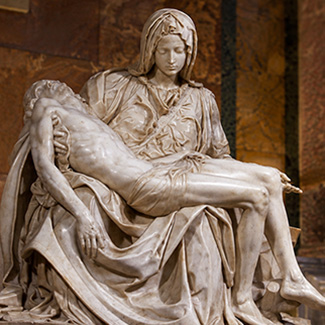
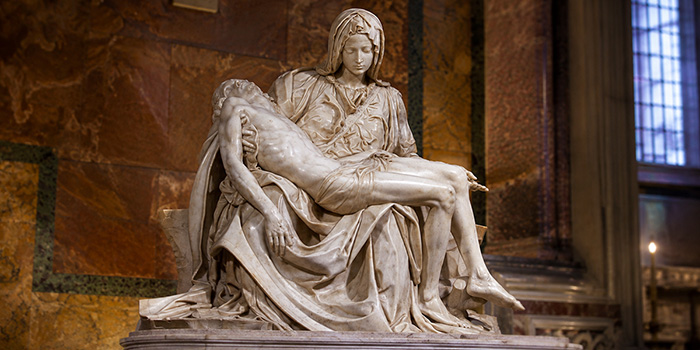
Michelangelo’s Pietà is kept in St. Peter’s Basilica.
-
It depicts the Virgin Mary holding the body of Christ on her lap after the Crucifixion.
-
Michelangelo created it at the end of the 15th century, when he was still a young artist.
-
The sculpture is remarkable for the delicacy of the marble, the gentleness of the faces and the precision of the drapery.
-
Mary appears surprisingly young, which may symbolize her purity.
-
The Pietà is the only work that Michelangelo signed.
-
It is now protected behind glass after being damaged in an attack in 1972.
St. Peter’s Square
-
St. Peter’s Square was designed in the 17th century by Gian Lorenzo Bernini.
-
It is surrounded by vast colonnades arranged in the shape of open arms.
-
This design is often interpreted as symbolizing the Church welcoming the faithful.
-
An ancient Egyptian obelisk stands at the centre of the square.
-
The obelisk was brought to Rome in ancient times before being moved to its present location during the 16th century.
-
Two fountains complete the symmetrical design of the square.
-
From the square, visitors can see the central balcony of the basilica, where a newly elected pope is presented.
-
The Latin words Habemus Papam, meaning “We have a pope,” are then proclaimed.
The Apostolic Palace
-
The Apostolic Palace is the official residence of the pope.
-
It includes apartments, offices, chapels, reception rooms and administrative areas.
-
Some sections of the palace can be visited as part of the Vatican Museums.
-
The building developed gradually over several centuries.
-
It contains the Sistine Chapel, the Raphael Rooms and several galleries.
-
Pope Francis chose, however, to live in the Domus Sanctae Marthae rather than in the traditional papal apartments.
The Sistine Chapel
-
The Sistine Chapel was built during the 15th century under Pope Sixtus IV.
-
It was named after this pope.
-
The chapel is used for certain religious ceremonies and for the conclaves that elect popes.
-
Its walls were decorated by several great Renaissance painters.
-
Sandro Botticelli, Perugino, Domenico Ghirlandaio and Cosimo Rosselli were among those who contributed to the wall decorations.
-
The frescoes depict episodes from the lives of Moses and Christ.
-
The chapel is best known for the works Michelangelo created on the ceiling and on the altar wall.
Michelangelo’s Ceiling
-
Michelangelo painted the ceiling of the Sistine Chapel between 1508 and 1512.
-
He regarded himself primarily as a sculptor and accepted the project reluctantly.
-
The complete work includes hundreds of figures.
-
The central scenes are mainly taken from the Book of Genesis.
-
They depict the creation of the world, Adam and Eve, the Flood and Noah.
-
The Creation of Adam has become one of the most famous images in the history of art.
-
It shows God reaching toward Adam, whose finger appears about to touch that of the Creator.
-
Michelangelo used powerful and expressive bodies to give the biblical stories a monumental quality.
The Last Judgment
-
Michelangelo returned to the Sistine Chapel many years after completing the ceiling.
-
He painted The Last Judgment on the altar wall between 1536 and 1541.
-
The fresco depicts the return of Christ and the judgment of souls.
-
Christ appears as a powerful figure surrounded by saints, angels, the saved and the damned.
-
The work provoked criticism because many of its figures were nude.
-
Some of the figures were later partially covered with painted draperies.
-
The Last Judgment expresses fear, hope, downfall and salvation.
The Vatican Museums
-
The Vatican Museums contain collections assembled by the popes over many centuries.
-
They are among the most visited museums in the world.
-
The route through the museums includes ancient sculptures, paintings, tapestries, maps, religious objects and works from various civilizations.
-
The collections are not limited to Christian art.
-
They include Egyptian, Etruscan, Greek and Roman antiquities.
-
The buildings themselves form a vast artistic complex.
-
The galleries, ceilings and courtyards reflect several centuries of papal patronage.
The Raphael Rooms
-
The Raphael Rooms are a group of rooms decorated during the early 16th century.
-
Pope Julius II commissioned Raphael and his workshop to decorate them.
-
They were used as apartments and official rooms.
-
The School of Athens is one of the most famous frescoes in the group.
-
It depicts several philosophers of antiquity gathered in a monumental architectural setting.
-
Plato and Aristotle occupy the centre of the composition.
-
Raphael gave some of the philosophers the features of artists from his own time.
-
The fresco celebrates reason, knowledge and the search for truth.
-
The other works in the rooms address theology, poetry, law and the history of the Church.
Ancient Sculptures
-
The Vatican collections contain several masterpieces of ancient sculpture.
-
The Laocoön Group depicts a Trojan priest and his sons being attacked by serpents.
-
The work had a profound influence on Renaissance artists.
-
Michelangelo is believed to have helped identify the sculpture shortly after its discovery.
-
The Apollo Belvedere was long regarded as an ideal model of male beauty.
-
The Belvedere Torso influenced Michelangelo through its muscular power and posture.
-
The rediscovery of these works helped renew the study of the human body in European art.
The Gallery of Maps
-
The Gallery of Maps was created during the 16th century.
-
It displays large painted maps of the different regions of Italy.
-
The maps show cities, mountains, rivers, roads and territories.
-
They reflect the geographical and cartographic knowledge of the Renaissance.
-
Their purpose was scientific, political and decorative.
-
The richly ornamented ceiling makes the gallery especially spectacular.
The Vatican Apostolic Library
-
The Vatican Apostolic Library is one of the oldest major libraries in the world.
-
It preserves manuscripts, rare books, maps, drawings, coins and historical documents.
-
Its collections include ancient, medieval and modern texts.
-
Many documents are written in Latin, Greek, Hebrew, Arabic and other languages.
-
The library is an important centre for historical, religious and philological research.
-
Access to the collections is mainly reserved for qualified researchers.
-
Digitization projects help preserve fragile documents and make them easier to study.
The Vatican Archives
-
The Vatican Apostolic Archives preserve the administrative and diplomatic records of the Holy See.
-
They were formerly known as the Vatican Secret Archives.
-
In this context, the word “secret” mainly meant “private” or “personal.”
-
The archives contain correspondence, papal registers, trial records and diplomatic documents.
-
They cover several centuries of European and world history.
-
Some files become available to researchers only after a specific period of time.
The Vatican Gardens
-
The gardens occupy a significant portion of Vatican territory.
-
They include lawns, fountains, sculptures, grottoes and historic buildings.
-
Their development began during the Middle Ages and was modified by several popes.
-
The gardens served as places of rest, meditation and walking.
-
They provide a contrast with the heavily visited areas of the basilica and museums.
-
Some of the Vatican’s technical, administrative and media facilities are also located there.
The Swiss Guard
-
The Pontifical Swiss Guard protects the pope.
-
It was founded in 1506 during the pontificate of Julius II.
-
Its members must be Swiss citizens, Catholic and militarily trained.
-
They guard several Vatican entrances and take part in official ceremonies.
-
Their colourful uniforms have become one of the most recognizable symbols of the Vatican.
-
Despite their historic appearance, the Swiss Guard is a genuine security unit.
Faith, Art and Power
-
The works of the Vatican were often commissioned to teach the faith, glorify God and affirm the authority of the Church.
-
Renaissance popes also used art to strengthen the prestige of Rome.
-
Architecture, painting and sculpture were intended to impress visitors as well as communicate religious stories.
-
Major papal commissions allowed artists such as Michelangelo, Raphael and Bernini to create some of their most ambitious works.
-
This accumulation of artistic wealth has sometimes prompted criticism of the relationship between the Church, power and money.
-
The Vatican nevertheless remains a place where religious history and art history are deeply intertwined.
The Vatican Today
-
The Vatican has its own administrative institutions, security services and means of communication.
-
It issues its own coins and postage stamps.
-
It operates a radio station, a news service and official publications.
-
Its population consists mainly of members of the clergy, religious communities, guards and civil servants.
-
Vatican citizenship is generally connected to a position held in the service of the Holy See.
-
Latin remains the official language of the Holy See, while Italian is widely used in daily life.
-
Despite its very small size, the Vatican exercises global influence through religion, diplomacy, culture and the preservation of its heritage.
Quiz questions preview
-
This famous double-helix spiral staircase of Vatican Museums allows incoming visitors to avoid those who leave.
Lateran Staircase | Trinity Staircase | Bramante Staircase | Giotto Staircase -
What is the name of the Vatican museum complex, which includes twelve museums, five galleries, three chapels and 1400 rooms?
Peace Museums | Vatican Museums | Capitoline Museums | National Museums -
How many rooms are there in the Vatican Museums?
800 | 1100 | 500 | 1400 -
This suite of rooms, located in the Vatican Palace, is also an integral part of the Vatican Museums complex.
The Tribune Chambers | The Sforza Apartments | The Pinacoteca | Raphael Rooms -
Which of these museums is not part of the Vatican Museums?
The Galileo Museum | The Museo Chiaramonti | The Museo Gregoriano Egiziano | The Museo Pio Cristiano

