
Who Painted? — Topic Guide
Behind every famous painting is an artist whose vision, technique and era shaped the work. Recognizing a painter is not simply a matter of memorizing a name: it also requires observing the colours, light, subjects, forms and emotions that define a style. From Leonardo da Vinci to Vincent van Gogh, the history of painting is filled with creators who transformed the way we represent the world.
The Italian Renaissance
-
Leonardo da Vinci painted the Mona Lisa, one of the most famous portraits in history.
-
Her mysterious smile, gaze and the very soft transitions between shadow and light contribute to the painting’s fame.
-
Leonardo used the technique of sfumato, which softens outlines and gives forms a hazy appearance.
-
He also painted The Last Supper, which depicts the moment when Jesus announces that one of his disciples will betray him.
-
Michelangelo is best known as a sculptor, but he also painted the ceiling of the Sistine Chapel.
-
The Creation of Adam shows God reaching toward the first man.
-
Raphael painted The School of Athens, a vast fresco bringing together several philosophers of antiquity.
-
Sandro Botticelli created The Birth of Venus and Primavera, two works inspired by ancient mythology.
-
Titian was one of the great Venetian painters of the Renaissance and was distinguished by the richness of his colours.
The Northern Masters
-
Jan van Eyck was one of the great Flemish painters of the 15th century.
-
He is notably associated with the Arnolfini Portrait, famous for its many details and symbols.
-
Albrecht Dürer, a German artist, created highly precise paintings, drawings and engravings.
-
He is particularly known for his self-portraits and depictions of nature.
-
Pieter Bruegel the Elder painted village scenes, agricultural work and popular celebrations.
-
The Hunters in the Snow depicts a winter landscape animated by human figures.
-
Hieronymus Bosch created The Garden of Earthly Delights, a work filled with strange creatures, fantastical scenes and disturbing visions.
-
Northern painters often placed great importance on textures, objects and the details of everyday life.
Caravaggio and Chiaroscuro
-
Caravaggio transformed European painting through his intense realism and dramatic contrasts of light.
-
He often represented religious figures as ordinary human beings.
-
His scenes sometimes appear to be illuminated by a single light source that sharply separates the figures from the darkness.
-
This technique is known as chiaroscuro.
-
The Calling of Saint Matthew is one of his most famous works.
-
Artemisia Gentileschi was influenced by Caravaggio while developing a powerful personal style.
-
She painted several biblical scenes highlighting determined heroines.
-
Judith Slaying Holofernes is one of her best-known paintings.
The Great Spanish Painters
-
Diego Velázquez was a court painter to King Philip IV of Spain.
-
His most famous work, Las Meninas, depicts the Infanta Margaret surrounded by members of the court.
-
Velázquez included himself in the painting, standing in front of a large canvas.
-
The interplay of gazes, the mirror and the depth makes the scene especially complex.
-
Francisco Goya painted court portraits as well as scenes of war and disturbing images.
-
The Third of May 1808 depicts the execution of Spanish resistance fighters by French soldiers.
-
Goya’s Black Paintings reveal a dark and tormented vision of humanity.
-
El Greco developed a recognizable style through his elongated figures and intense colours.
Rembrandt and Dutch Painting
-
Rembrandt van Rijn was one of the great Dutch masters of the 17th century.
-
He painted many portraits, self-portraits and biblical scenes.
-
The Night Watch is a vast group portrait animated by movement and light.
-
Rembrandt often used dramatic lighting to emphasize faces and emotions.
-
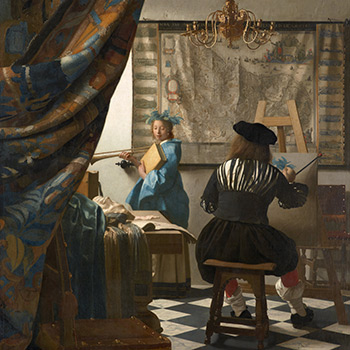
Johannes Vermeer painted quiet scenes generally set in domestic interiors.
-
Girl with a Pearl Earring is sometimes called the “Mona Lisa of the North.”
-
The Milkmaid shows a woman performing an everyday task in soft light.
-
Frans Hals was distinguished by his lively portraits and rapid brushwork.
French Classicism
-
Nicolas Poussin developed an orderly style of painting inspired by history, mythology and antiquity.
-
His compositions seek balance, clarity and control of emotion.
-
Claude Lorrain is best known for landscapes bathed in golden light.
-
Georges de La Tour painted religious and everyday scenes illuminated by candles.
-
Hyacinthe Rigaud created the famous official portrait of Louis XIV in his coronation robes.
-
The painting became one of the great representations of monarchical power.
Rococo
-
Rococo developed in France during the 18th century.
-
It favoured light colours, elegant scenes, gardens and the pleasures of aristocratic life.
-
Antoine Watteau painted fêtes galantes in poetic landscapes.
-
Jean-Honoré Fragonard created The Swing.
-
The painting shows a young woman on a swing in a lush garden.
-
François Boucher painted mythological and decorative scenes in soft colours.
-
Rococo was often criticized for its lightness and association with aristocratic luxury.
Neoclassicism
-
Neoclassicism drew inspiration from the art and values of antiquity.
-
Jacques-Louis David was one of its main representatives.
-
He painted The Oath of the Horatii, a scene celebrating courage, duty and sacrifice.
-
David also created The Death of Marat, showing the murdered revolutionary in his bathtub.
-
Jean-Auguste-Dominique Ingres continued the Neoclassical tradition.
-
He is known for the precision of his drawing and his portraits.
-
Grande Odalisque, however, presents a deliberately elongated and unrealistic body.
Romanticism
-
Romanticism gave great importance to emotion, drama, nature and freedom.
-
Eugène Delacroix painted Liberty Leading the People.
-
Liberty appears as a woman carrying the French flag.
-
Théodore Géricault created The Raft of the Medusa, inspired by a real shipwreck.
-
The painting shows the survivors at the moment they see a ship in the distance.
-
Caspar David Friedrich painted silent and majestic landscapes.
-
Wanderer Above the Sea of Fog depicts a man observing a mountainous landscape.
-
William Turner used light, colour and movement to represent storms, the sea and fires.
Realism
-
Realism sought to represent everyday life without idealizing it.
-
Gustave Courbet painted A Burial at Ornans, which gives monumental scale to a provincial ceremony.
-
He claimed that he wanted to paint only what he could see and know.
-
Jean-François Millet often depicted peasants and agricultural labour.
-
The Gleaners shows three women collecting ears of grain left behind after the harvest.
-
Honoré Daumier painted and drew social and political scenes.
-
Édouard Manet played a transitional role between Realism and Impressionism.
-
Luncheon on the Grass and Olympia caused major scandals.
Impressionism
-
The Impressionists sought to capture the changing effects of light.
-
They often painted outdoors using quick, visible brushstrokes.
-
Claude Monet created Impression, Sunrise, the painting that gave the movement its name.
-
He also painted many series devoted to haystacks, cathedrals and water lilies.
-
Pierre-Auguste Renoir depicted scenes of leisure, portraits and groups bathed in warm light.
-
Edgar Degas is famous for his dancers, horse races and scenes observed from unusual angles.
-
Berthe Morisot painted intimate scenes, gardens and portraits with great freedom of brushwork.
-
Camille Pissarro depicted rural landscapes and urban views.
Post-Impressionism
-
The Post-Impressionists built on the discoveries of Impressionism to develop more personal styles.
-
Vincent van Gogh used intense colours and highly expressive brushstrokes.
-
He painted several versions of the Sunflowers.
-
The Starry Night shows a swirling sky above a village.
-
Van Gogh also created many self-portraits.
-
Paul Cézanne sought to represent the structure of objects and landscapes.
-
His simplified forms influenced the development of Cubism.
-
Paul Gauguin used broad areas of colour and subjects inspired in part by his stays in Polynesia.
-
Georges Seurat developed Pointillism, a technique made up of small adjacent touches of colour.
Symbolism
-
Symbolism sought to represent dreams, ideas, myths and inner states.
-
Gustave Moreau painted richly detailed mythological scenes.
-
Odilon Redon created mysterious images filled with imaginary figures.
-
Edvard Munch created The Scream, one of the most famous representations of anxiety.
-
The central figure stands on a bridge beneath a sky of undulating colours.
-
Gustav Klimt combined portraiture, decorative patterns and gold leaf.
-
The Kiss shows a couple enveloped in a golden setting.
Fauvism and Henri Matisse
-
Fauvist painters used strong colours without attempting to reproduce reality faithfully.
-
Henri Matisse was one of the movement’s main figures.
-
The Dance depicts figures forming a circle against a highly simplified background.
-
André Derain also used brilliant colours in his landscapes.
-
The term “Fauves,” meaning “wild beasts,” was first used critically because of the apparent violence of their colours.
-
The movement was brief, but it greatly liberated the use of colour.
Cubism
-
Pablo Picasso and Georges Braque developed Cubism in the early 20th century.
-
Cubism often represents a subject from several viewpoints at once.
-
Forms are broken down into geometric planes.
-
Picasso’s Les Demoiselles d’Avignon anticipated several characteristics of the movement.
-
Guernica was painted later to condemn the bombing of a Spanish town during the Civil War.
-
Georges Braque painted many Cubist still lifes.
-
Juan Gris developed a more orderly and colourful form of Cubism.
Abstraction
-
Abstract painting does not necessarily seek to represent recognizable objects.
-
Wassily Kandinsky used lines, forms and colours to create compositions comparable to music.
-
Piet Mondrian reduced his paintings to straight lines and areas of primary colour.
-
Kazimir Malevich painted Black Square, an emblematic work of radical abstraction.
-
Paul Klee developed a poetic language composed of signs, colours and simple forms.
-
Abstraction profoundly transformed the very definition of painting.
Surrealism
-
The Surrealists were interested in dreams, the unconscious and unexpected associations.
-
Salvador Dalí painted The Persistence of Memory, famous for its melting clocks.
-
René Magritte created The Treachery of Images, in which an image of a pipe is accompanied by the words “This is not a pipe.”
-
The work reminds viewers that a representation is not the real object.
-
Max Ernst used experimental techniques to create strange landscapes.
-
Joan Miró developed a world of simple forms, signs and bright colours.
Frida Kahlo and Diego Rivera
-
Frida Kahlo created many self-portraits marked by pain, identity and Mexican culture.
-
Her paintings often refer to her injuries, personal life and relationship with her body.
-
The Two Fridas presents two versions of the artist seated side by side.
-
Diego Rivera, her husband, was one of the great Mexican muralists.
-
He painted vast frescoes devoted to Mexican history, labour and social struggles.
-
Their work helped introduce Mexican art to the world.
Modern American Art
-
Grant Wood painted American Gothic, which shows a man and a woman standing in front of a rural house.
-
Edward Hopper depicted urban scenes marked by silence and isolation.
-
Nighthawks shows customers inside a brightly lit diner at night.
-
Jackson Pollock developed a gestural style of painting based on dripping and splattering.
-
Mark Rothko created large rectangular fields of colour intended to produce an emotional experience.
-
Andy Warhol transformed images from popular culture into works of art.
-
He notably created portraits of Marilyn Monroe and series based on Campbell’s soup cans.
Recognizing a Painter
-
Identifying a painter requires observing several clues.
-
The historical period can help eliminate certain artists.
-
The treatment of light may reveal the influence of Rembrandt, Caravaggio or the Impressionists.
-
Bright colours and simplified outlines may suggest Matisse or Gauguin.
-
Fragmented forms often point toward Picasso, Braque or Cubism.
-
Dreamlike scenes may suggest Dalí, Magritte or Surrealism.
-
Swirling brushstrokes and intense colours often recall Van Gogh.
-
The subject, composition, clothing and techniques all provide clues that can connect a work with its creator.
Quiz questions preview
-
Who painted "Las Meninas" in 1656, regarded as one of the masterpieces of Western art.
Diego Vélasquez | El Greco | Juan Sanchez Coton | Francisco de Goya -
Who painted "The Death of Sardanapale", which caused a huge scandal when it was exhibited in the Louvre in 1827?
Théodore Géricault | Joseph Latour | Eugène Delacroix | Jean-Auguste-Dominique Ingres -
Who painted "The Persistence of Memory" in 1931, where soft watches melt away in an unreal environment.
Salvador Dalí | Joan Miró | Marcel Duchamp | Henri Matisse -
Who painted the abstract "Composition VII" in 1913?
Paul Klee | Wassily Kandinsky | Kazimir Malevich | Franz Marc -
Who painted the Expressionist work "The Scream" in 1893?
Wassily Kandinsky | Edvard Munch | Frida Kahlo | Kazimir Malevich

