World War II - The Fall of the Third Reich — Topic Guide
From 1944 onward, the Third Reich entered a phase of accelerating collapse. In the East, the Red Army steadily destroyed German forces and advanced toward the borders of the Reich; in the West, the Allies landed in Normandy, liberated France, and then entered Germany. Despite a military situation that had become hopeless, Adolf Hitler refused any surrender and continued the war until the destruction of Berlin in the spring of 1945.
Germany Trapped Between Two Fronts
At the beginning of 1944, Germany still occupied much of Europe, but it had lost the strategic initiative. The Soviet Union had won the battles of Stalingrad and Kursk, while the Anglo-Americans were advancing in Italy and preparing to open a new front in Western Europe. Allied industrial superiority was becoming overwhelming: they produced more tanks, aircraft, trucks, ammunition, and fuel than the Reich could hope to supply to its armies.
Germany’s position was further weakened by the air war. British and American bombers struck cities, factories, refineries, and transportation networks. Despite the losses inflicted on Allied aircrews and the introduction of modern fighters, the Luftwaffe was no longer capable of effectively protecting German territory. Fuel shortages reduced its activity even further, while the Reich’s economy had to support several fronts at once.
The Normandy Landings
On June 6, 1944, the Western Allies landed in Normandy as part of Operation Overlord. American, British, Canadian, and other Allied troops established a foothold on the continent despite German resistance. Hitler now faced the scenario he had long feared: a major land war in both the East and the West.
After several weeks of difficult fighting in the Norman bocage, American forces broke through the German lines during Operation Cobra at the end of July. A large part of the German forces in Normandy was then encircled in the Falaise Pocket. The survivors retreated rapidly eastward, while Paris was liberated on August 25.
The Allied advance across France was spectacular. Brussels and Antwerp were liberated in early September, and Western forces approached the German border. The advance eventually slowed, however, because of logistical problems and a German defence that began to reorganize.
Operation Bagration Destroys the German Front in the East
While the Western Allies were landing in France, the Soviet Union launched Operation Bagration in Belarus on June 22, 1944. The offensive was aimed mainly at Army Group Centre, one of Germany’s principal formations on the Eastern Front.
The Soviet attack became a catastrophe for the Wehrmacht. Several German armies were surrounded or destroyed, Minsk was liberated, and the Red Army advanced hundreds of kilometres within a few weeks. German losses were enormous and could no longer be replaced by sufficient reserves.
By the end of the summer, Soviet forces were approaching Poland and the eastern borders of the Reich. Romania also abandoned the Axis and joined the Allies, depriving Germany of an important partner and valuable oil resources. Bulgaria changed sides as well, while Finland concluded an armistice with Moscow.
The July 20 Plot
The worsening military situation strengthened opposition to Hitler within some German circles. Certain military officers and conservative civilians believed that the Führer was leading the country toward destruction and sought to overthrow the regime in order to negotiate with the Allies.
On July 20, 1944, Colonel Claus von Stauffenberg placed a bomb inside a conference room at Hitler’s headquarters in East Prussia. The explosion killed several people, but Hitler survived with relatively minor injuries. The planned coup in Berlin quickly collapsed once it became known that the dictator was still alive.
The repression was brutal. Stauffenberg and several conspirators were executed immediately, while thousands of people were arrested in the following weeks. Many were sentenced to death after humiliating trials. The failure of the plot temporarily strengthened Hitler’s control over the military establishment even as the strategic situation continued to deteriorate.
The Last Offensive in the West
In the autumn of 1944, the Western Allies encountered stronger resistance as they approached German territory. The failure of Operation Market Garden in the Netherlands prevented a rapid crossing of the Rhine and gave the Wehrmacht several additional months to reorganize.
Hitler used this respite to prepare a surprise offensive in the Ardennes. On December 16, 1944, German forces attacked American lines in a wooded region regarded as relatively quiet. The objective was extraordinarily ambitious: cross the Meuse, recapture Antwerp, and split the British and American armies.
The offensive created a deep bulge in the Allied front, giving rise to the English name “Battle of the Bulge.” Bastogne became one of the main centres of American resistance. The Germans, however, quickly ran short of fuel and lacked the reserves needed to exploit their early successes. When the weather cleared, Allied air power again became fully effective. By January 1945, the offensive had been decisively defeated.
The Battle of the Bulge exhausted much of Germany’s remaining mobile reserves. Losses in soldiers, tanks, and aircraft were particularly serious because the Reich was no longer capable of replacing them.
The Soviet Offensive of January 1945
On January 12, 1945, the Red Army launched a massive offensive from its positions on the Vistula. German defences collapsed rapidly, and Soviet armies advanced at remarkable speed across Poland.
Warsaw was liberated, and Soviet forces then reached the Oder, only a few dozen kilometres from Berlin. East Prussia was gradually isolated, while millions of German civilians attempted to flee westward ahead of the Soviet advance.
This flight became one of the largest population movements of the war in Europe. Refugees faced freezing temperatures, bombing, and chaos on overcrowded roads. Ships evacuating civilians and military personnel across the Baltic were also attacked; the liner Wilhelm Gustloff, torpedoed by a Soviet submarine in January 1945, became the site of one of the deadliest maritime disasters in history.
Yalta and the Postwar Order
In February 1945, with Germany clearly close to defeat, Franklin D. Roosevelt, Winston Churchill, and Joseph Stalin met at Yalta in Crimea. The three leaders were now discussing less how to defeat Hitler than how the world would be organized after his fall.
They planned, among other things, the occupation of Germany by several Allied powers and discussed Poland’s borders, the future of Eastern Europe, and the creation of the United Nations. Stalin also agreed to enter the war against Japan after Germany had been defeated.
The decisions made at Yalta would later become highly controversial, especially because of the growing Soviet influence in Eastern Europe. They nevertheless show that, by early 1945, Allied leaders already regarded the destruction of the Nazi regime as inevitable.
The Allies Cross the Rhine
In the West, Allied armies advanced toward the Rhine. In March 1945, American forces discovered that the railway bridge at Remagen had not been destroyed by the Germans and successfully crossed it. Other crossings of the river soon followed.
Once beyond the Rhine, the defence of western Germany began to collapse. The Allies surrounded the Ruhr, the industrial heartland of the Reich, where hundreds of thousands of German soldiers eventually surrendered. American armies then advanced into central and southern Germany, while the British moved through the north.
American and Soviet forces met on April 25 along the Elbe near Torgau. Germany was now cut in two and no longer had any realistic possibility of coordinating military resistance on a national scale.
The Discovery of the Camps
The Allied advance also revealed the scale of Nazi crimes. Soviet troops had already discovered several extermination centres as they moved westward, including Auschwitz in January 1945. Western armies liberated camps such as Buchenwald, Bergen-Belsen, and Dachau during the spring.
Soldiers found thousands of starving prisoners, corpses, and evidence of a concentration-camp system whose full scale was still unknown to much of the Western public. German civilians were sometimes forced to visit the camps so that they could see the consequences of crimes committed by the regime.
These discoveries strengthened Allied determination to impose total surrender and to prosecute Nazi leaders after the war.
Hitler in His Bunker
While the Reich collapsed, Hitler remained in Berlin. From January 1945 onward, he lived mainly in the Führerbunker beneath the Reich Chancellery. His physical condition deteriorated, and his grasp of the military situation became increasingly detached from reality.
He nevertheless continued moving divisions around on maps even when some of them existed only on paper. He ordered impossible counterattacks and generally refused to authorize retreats, even when withdrawal might have saved troops. Hitler declared that if the German people were incapable of winning the war, they did not deserve to survive the defeat.
In March, he even ordered the destruction of infrastructure that might fall into enemy hands. This order, sometimes called the Nero Decree, was only partially carried out, partly because Armaments Minister Albert Speer later claimed that he had sought to prevent its implementation.
The Battle of Berlin
On April 16, 1945, Soviet forces launched their final offensive against Berlin. After extremely violent fighting on the Seelow Heights, they broke through German defences and gradually surrounded the capital.
Berlin was defended by regular soldiers, SS units, the Volkssturm, which included older men and young boys, as well as members of the Hitler Youth. Fighting took place street by street and house by house in a city already devastated by years of bombing.
On April 20, Hitler celebrated his 56th birthday in the bunker while Soviet artillery began striking central Berlin. A few days later, he understood that the forces supposedly coming to save the capital could no longer do so.
Hitler’s Suicide
On April 29, Hitler married Eva Braun in the bunker. He also dictated his political testament, in which he refused responsibility for the catastrophe and continued to blame Jews for the war.
The following day, April 30, 1945, Adolf Hitler committed suicide with Eva Braun. Their bodies were taken outside the bunker and burned according to his instructions.
Joseph Goebbels briefly became chancellor but also refused to leave Berlin. On May 1, after having their six children killed, Goebbels and his wife Magda committed suicide. Admiral Karl Dönitz, whom Hitler had designated as president of the Reich, then formed a government in northern Germany.
The Fall of Berlin
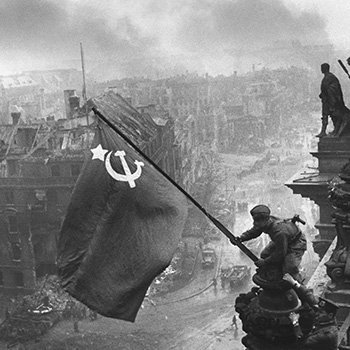
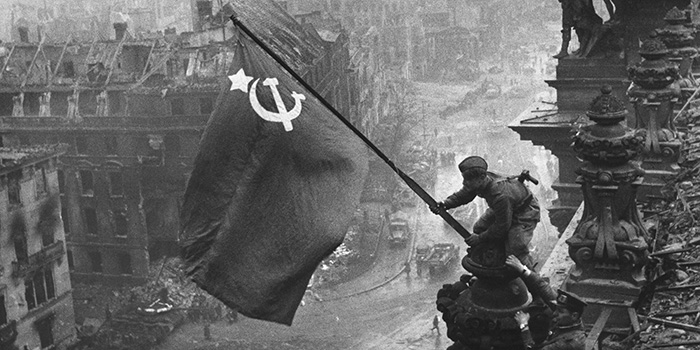
Fighting continued for several days after Hitler’s death. Soviet soldiers reached the Reichstag, where fierce combat took place. The red flag raised over the building became one of the symbolic images of Nazi Germany’s defeat.
On May 2, German forces in Berlin surrendered. The capital lay in ruins, and tens of thousands of soldiers and civilians had died during the battle.
The war, however, was not yet officially over. Dönitz’s government sought to delay a general surrender so that as many soldiers and refugees as possible could reach areas controlled by the British and Americans rather than fall into Soviet hands.
The Surrender of the Third Reich
On May 7, 1945, General Alfred Jodl signed the unconditional military surrender of all German forces at Reims. It was to take effect on May 8 at 11:01 p.m. Central European Time.
Stalin, however, demanded a second ceremony in the conquered German capital. During the night of May 8–9, Field Marshal Wilhelm Keitel signed another act of surrender in Berlin before Allied representatives.
May 8 is celebrated across much of Western Europe as Victory in Europe Day. In the Soviet Union, because of the time difference at the moment of the final signing, victory was traditionally commemorated on May 9.
A Regime Destroyed Along with Its Country
The fall of the Third Reich was total. Germany had lost millions of soldiers and civilians, its major cities were partly destroyed, and much of its infrastructure lay in ruins. The Nazi regime disappeared with military defeat, while the leading figures who remained alive were arrested, committed suicide, or attempted to flee.
The Allies occupied the country and divided it into zones administered by the United States, the Soviet Union, the United Kingdom, and France. Berlin was also placed under four-power occupation. The Nuremberg Trials would later prosecute several of the leading Nazi officials for war crimes, crimes against humanity, and other offences.
The destruction of the Reich profoundly altered the European balance of power. The continent’s former great powers emerged weakened, while the United States and the Soviet Union became the two dominant superpowers. The alliance that had made Hitler’s defeat possible quickly gave way to rivalry between them, opening almost immediately onto a new era: the Cold War.
Quiz questions preview
-
What did Hitler want to be done with his body after his death?
To be burned | Taken to Bavaria | Buried in the bunker | Thrown into the Spree -
Which Nazi fanatic poisoned her children in Hitler’s bunker before committing suicide in April 1945?
Eva Braun | Margarete Speer | Magda Goebbels | Gerda Bormann -
What position did Wilhelm Keitel hold when he signed the act of surrender in Berlin in May 1945?
Minister of War | SS Commander | Chief of the German High Command | Ambassador of the Reich -
In which city was the final act of German surrender signed on May 8, 1945?
Potsdam | Munich | Berlin | Yalta -
What date was officially recognized in the West as the end of the war in Europe, following the German surrender?
May 6, 1945 | May 2, 1945 | May 4, 1945 | May 8, 1945

